How to Invoice Brands as a Creator in India: Complete Guide
What a creator invoice should include, how GST and TDS usually affect it, payment terms that protect you, and how to follow up when payment is late.
A surprising number of late creator payments come down to the invoice: a missing PO number, the wrong billing entity, no GST details, or bank information the finance team can't verify. A clean invoice sent on time is the simplest thing you can do to get paid faster.
This guide is general information, not tax or legal advice. Indian tax rules change, and your obligations depend on your turnover, registration status, business structure and clients. Speak to a chartered accountant or tax professional about your situation. Figures and rules below were checked in September 2026.
Quick answer
A creator invoice in India should include a unique invoice number, date, your name or business name, address, contact details and PAN, the brand's (or agency's) billing name and address, a PO or campaign reference if provided, a clear description of deliverables, the fee, applicable taxes (GST only if you're registered, with your GSTIN and the required GST details), the total, payment terms and due date, and your bank or UPI details. Send it as soon as you're entitled to (usually on posting or per the contract), and follow up politely on the due date.
What to include on every invoice
| Field | What to write | Why it matters |
|---|---|---|
| Invoice number | A unique, sequential number, e.g. KC/2026-27/014 | Finance teams reject duplicates; GST rules require unique serial numbers per financial year if you're registered |
| Invoice date | The date you issue it | Starts the payment-terms clock |
| Your name / business name | Legal name or registered business name | Must match your bank account and tax records |
| Your address and contact | Address, email, phone | Required for vendor records |
| PAN | Your PAN | Needed for TDS and vendor onboarding |
| GSTIN | Only if you're GST-registered | Required on a GST tax invoice |
| Brand / client details | The exact legal entity you're billing, address, GSTIN if they have one | Billing the brand's trade name instead of its legal entity is a common cause of rejection |
| PO or campaign reference | Purchase order number, campaign name, agreement date | Many companies can't pay without a PO match |
| Deliverables | e.g. 1 Instagram Reel (posted 12 Sep 2026, link), 1 Story set, 60 days paid usage | Links the invoice to what you delivered |
| Fee | Amount per line item | Clear breakdown avoids queries |
| Taxes | GST lines if applicable; otherwise no GST | Unregistered creators should not charge GST |
| Total | Total payable | Obvious, but double-check it |
| Payment terms | e.g. Due within 15 days of invoice date, per agreement dated… | Sets expectations and supports follow-ups |
| Bank / payment details | Account name, number, IFSC, bank; UPI if accepted | Account name should match the invoice name |
| Signature | Signature or digital signature where required | Some finance teams require it |
GST on your invoice
If you're GST-registered, your invoice must be a GST tax invoice: add your GSTIN, the client's GSTIN if they have one, the SAC code, taxable value, tax rate and amount (CGST and SGST for a client in your state, IGST for a client in another state) and place of supply, as set out in Rule 46 of the CGST Rules. If you're not registered, don't charge GST. Registration becomes mandatory once your aggregate turnover crosses ₹20 lakh in a financial year (₹10 lakh in certain special category states). When to register, rates, inter-state and foreign clients are covered in GST for influencers and creators in India.
TDS: why you may receive less than you invoiced
Indian businesses paying creators may deduct tax at source (TDS) and deposit it against your PAN. Your invoice shows the full fee; the payment you receive is the fee minus any TDS. From 1 April 2026 these rules sit in section 393 of the Income-tax Act, 2025, and the TDS certificate is Form No. 131 (earlier Form 16A). Ask before signing whether TDS will be deducted and at what rate, and check the credit on the Income Tax e-filing portal. The categories, gifted products and records to keep are covered in TDS for influencers and creators in India.
A creator invoice template
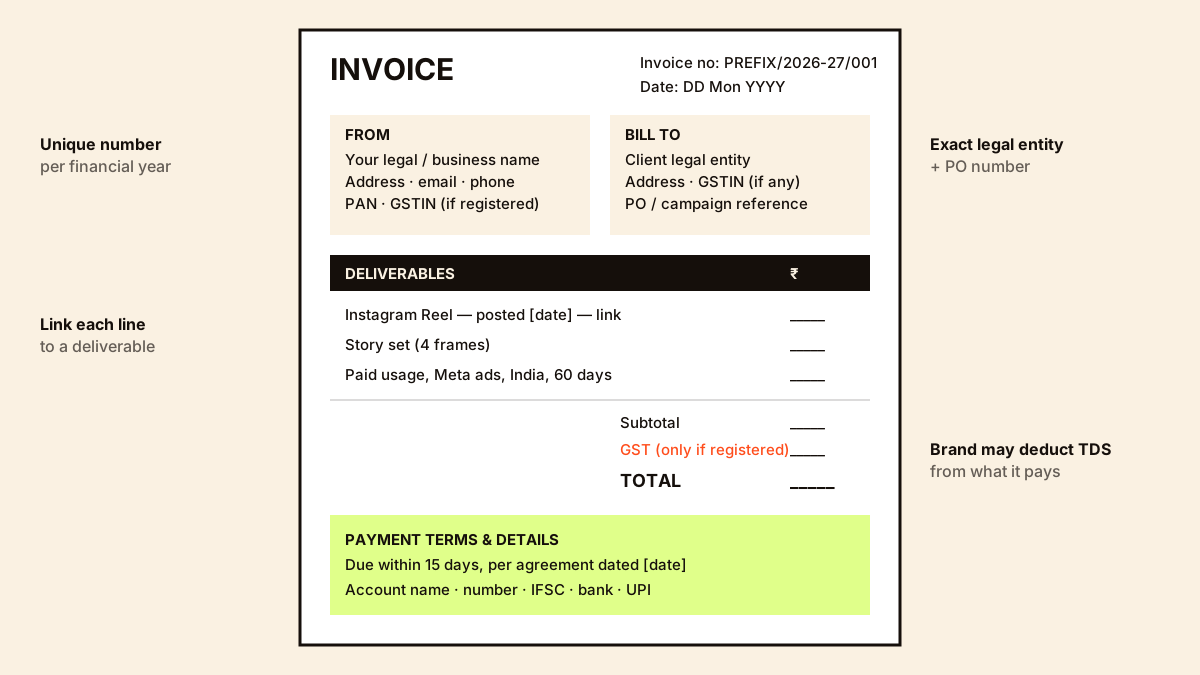
INVOICE
Invoice no: [PREFIX/2026-27/001]      Date: [DD Mon YYYY]

FROM
[Your legal name / business name]
[Address]
[Email] · [Phone]
PAN: [XXXXX0000X]
GSTIN: [only if registered]

BILL TO
[Client legal entity name]
[Address]
GSTIN: [if provided]
PO / Reference: [PO number / campaign name / agreement date]

DELIVERABLES                                      AMOUNT (₹)
1. Instagram Reel — posted [date] — [link]        ______
2. Instagram Story set (4 frames) — [date]        ______
3. Paid usage, Meta ads, India, 60 days           ______
                                   Subtotal       ______
        [If registered] GST @ __% (CGST/SGST or IGST) ______
                                   TOTAL          ______

Amount in words: [________]

PAYMENT TERMS
Due within [15] days of invoice date, per agreement dated [date].
Advance received: ₹[__] on [date] (if any).

PAYMENT DETAILS
Account name: [must match invoice name]
Account no: [____]  IFSC: [____]  Bank: [____]
UPI: [optional]

[Signature]When to send the invoice
- Advance invoices: when the agreement is signed, if an advance is agreed.
- Final invoice: on posting or delivery, as the contract specifies. Don't wait until the end of the month.
- Retainers: on a fixed date each month.
- Send to the right address: many companies have an accounts-payable email separate from your marketing contact. Copy your contact.
Vendor onboarding
Larger brands and agencies often need you to register as a vendor before they can pay: PAN, GST certificate or a declaration that you're not registered, cancelled cheque or bank letter, address proof, and sometimes an MSME registration. Ask early, because onboarding can take longer than the campaign.
Following up on late payments
Subject: Invoice [number] — due today

Hi [Name],

A quick reminder that invoice [number] for ₹[amount] ([campaign]) is due today. I've attached it again for convenience.

Could you confirm the expected payment date?

Thanks,
[Name]
Subject: Invoice [number] — overdue

Hi [Name],

Following up on invoice [number] for ₹[amount], which was due on [date]. Could you let me know if anything is holding it up (PO, vendor details, approvals)? I'm happy to resend anything needed.

Cc: [accounts email]

Thanks,
[Name]
If payments stay overdue despite polite follow-ups, escalate in writing to a more senior contact and refer to the agreement. For significant sums, get professional advice on your options. Most late-payment problems are easier to prevent than to chase; see creator payment terms for what to agree before you start.
After sending, track each invoice to payment with an invoice log; see creator invoice management.
Record keeping
- Keep a simple register: invoice number, date, client, amount, GST, TDS, date paid.
- Save contracts, POs, emails confirming scope, and posting screenshots with each invoice.
- Track gifted products and their approximate value.
- Keep business and personal spending separate where possible.
For the spending side, see what Indian creators should track in creator business expenses.
Brands have their own side of this process. Our brand-side guide to influencer marketing payments explains what finance teams typically need from creators.
Track every invoice until it's paid in a creator income tracker, and if payment slips, follow the steps in how creators can handle late brand payments.