Influencer Negotiation Strategy: How Brands Can Negotiate Better Creator Deals
A practical, fair approach to influencer rate negotiation — what actually determines pricing, which terms are worth discussing beyond the number, and why a transparent process leads to better collaborations.
Negotiating with influencers means agreeing on compensation, deliverables, and terms for a collaboration in a way that's fair to both sides, not simply trying to pay the lowest possible rate. Brands that negotiate purely on price tend to get the minimum-effort version of a creator's work; brands that negotiate transparently tend to get creators who want to work with them again.
Quick answer
To negotiate with influencers, define what you need before you talk: deliverables, platform and format, timeline, usage rights, exclusivity, revisions and payment terms. Research the creator's typical performance and rates, make a clear offer, listen to what's included in their quote, adjust scope rather than squeezing price, and put everything agreed in writing. Aim for terms both sides would happily repeat.
Research the creator before making an offer
Review recent content, engagement patterns, and any previous brand partnerships to understand realistic pricing and fit before reaching out. Coming in with an informed opening offer, rather than a lowball guess, tends to shorten the entire negotiation.
Understand what actually determines creator pricing
- Audience size and, more importantly, engagement quality
- Platform and content format: a produced video typically costs more than a single photo post
- Usage rights: organic-only posting rights cost less than a license to run the content as a paid ad
- Exclusivity: restricting the creator from competing brands for a period
- Production complexity: multiple locations, props, or scripted scenes add cost
For realistic rate ranges by tier, see how much does influencer marketing cost.
Define campaign requirements clearly before negotiating
Vague requirements make fair pricing difficult for both sides. Come to the conversation with a clear sense of objective, platform, and rough deliverable count, even if the exact brief isn't finalized yet.
Clarify deliverables early
Specify format and count precisely — one Reel and two Stories is a different price than three Reels — since vague deliverables are one of the most common sources of scope creep after a rate has already been agreed.
Discuss content usage rights directly
Ask specifically whether the brand can reuse the content in paid ads, on the website, or in email, and for how long. Usage rights are one of the most commonly under-negotiated terms, and disputes over them are far more common after delivery than before.
Discuss exclusivity, if relevant
Exclusivity, asking a creator not to promote a competing brand for a set window, is a real cost to the creator and should be compensated as its own line item, not assumed as part of a standard rate. How narrowly to define it, and how to judge whether it's worth paying for, is covered in influencer exclusivity.
Agree on a realistic timeline
Confirm content due dates, review windows, and the publish date together, accounting for the creator's other existing commitments. A rushed timeline is one of the more common reasons a fairly negotiated rate still produces rushed, lower-quality content.
Settle payment terms upfront
Agree on payment timing, such as on signing, on delivery, or split, and method before content production begins. Late payment is one of the most common creator complaints about brands, and it directly affects whether a creator wants to work with you again.
Set creative expectations, not creative scripts
Negotiate the outcomes you need, such as key messages, mandatory claims, and tone, rather than exact wording. Creators who feel like the brief respects their voice are more likely to negotiate fairly on rate in future collaborations, since the working relationship, not just the pay, is part of what they're evaluating.
Building a mutually beneficial relationship, not just a deal
The best long-term outcomes come from treating a negotiation as the start of a relationship rather than a one-time transaction — a fair first deal is often what determines whether a strong creator is available, and enthusiastic, for a second one. Our guide to building long-term influencer partnerships covers what comes after this first negotiation.
What brands should never negotiate away
- Disclosure: a creator refusing to disclose a paid collaboration clearly isn't a negotiable point, it's a compliance requirement for both sides
- Written confirmation of deliverables and timeline: a verbal-only agreement, however friendly the conversation, leaves both sides exposed if expectations diverge
- Usage rights for anything beyond organic: never assume paid ad or whitelisting rights are included by default just because a rate seemed reasonable
- The right to review content before it publishes: even a light-touch review window protects both the brand and the creator from a genuine misunderstanding going live
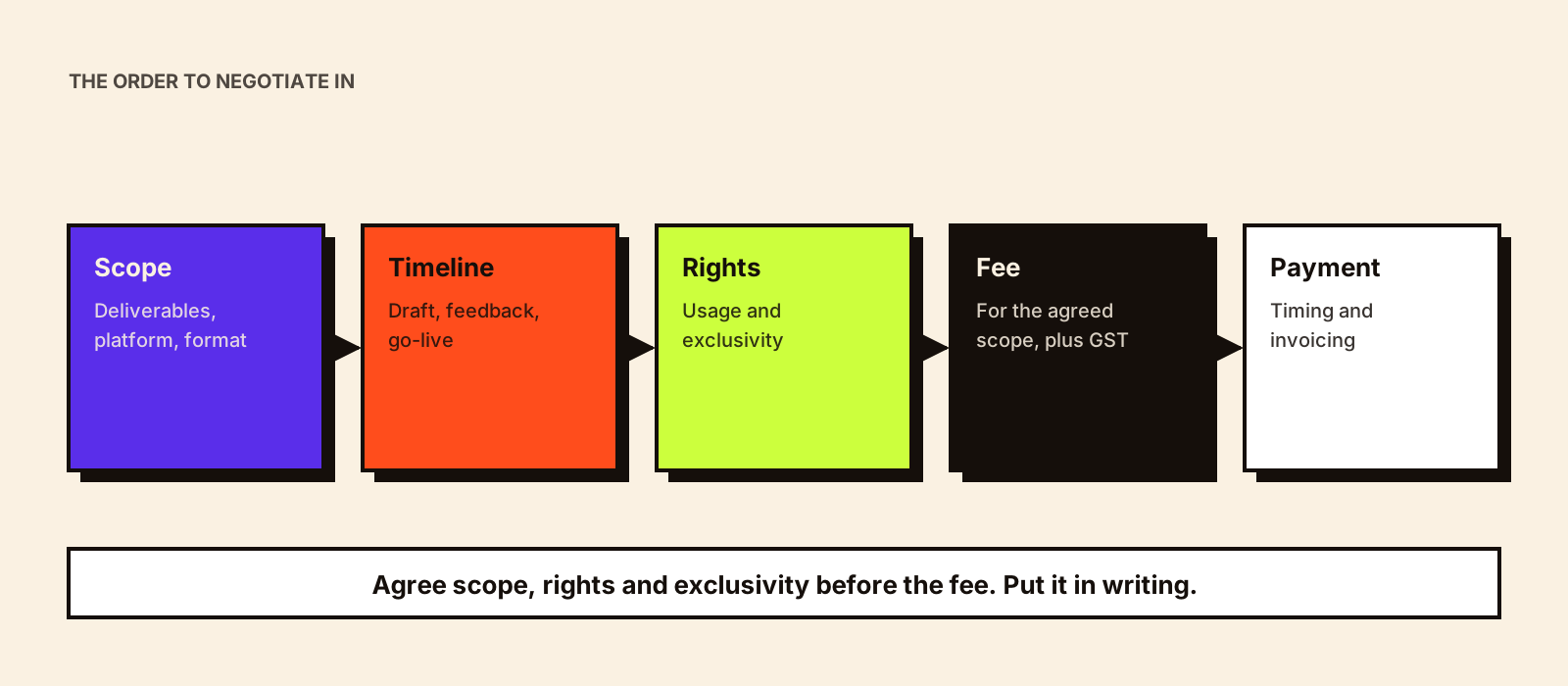
The order to negotiate in
1. Scope: deliverables, platform, format, number
2. Timeline: product delivery, draft, feedback window, go-live
3. Creative: what's fixed (claims, disclosure) and what's theirs
4. Revisions: how many rounds, what counts as a revision
5. Usage rights: organic only or paid; platforms; duration
6. Exclusivity: category, length, whether paid separately
7. Fee: for the agreed scope, plus GST
8. Payment: timing, invoicing, TDS
9. Cancellation and changes: what happens if either side needs to change plans
Agreeing scope, rights and exclusivity before fee avoids a common trap: settling a price, then discovering the creator assumed organic-only usage while you planned to run the content as ads.
Levers beyond the fee
When budgets and quotes don't meet, change the scope rather than asking for the same work for less: fewer deliverables, a simpler format, shorter or no paid usage, shorter exclusivity, a longer timeline, or a package across several posts. Negotiate influencer rates covers the money conversation in detail, and how much to pay influencers covers evaluating a quote.
Negotiating in India
- Clarify whether quotes include GST, and agree who handles TDS and how.
- Many creators negotiate through managers; be direct and professional with them.
- For physical products, agree delivery dates that account for courier times to the creator's city.
- Festival-season rates and availability can differ; plan early.
- Smaller and regional creators may not have standard contracts; offer a clear, simple agreement.
After you agree
- Send a written summary the same day, then the agreement.
- Confirm the brief, product dispatch and key dates.
- Pay as agreed; it sets the tone for the whole relationship.
- After the campaign, share results and talk about what's next.
Influencer marketing contract covers what the agreement should include; influencer relationship management covers what happens after.
Example negotiation scenarios
A creator quotes above your budget for a single Reel. Rather than simply asking for a lower number, offer a trade: a slightly lower rate in exchange for a longer usage license, or a smaller deliverable, one Reel instead of a Reel plus three Stories, at the original rate. This keeps the conversation collaborative rather than adversarial.
A creator's rate includes only organic posting rights, but you want to run the content as a paid ad too. Ask for a specific quote for paid usage as a separate, add-on line item, rather than assuming it's bundled in, and be upfront that this is exactly why you're asking before content is created, not after it performs well.
A creator wants exclusivity across your entire category for six months but hasn't priced it into their quote. Point out the gap directly, exclusivity has a real cost to the creator in lost opportunities, and either agree to compensate for it explicitly or scope the exclusivity down to your specific sub-category rather than the whole space.
Influencer collaboration negotiation checklist
- Creator's recent content and pricing context researched before outreach
- Deliverables specified by exact format and count
- Usage rights and channels confirmed explicitly
- Exclusivity discussed and compensated separately if required
- Timeline agreed, accounting for the creator's existing commitments
- Payment amount, timing, and method confirmed in writing
- Creative expectations framed as outcomes, not scripted lines
The brands who build the best creator relationships tend to negotiate the clearest, not the hardest.— Kudozz Partnerships Team
Creators can find the other side of this conversation in how to negotiate brand deals as a creator, which includes example messages for common situations.
How an agency simplifies negotiation
Negotiating fairly and consistently across many creators at once, while keeping terms clear and documented, is a core part of our influencer outreach and management service.