Earned Media Value (EMV) in Influencer Marketing: What It Measures and When to Use It
EMV puts a currency figure on creator exposure by estimating what it would have cost as paid media. How it's calculated, why two tools give different numbers for the same post, why it isn't revenue or ROI, and when it's still useful.
A campaign report says the creators generated '₹48 lakh in earned media value' on a ₹12 lakh spend. It sounds like a fourfold return. It isn't: nobody paid the brand ₹48 lakh, and the number depends almost entirely on prices the reporting tool chose.
Quick answer
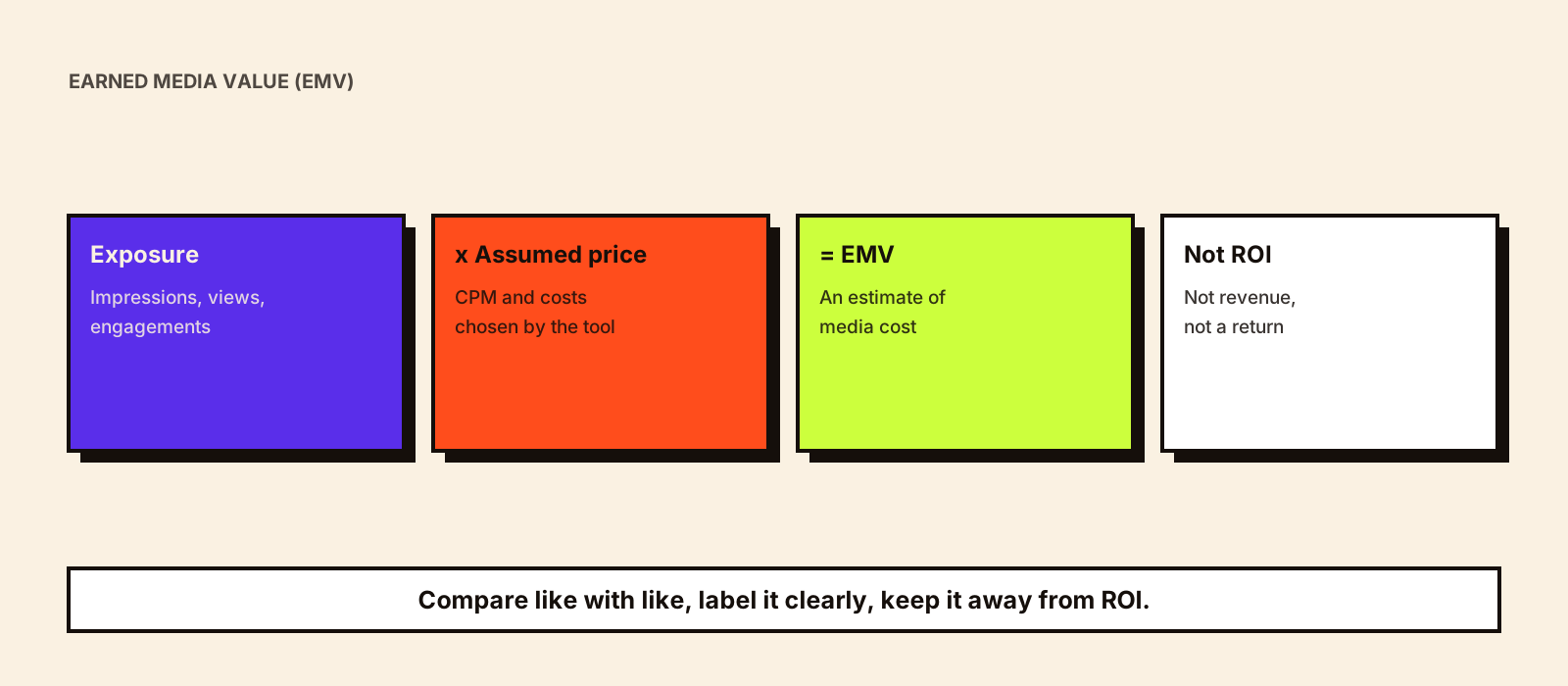
Earned media value (EMV) is an estimate of what the exposure from creator content would have cost if the brand had bought equivalent paid media. It's calculated by multiplying metrics such as impressions, views or engagements by an assumed price for each. There's no industry-standard formula, so different tools give different EMV for the same post. EMV can help compare creators or campaigns measured the same way, but it isn't revenue, it isn't ROI, and it shouldn't be added to sales or used to justify a budget on its own.
How EMV is calculated
Most EMV models follow the same shape: take each metric the content produced, multiply it by a value the tool assigns to that metric, and add the results.
EMV = (impressions ÷ 1,000 × assumed CPM)
    + (video views × assumed cost per view)
    + (engagements × assumed cost per engagement)
    + (clicks × assumed cost per click)

The 'assumed' prices are the tool's or agency's choice. Some models also weight by platform, content type, creator tier or audience quality.| Metric | Volume (illustrative) | Tool A value | Tool A EMV | Tool B value | Tool B EMV |
|---|---|---|---|---|---|
| Impressions | 4,00,000 | ₹150 CPM | ₹60,000 | ₹250 CPM | ₹1,00,000 |
| Engagements | 12,000 | ₹5 each | ₹60,000 | ₹12 each | ₹1,44,000 |
| Link clicks | 1,500 | ₹20 each | ₹30,000 | Not counted | ₹0 |
| Total EMV | ₹1,50,000 | ₹2,44,000 |
The figures are hypothetical. The same post produces EMV about 60% higher in Tool B, not because it performed better but because Tool B assumes higher prices. That's the core problem with comparing EMV across tools, agencies or years.
Why EMV isn't ROI
- EMV is a cost estimate, not money received. It says what the exposure might have cost to buy, not what it earned.
- Paid media and creator content aren't equivalent. Paid ads are targeted, controlled and bought at known prices; a creator's audience may be more or less valuable than the assumed price implies.
- It counts exposure, not outcomes. A post with high EMV can produce no sales, and a modest one can sell well.
- It's easy to inflate. Raise the assumed CPM or count more engagement types and EMV goes up with no change in results.
Comms measurement has been here before. Advertising value equivalents (AVEs), which priced press coverage as if it were bought advertising, were rejected by the measurement body AMEC in its Barcelona Principles, first in 2010 and again in the 2020 version 3.0, which states that AVEs are not the value of communication. EMV applies a similar idea to creator content and has the same weakness. See AMEC's Barcelona Principles 3.0.
When EMV can still be useful
| Use | Why it works | Condition |
|---|---|---|
| Comparing creators within one campaign | Same tool, same prices, so differences reflect performance | Use the same model for everyone; state it in the report |
| Tracking an organic seeding or PR program over time | Gives a consistent, if rough, index of exposure where nothing was paid per post | Never change the model mid-series without restating past figures |
| Giving a currency sense of reach to non-marketing stakeholders | Some finance teams find a currency figure easier to grasp than impressions | Label it clearly as an estimate of media cost, not a return |
What to report instead, by objective
| Objective | Better primary metric | Supporting metrics |
|---|---|---|
| Awareness | Unique reach and cost per thousand people reached; brand lift where you can run it | Completed views, frequency, branded search change |
| Consideration | Engagement quality: saves, shares, meaningful comments, profile visits | Click-through rate, landing-page time |
| Sales | Incremental sales or cost per new customer | Tracked revenue, ROAS, contribution after costs |
| Content for ads | Cost per result when creator content runs as ads, against your other creative | Hold rate, click-through rate |
For definitions and formulas, see influencer marketing KPIs; for return on spend, how to measure influencer marketing ROI; and for awareness campaigns, influencer marketing for brand awareness.
If your agency or tool reports EMV
- Which metrics are included, and what price is assigned to each?
- Where do the prices come from, and are they the same for every platform and creator tier?
- Has the model changed since our last report? If so, are past figures restated?
- Is EMV ever added to sales or presented as a return? (It shouldn't be.)
- What does the report say about outcomes: sales, leads, sign-ups or brand lift?
How to show EMV honestly in a report
- Call it 'estimated media value of exposure', not 'value generated' or 'return'.
- Print the method and prices next to the number.
- Keep it in the exposure section, separate from sales and ROI.
- Never divide EMV by cost and call the result ROI.
- Show it alongside reach and outcome metrics, never instead of them.
A report structure that keeps exposure and outcomes apart is set out in the influencer marketing report guide.
Conclusion
EMV answers a narrow question: roughly what would this exposure have cost to buy, under one set of assumptions? Use it, if at all, to compare like with like inside one model, label it clearly and keep it away from ROI. Judge campaigns on reach, engagement quality and the outcomes they were meant to produce. Kudozz reports campaigns against the objective agreed at the start, without blended value scores, through its campaign reporting service.