Influencer Marketing for Finance and Fintech Brands: Complete Campaign Guide
A compliance-first approach to influencer marketing for Indian fintech and finance brands, covering appropriate creator selection, financial education content, and a risk and review framework, without providing financial advice.
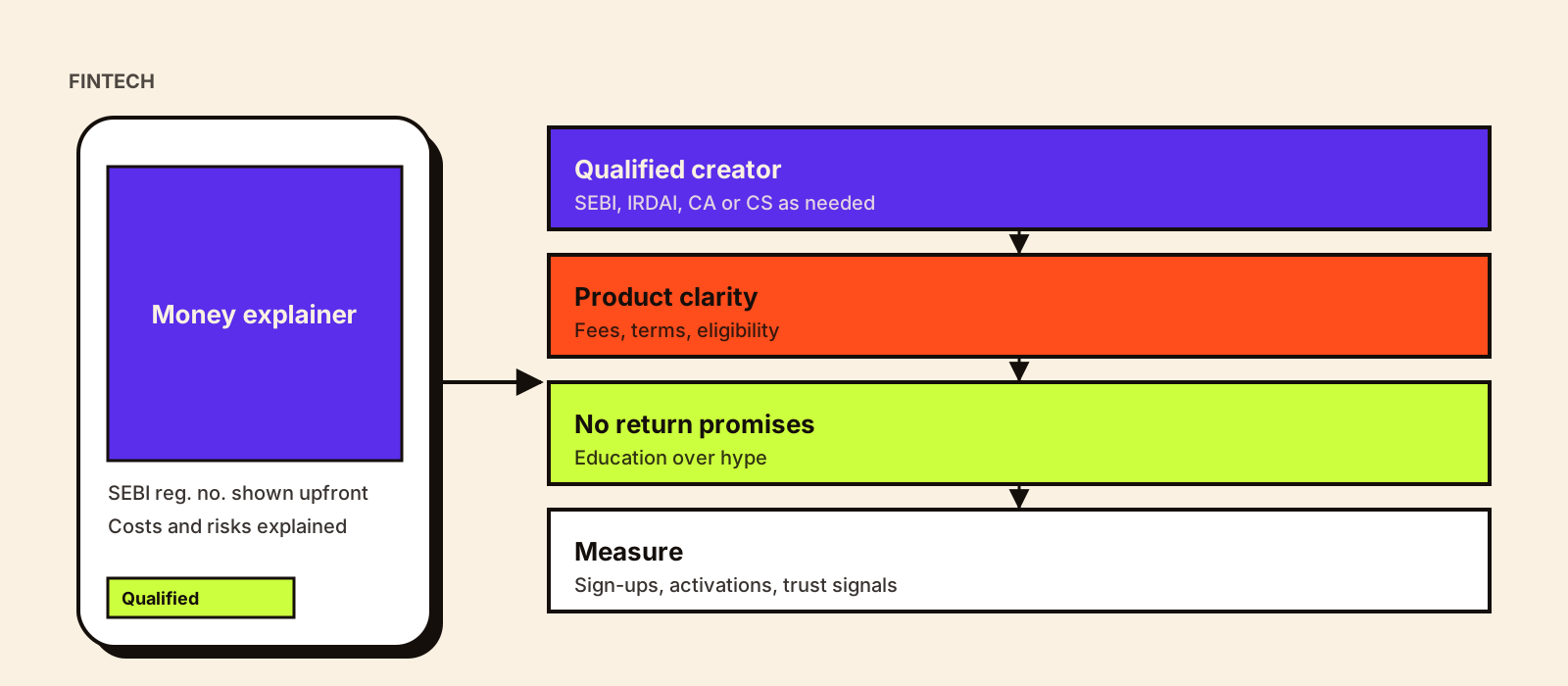
Fintech and financial products involve real financial risk and, in many cases, regulatory oversight, which means influencer content here should prioritize accurate financial education over persuasion. This article offers general strategic guidance; it does not provide financial, legal, or compliance advice, and any specific fintech campaign or claim should be reviewed by qualified legal and compliance professionals before publishing.
Quick answer
Fintech and finance brands in India should put accurate financial education ahead of persuasion, choose creators qualified to talk about money, and review every piece of content before it goes live. SEBI-registered entities can't associate with unregistered finfluencers who give investment guidance, so check each creator's status. Measure qualified sign-ups and activation.
Why trust and accuracy matter especially here
Financial decisions carry real consequences for a person's money, and misleading financial content can cause genuine harm, which is why financial content faces, appropriately, more scrutiny from both audiences and regulators than most other categories.
Financial education content
Content that explains a financial concept or product feature accurately, without steering toward a specific investment decision or implying a guaranteed outcome, tends to build more durable trust than persuasion-focused promotional content.
Choosing appropriate creators
Select creators who demonstrate genuine financial literacy and responsible communication in their existing content, and never imply a creator holds a financial credential or license they don't actually have. The general evaluation discipline in how to find the right Indian influencers for your brand applies, with this credibility check added specifically for finance.
Audience relevance
Fintech products often target quite specific financial situations or life stages, first-time investors, small business owners, salaried professionals, and creator selection should reflect genuine relevance to that specific audience, not broad finance-adjacent reach.
Product education
Explain how a product actually works, fees, terms, and genuine features, clearly and completely, rather than emphasizing potential upside alone.
Compliance considerations
Fintech content should never promise guaranteed returns, imply investment advice from an unqualified creator, or make claims about a financial product's performance that aren't accurate and substantiated. Specific regulatory requirements for financial marketing and advertising in India should be confirmed with qualified legal and compliance counsel, since these can be complex and vary by product type.
Disclosure and transparency
Disclosure should be unambiguous and consistent with ASCI guidelines, and any risk associated with a financial product should be communicated clearly rather than downplayed or omitted.
Content review processes
Fintech campaigns warrant a rigorous review process, ideally including a compliance or legal reviewer, before any content involving specific financial claims, numbers, or product features goes live.
Measuring campaigns
Awareness and product education campaigns are reasonably judged on engagement and genuine comprehension signals where measurable, while app installs or account sign-ups can be tracked through referral links, with the same measurement discipline covered in influencer marketing KPIs.
SEBI's restrictions on unregistered finfluencers
For fintech platforms operating as, or partnering with, SEBI-registered intermediaries, an important and specific restriction applies: since amendments introduced in September 2024 and a circular issued in January 2025, SEBI-registered entities are barred from any direct or indirect association with unregistered "finfluencers" giving investment-related guidance. This means a registered fintech intermediary should not engage a creator for investment commentary unless that creator is also appropriately registered or the content stays within general financial education, not specific investment advice or recommendations. This is a specific, actively enforced restriction, not general caution, and should be confirmed against current SEBI guidance with qualified legal counsel before any campaign involving investment-adjacent creator content.
Vetting matters because most finance creators aren't registered. CFA Institute's 2026 study of 48 Indian finfluencers, with content analysed from January to October 2025, found that 3 (6.3%) were registered with SEBI while 16 (33.3%) gave explicit buy, hold or sell recommendations. The full report is in CFA Institute's analysis.
- Check registration on SEBI's intermediary lists (for example investment adviser or research analyst) if a creator will discuss securities, and keep a screenshot dated on the day you check.
- Review the creator's last few months of content for stock tips, return promises or unregistered advisory services, not just the post you plan to sponsor.
- Keep sponsored content to education, product features and fees unless the creator is appropriately registered.
- Add contract terms that require compliance with SEBI and ASCI rules and allow you to end the agreement if they're breached.
Fintech Influencer Marketing Risk and Review Framework
- No guaranteed returns, performance claims, or investment advice included in creator content
- Creator credibility confirmed for financial topics, without implying credentials they don't hold
- All financial claims, fees, and terms reviewed for accuracy before publishing
- Risk disclosures included clearly, not downplayed or omitted
- Disclosure language consistent with ASCI guidelines
- Legal and compliance review completed before publishing any content with specific financial claims
Fintech doesn't get a different rulebook here. The same foundation applies: influencer marketing in India and how to build an influencer marketing strategy for the Indian market for the overall approach, how influencer campaign management works for execution, and how to measure influencer marketing ROI for Indian brands for judging whether a campaign actually worked.
In fintech, the creator's enthusiasm for a product is never a substitute for compliance review. Both matter, but only one of them is optional to skip.— Kudozz Strategy Team
This is general guidance, not financial or legal advice
This article provides general strategic guidance and does not constitute financial, legal, or compliance advice. Fintech brands should consult qualified legal and compliance professionals before running any influencer campaign involving financial claims or products.
Who can talk about money: ASCI's qualification rule
ASCI's influencer guidelines require influencers who give advice or comment on banking, financial services and insurance products to hold relevant qualifications and state them upfront. For stock market and investment content, the influencer should be registered with SEBI and show the SEBI registration number with their name and qualifications. For other financial advice, suitable qualifications such as an IRDAI insurance licence, CA or CS are expected, along with any disclosures required by financial regulators.
Launching a fintech product with creators
| Phase | Creator activity | Care point |
|---|---|---|
| Pre-launch | Qualified creators explain the problem the product solves | No product claims before approvals and licences are in place |
| Launch | Walkthroughs of onboarding, costs and safety features | Fees and terms shown fairly |
| Adoption | How-to content for first transactions | Security tips; no pressure tactics |
| Ongoing | Education series from qualified creators | Keep content updated as terms change |
What to watch by product type
| Product | Creator content that fits | Main care points |
|---|---|---|
| Payments and UPI apps | How-to, safety tips, everyday use | No misleading cashback or reward claims |
| Lending and credit | Explaining costs and eligibility clearly | Show real costs; no "instant approval" promises |
| Credit cards | Benefit comparisons, fee explanations | Fees, conditions and eligibility shown fairly |
| Insurance | Explaining cover and exclusions | Qualified creators for advice; no misleading claims about cover |
| Investments and trading | Education by SEBI-registered creators | No return promises; SEBI rules on association with unregistered persons |
Working with credentialed finance experts, and SEBI's rules on unregistered finfluencers, is covered in expert creator marketing. This is general information, not legal or financial advice.
Planning a fintech campaign
Personal finance education brands should also see personal finance influencer marketing in India, and insurers influencer marketing for insurance brands.