How to Brief Creators for Honest Product Comparisons
How to brief creators for product comparisons that are fair and persuasive: what India's ASCI Code allows, comparison formats and their risks, 12 rules for the brief, a template and ideas for complex products.
Comparison content is some of the most useful content a creator can make, because people comparing products are close to buying. It's also where creator campaigns most often go wrong: a test set up to favour the sponsor, a competitor shown at its worst, specifications that were out of date before the video went live. Viewers notice, competitors complain, and the content stops being trusted. A good brief prevents most of that before filming starts.
Quick answer
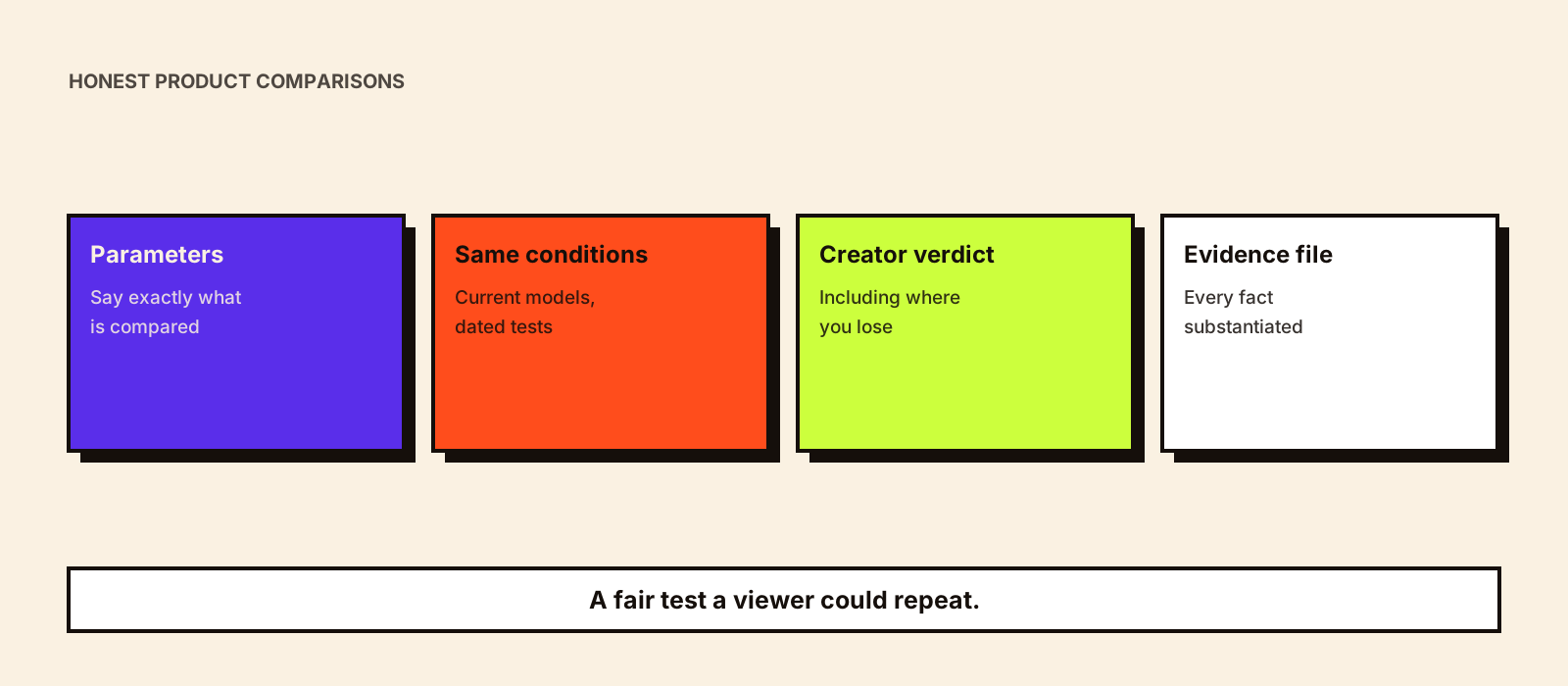
To brief creators for honest product comparisons, define exactly what's being compared, test both products under the same conditions with current models and prices, let the creator run the test and report where your product loses, and keep a file of evidence for every factual claim. In India, the ASCI Code allows comparisons with competitors, including naming them, provided they are factual, accurate and capable of substantiation and don't unfairly denigrate the other product. Disclose the paid relationship, and keep raw footage in case the comparison is challenged.
When a comparison helps, and when it doesn't
| Situation | Comparison helps? | Why |
|---|---|---|
| Buyers are choosing between a few known options | Yes | It answers the question they're already asking |
| Your product wins on something measurable | Yes | Clear, testable parameters |
| Your product is better only for some users | Yes, framed by user type | 'Better for whom' is honest and useful |
| The difference is mostly taste or style | Rarely | Hard to substantiate; looks like a forced win |
| You'd need to test in unrealistic conditions to win | No | It won't survive scrutiny |
| The competitor's product changes often | Only with dated footage | Comparisons go stale fast |
What India's advertising code says
Chapter IV of the ASCI Code permits advertisements containing comparisons with other manufacturers, suppliers or products, in the interests of competition and public enlightenment, provided the comparisons are factual, accurate and capable of substantiation, and the advertisement does not unfairly denigrate, attack or discredit other products, advertisers or advertisements, directly or by implication. A paid creator's comparison is an advertisement, so the same applies. Legal commentary on comparative advertising in India also stresses identifying clearly which aspects are being compared, and courts have generally allowed a brand to say its product is better while objecting to untruthful claims that a rival's is bad. This is general guidance, not legal advice; have a lawyer review any comparison that names a competitor.
Disclosure and creator due diligence apply as for any paid post; see influencer campaign compliance in India.
Comparison formats and their risks
| Format | Example | Main risk |
|---|---|---|
| Named competitor, side by side | Two blenders crushing the same ice | Unequal conditions or an old competitor model |
| Your product versus the old way | An electric toothbrush versus a manual one | Exaggerating the problem with the old way |
| New version versus your previous one | This year's phone versus last year's | Overstating the upgrade |
| Price tiers | What you get at ₹2,000, ₹5,000 and ₹10,000 | Prices out of date at posting |
| 'Which one should you buy?' by user type | Three laptops for a student, a designer and a gamer | Steering every user to your product |
| Total cost over time | Refills, servicing and lifespan over two years | Unrealistic usage assumptions |
| Long-term test | Two mattresses after three months | Selective reporting of the period |
12 rules to put in the brief
| # | Rule | Why it matters |
|---|---|---|
| 1 | State exactly what is being compared, and on which parameters | Vague comparisons can't be substantiated |
| 2 | Use the same conditions for both products: same light, quantity, time, settings | The most common source of complaints |
| 3 | Use current models and prices, and show the date of testing | Comparisons go out of date |
| 4 | Give the creator the test method, and let them run it themselves | Their own test is more credible, and more defensible |
| 5 | Allow the creator to say where your product loses | An honest loss makes the wins believable |
| 6 | Don't edit footage in a way that changes results | Edits that alter outcomes are misleading |
| 7 | Keep an evidence file for every factual claim (specs, test reports, prices) | You'll need it if the comparison is challenged |
| 8 | Name competitors only on factual parameters, not in jokes or insults | Denigration is what the code prohibits |
| 9 | Keep the competitor's product in good condition and used as intended | Mishandling the rival product looks rigged |
| 10 | Disclose the paid relationship, and that you supplied the product | Viewers judge comparisons by who paid |
| 11 | Review claims for accuracy, not tone | Legal review should check facts, not rewrite the creator |
| 12 | Keep raw footage and test notes for at least as long as the content runs | Evidence for any dispute |
A comparison brief you can adapt
Products: [our product, model] vs [competitor product, model], both bought or supplied on [date].
Parameters compared: [e.g. noise in dB at max speed; time to blend 200g ice; price on [date]].
Test method: [same quantity, same surface, timer on screen, one take per test].
What we can prove: [specs and test reports in the evidence file].
What the creator decides: format, tone, verdict, and anything they think matters to their audience, including where our product is worse.
Not allowed: mocking the competitor, untested claims, edited results.
Disclosure: paid partnership label, plus 'product provided by [brand]'.
Review: brand checks facts against the evidence file within [x] working days; creative stays with the creator.
Ideas for complex comparisons
When products differ on many specifications, a straight side-by-side can confuse more than it helps. These approaches suit complex categories such as electronics, appliances, cars and financial products.
- Explain what each specification actually changes in daily use, then compare only the two or three that matter.
- Compare by user type, so viewers can find themselves ('if you mostly cook for two…').
- Show total cost of ownership over a realistic period, with the assumptions on screen.
- Run a short series: unboxing, two weeks in, then a verdict, so the comparison isn't based on first impressions.
- Invite viewers' questions and answer them in a follow-up with the same test conditions.
- Use a qualified creator for regulated categories such as finance or health, and keep to what they're allowed to say.
Working with independent review creators is covered in YouTube product reviews, and how tech reviewers approach comparisons in influencer marketing for electronics and gadget brands.
Common mistakes
- Testing your newest model against a competitor's older one.
- Writing the verdict into the brief.
- Cutting the part where your product lost.
- Comparing on a parameter you can't substantiate.
- Treating a competitor's complaint as a PR problem rather than checking the evidence.
Conclusion
An honest comparison is a fair test that a viewer could repeat: clear parameters, same conditions, current products, the creator's own verdict and evidence behind every fact. Brief it that way and it will persuade the people who are closest to buying. Kudozz plans review and comparison content with YouTube creators through its YouTube influencer marketing service.