Influencer Marketing for Consumer Electronics Brands: How to Work With Tech Creators
How Indian consumer electronics and gadget brands can use creators for reviews, unboxings, and comparisons across a research-heavy purchase journey, without fabricating specifications or performance claims.
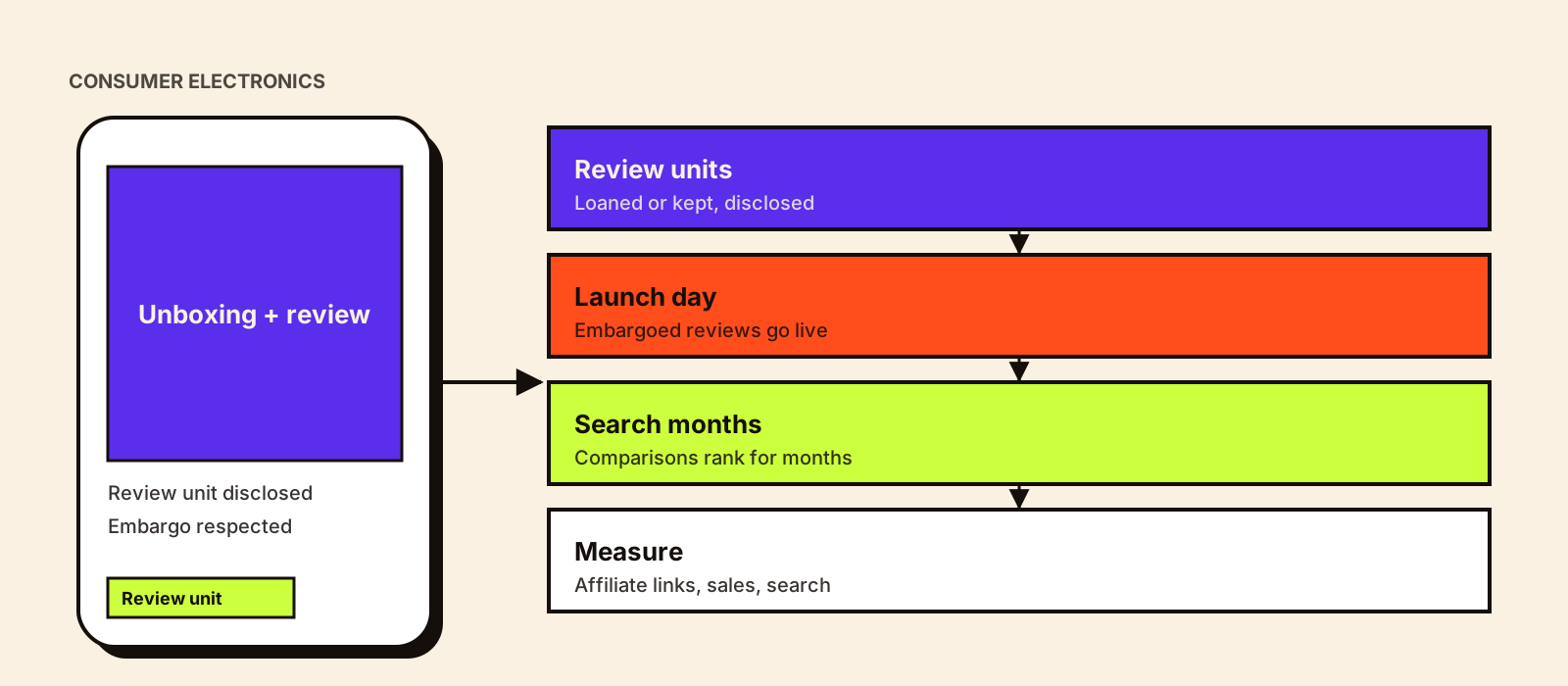
Buying a phone, laptop, or home appliance in India usually involves watching several reviews, reading comparisons, and checking real-world performance before committing, which makes creator content one of the most influential factors in a category where the actual purchase happens on an e-commerce site or in a store days or weeks later.
Quick answer
Consumer electronics and gadget brands in India should plan for a research-heavy purchase. Long-form YouTube reviews, comparisons and unboxings from credible tech creators carry most consideration, and short-form clips add discovery. Provide review units early, agree embargo dates, keep every specification and performance claim accurate, and measure consideration and search, not only launch-day views.
Why creators matter in consumer electronics
Specification sheets tell a buyer what a product has; they don't tell a buyer whether it's actually worth the money compared to the alternatives, or whether a promised feature works well in daily use. A creator who has genuinely used the product can answer that in a way a product page can't.
Product reviews
A detailed, honest review, covering both strengths and real limitations, remains the single most trusted format in this category, since buyers are specifically trying to validate a purchase decision before spending on something they'll use for years.
Unboxing content
Unboxing content works well for new or highly anticipated products because it captures a genuine first impression, build quality, packaging, initial setup, before the more considered review that usually follows.
Feature demonstrations
Short, specific demonstrations of a single feature, camera performance, battery life, a particular software capability, answer a precise question a researching buyer is likely searching for directly, rather than requiring them to watch a full review.
Comparison content
Many electronics purchases come down to a shortlist of two or three products, and comparison content, addressing that shortlist directly, tends to influence the final decision more than a standalone review of a single product.
Technology experts versus general tech creators
Creators with genuine technical depth, benchmark testing, camera sample analysis, build quality assessment, carry more credibility for higher-consideration purchases, while general tech or lifestyle creators can be effective for broader awareness and everyday-use framing.
Product launches
A new product launch benefits from staggered coverage: early access for a small, credible group of reviewers ahead of the announcement, followed by broader review and comparison content once the product is publicly available.
Long-form YouTube content
YouTube remains the primary platform for detailed electronics reviews and comparisons, since the format accommodates the depth, benchmarks, camera samples, extended use, that a purchase decision at this price point often warrants.
Short-form product discovery
Shorter-form content on Instagram and YouTube Shorts works well for initial awareness and a single standout feature, often driving a viewer toward a longer review before they make a final decision.
Affiliate and creator partnerships
Affiliate links and creator-specific discount codes give both an incentive for the audience to act and a direct way to measure which creators are actually driving purchases, not just views, particularly useful for e-commerce-driven electronics brands.
Measuring product consideration
Given the multi-step research journey, measure awareness and consideration content on watch time, comment quality, and engagement, and track conversion-focused content through affiliate links or promo codes tied to a specific creator and product.
How the approach differs by product category
| Category | What creator content typically emphasizes |
|---|---|
| Smartphones | Camera comparisons, day-to-day performance, and value against competing models at the same price point |
| Laptops | Build quality, performance for specific use cases (work, gaming, creative), and battery life under real use |
| Wearables | Accuracy of health and fitness tracking, comfort over extended wear, and app or ecosystem integration |
| Audio products | Sound quality description, noise cancellation performance, and comfort for extended listening |
| Gaming products | Performance benchmarks, build quality under regular use, and community or streamer-relevant features |
| Smart home products | Ease of setup, actual reliability over time, and integration with other devices in the home |
| Accessories | Practical fit and utility demonstrations, often as shorter, lower-production content given the lower price point |
The common thread across every category is that creator content should demonstrate genuine, tested use, not repeat manufacturer specifications as if they were independently verified claims.
Kitchen appliances, water purifiers and other home appliances follow a different journey, with installation, service and household use; see influencer marketing for home appliance brands.
Gadget and accessory brands: a different playbook
Affordable gadgets such as earbuds, smartwatches, power banks, chargers, trimmers and phone accessories sell differently from flagship phones and laptops. The research is shorter, the purchase usually happens on a marketplace, and a lot of buying is concentrated around sale events. Creator plans for these brands lean towards volume, comparison and timing rather than a few long reviews.
| Decision | Flagship electronics | Gadgets and accessories |
|---|---|---|
| Creator mix | A few credible tech reviewers, plus launch coverage | Many micro and mid-tier tech, lifestyle and student creators, plus a few reviewers for credibility |
| Lead format | Long-form YouTube reviews and comparisons | Short-form unboxings, 'under ₹X' roundups and side-by-side comparisons at the same price |
| Timing | Launch embargo, then months of search-driven views | Build up before marketplace sale events, then remind during them |
| Where people buy | E-commerce and retail stores | Mostly marketplaces and the brand's own site |
| What builds trust | Independent testing and expert opinion | Durability over weeks, honest comparisons with similarly priced rivals, warranty and service answers |
- Plan creator content to land in the weeks before major marketplace sales, when shoppers research and wishlist, and keep a smaller burst for the sale days themselves.
- Ask for a follow-up post after a few weeks of real use; for cheap gadgets, 'is it still working?' is the question buyers most want answered.
- Brief creators on the exact model name and variant, because similar-sounding models confuse marketplace search.
- Prepare answers on warranty, service centres and returns, since these questions dominate comments in this category.
- Don't let creators claim certifications, water-resistance ratings or battery figures the product's documentation doesn't support.
Marketplace measurement for gadget brands is covered in influencer marketing for Amazon and Flipkart sellers.
Consumer Electronics Creator Selection Matrix
| Factor | What to evaluate |
|---|---|
| Technology expertise | Does the creator demonstrate genuine, accurate technical knowledge relevant to this product category? |
| Audience relevance | Does the creator's audience genuinely overlap with your target buyer's price point and use case? |
| Content format | Is the creator suited to the format this launch needs: long-form review, short-form demo, or comparison content? |
| Platform | Does the creator's primary platform match where your target buyer actually researches this category? |
| Brand suitability | Does the creator's tone and past coverage align with how the brand wants to be positioned? |
A note on specifications and performance claims
Any specification or performance claim included in creator content should reflect the product's actual, tested capabilities, not marketing copy repeated without verification. Encouraging a creator to overstate battery life, camera performance, or benchmark scores creates a credibility risk for both the brand and the creator once real-world use contradicts the claim.
Electronics brands with a companion mobile app should also see influencer marketing for mobile apps in India for the specific install and activation measurement that applies there, and SaaS-adjacent hardware brands may find influencer marketing for SaaS companies in India relevant for any subscription or software layer.
The review that convinces someone to buy isn't the one that praises everything. It's the one that's honest about the single thing that's mediocre, because that's the part a spec sheet would never admit.— Kudozz Strategy Team
Review units, embargoes and launch timing
| Decision | Options | Why it matters |
|---|---|---|
| Review units | Loaned and returned, or kept by the creator | A kept unit is a material connection and must be disclosed; loans should be stated clearly in the agreement |
| Embargo | Agreed date and time before which reviews can't publish | Coordinates launch-day coverage; must be written into agreements |
| Paid vs editorial | Sponsored integration, or independent review with a free unit | Audiences trust independent reviews; paid content must be labeled either way |
| Firmware and pricing | Share final specs and prices before content locks | Early reviews with wrong specs are hard to correct |
Search-driven YouTube: plan for months, not days
Electronics buyers search before they buy: "best phone under a budget", "X vs Y", "is X worth it". Long-form YouTube reviews keep being found in search for months after launch, so their value builds over time. Plan for this:
- Brief reviewers on the comparisons buyers actually search for.
- Keep a second wave of creators for four to eight weeks after launch, when real-use reviews rank.
- Use affiliate or tracked links in descriptions to see which reviews drive purchase intent.
- Correct errors quickly with pinned comments or updates.
- Regional-language tech creators reach buyers English reviews miss.
Launch planning is covered in influencer marketing for product launches, and YouTube creator campaigns in YouTube product reviews.
Planning an electronics campaign
For measuring sales from reviews and comparisons, see influencer marketing for sales; for mobile apps and gadgets aimed at younger audiences, influencer marketing for mobile apps.