How to Design a Brand Lift Survey for an Influencer Campaign
How to design a brand lift survey for creator campaigns in India: choosing the metric, writing neutral questions, building exposed and control groups for paid and organic creator content, sample sizes, platform study minimums, languages and reporting.
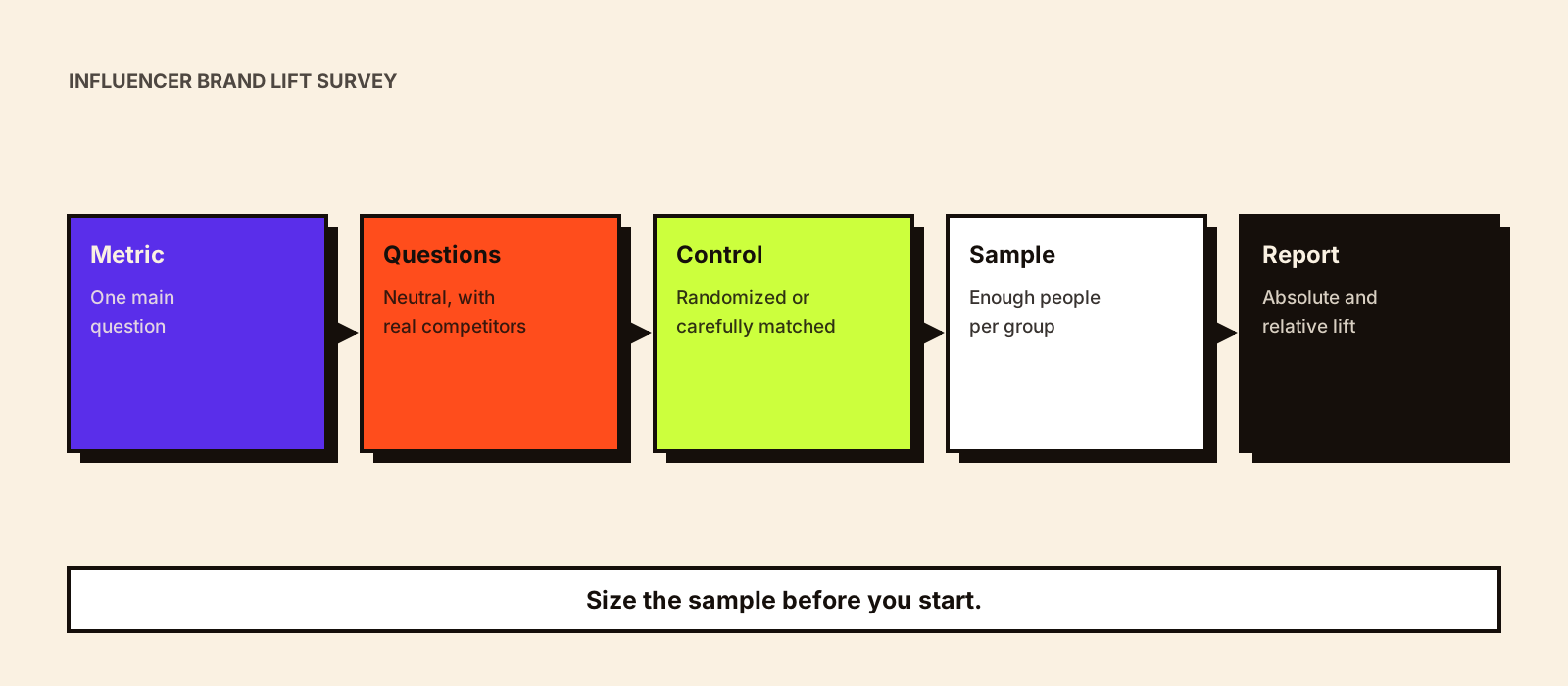
Awareness campaigns are judged on reach because reach is easy to count. A brand lift survey asks the harder question: did people who saw the creator content remember, know or think differently about the brand compared with similar people who didn't? This guide covers how to design one for creator campaigns, where much of the content runs on creators' own accounts.
Quick answer
Pick one main metric (usually ad recall or awareness), write neutral questions that list your brand among competitors, and compare an exposed group with a control group that is similar in every way except exposure. For creator content run as paid ads, use the platform's brand lift study, which randomizes the control group. For organic posts, use a survey panel matched on age, gender, city and language, and size it in advance: detecting a 5-point difference from a 30% baseline needs roughly 1,400 people per group.
Step 1: Choose one main metric
| Objective | Main metric | Example question |
|---|---|---|
| New brand or new market | Aided awareness | Which of these brands of [category] have you heard of? |
| Did the content register? | Ad recall | Do you recall seeing online content about [brand] in the last two weeks? |
| Established category, stronger competitors | Consideration | Which of these brands would you consider next time you buy [category]? |
| Repositioning | Brand association | Which of these brands do you associate with [attribute]? |
| Launch with stock available | Purchase intent | How likely are you to buy [brand] in the next month? |
Each extra question adds survey length and, in platform studies, cost. Choose the metric the campaign was actually designed to move, and treat others as secondary.
Step 2: Write neutral questions
- List your brand among four to six real competitors, in random order, plus 'None of these'.
- Don't name the creator or describe the campaign in awareness or consideration questions; it primes answers.
- Ask about a time window ('in the last two weeks') for recall.
- Use the same wording for exposed and control groups, and before and after if you run a pre-wave.
- Translate carefully: test Hindi or other language versions with native speakers, and keep brand names as people actually say them.
- Add a check question (a fake brand in the list) to spot careless answers.
Step 3: Build a fair control group
| How the content runs | Exposed group | Control group | Rigor |
|---|---|---|---|
| Paid creator ads (partnership, Spark or whitelisted ads) | People the platform served the ad | People held back at random by the platform | High |
| Organic creator posts | Panel respondents who saw the content (verified by showing it, or by following the creator) | Respondents matched on age, gender, city tier and language who didn't | Medium; depends on matching |
| Campaign in some cities only | Survey in campaign cities | Similar cities without the campaign, before and after | Medium |
| Anything | Target audience after the campaign | Same audience before (pre/post) | Low on its own |
Followers of a creator differ from non-followers before any campaign: they may already like your category. Matching reduces, but doesn't remove, that bias, which is why platform studies on paid ads are more reliable. When you can, run creator content as paid ads for part of the budget and measure that part properly. Holdout methods are explained in influencer marketing incrementality.
Step 4: Size the sample before you start
| Control result | Exposed result you want to detect | Approx. respondents per group |
|---|---|---|
| 30% | 33% (3 points) | 3,800 |
| 30% | 35% (5 points) | 1,400 |
| 30% | 40% (10 points) | 350 |
| 10% | 15% (5 points) | 700 |
Figures are for a standard two-group comparison at 95% confidence and 80% power, rounded. Small differences need large samples; if your budget only buys 300 people per group, you can only detect large effects. Decide this before fielding, and report 'not detected at this sample size' rather than 'no effect' when a result is small.
Platform brand lift studies
| Platform | How it works | Access (checked October 2026) |
|---|---|---|
| YouTube (Google) | Surveys people who saw the ads and eligible people who weren't shown them; reports absolute, relative and headroom lift | Through a Google account representative. India is in the lowest-minimum tier: USD 5,000 for one question, 10,000 for two, 20,000 for three, spent within 10 days |
| Meta (Facebook, Instagram) | Randomized test and control groups answer poll questions | Minimums vary by country; one language per test; check availability in Ads Manager |
| Others (Snapchat, LinkedIn and more) | Similar exposed-versus-control polls | Usually through an account team; check minimums |
Sources: Google's About Brand Lift and its minimum budget table, and Meta's guide to brand lift tests. Requirements change, so confirm with each platform before budgeting.
Step 5: Report it honestly
- Report absolute lift (percentage points) and relative lift (the difference divided by the control result), and say which a headline refers to.
- Show sample sizes and whether the result passed the confidence threshold you set in advance.
- Describe how the control group was formed and its known weaknesses.
- Keep brand lift separate from sales results; recall doesn't prove purchases.
Hypothetical example
Hypothetical, for illustration only. A snack brand runs creator videos in Hindi and Tamil. Half the budget runs as partnership ads with a YouTube brand lift study measuring recall; the organic posts are measured with a panel of 800 viewers and 800 matched non-viewers per language. The platform study shows a 6-point recall lift that clears its threshold. The panel shows a 4-point awareness difference in Hindi and nothing detectable in Tamil, which the team reports as inconclusive at that sample size.
Common mistakes
- Comparing followers with non-followers and calling the difference lift.
- Asking five metrics on a sample sized for one.
- Naming the creator in the awareness question.
- Changing question wording between waves.
- Reporting relative lift without the absolute numbers.
Conclusion
A brand lift survey is only as good as its control group and sample size. Choose one metric, write neutral questions, use platform studies for paid creator ads, match carefully for organic posts, and report what you can and can't conclude. For Gulf campaigns, see measuring influencer brand lift in the GCC; for awareness planning in general, see influencer marketing for brand awareness.