Measuring Brand Lift From Influencer Marketing in the GCC
How brands can measure the awareness and consideration effect of creator campaigns in the UAE, Saudi Arabia and other GCC markets: what brand lift is, which methods work for organic and paid creator content, platform study requirements, Arabic and English surveys, small-market sample sizes and reading results.
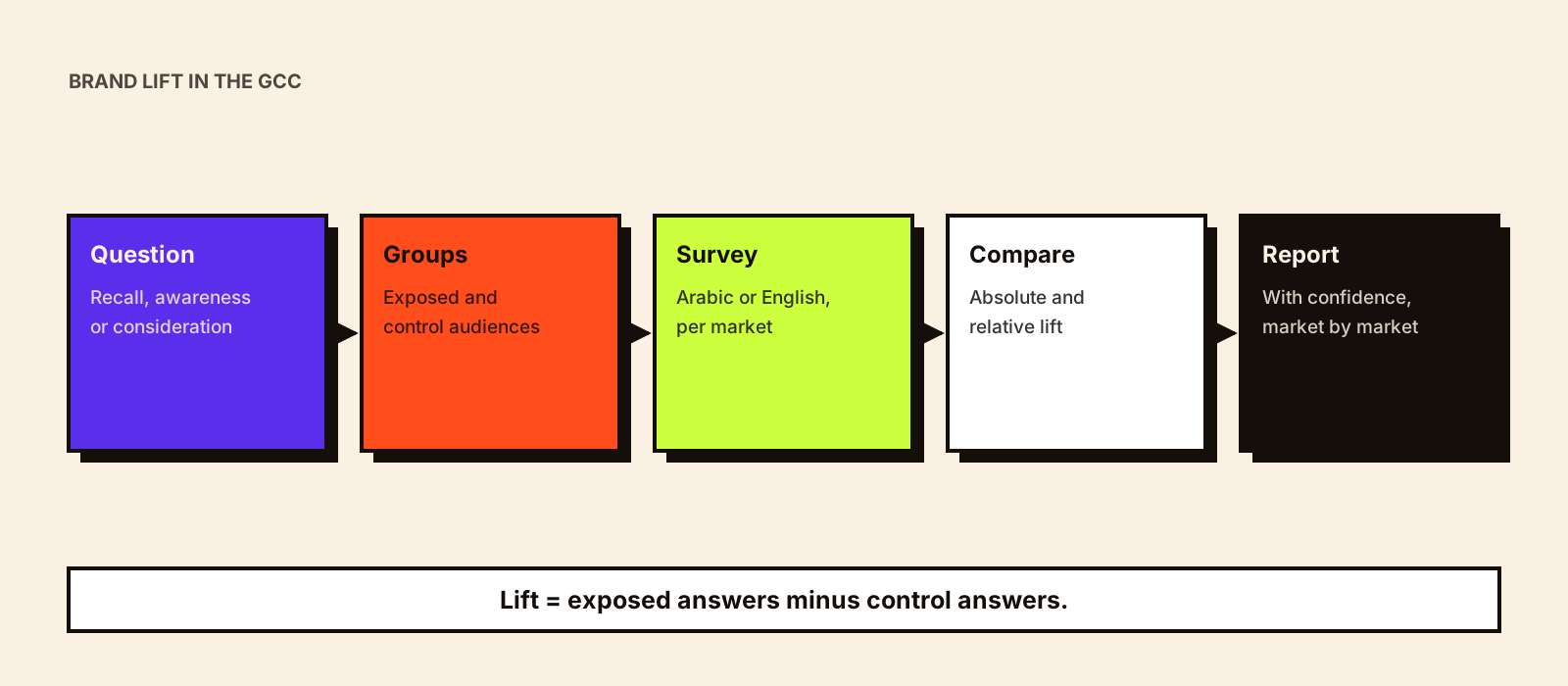
Many creator campaigns in the Gulf aim at awareness and consideration: a brand entering Saudi Arabia, a launch in the UAE, a category people don't yet know. Reach and engagement show that content was seen, not that it changed what people remember or think. Brand lift measurement answers that second question. This guide is for brand and insights teams who want a defensible number, and explains what is possible with organic creator posts, paid creator ads and survey panels in GCC markets.
Quick answer
Brand lift is the difference in survey answers (such as ad recall, awareness or consideration) between people who saw your campaign and a comparable group who didn't. For creator content run as paid ads, platform brand lift studies on Meta, YouTube, TikTok and Snapchat are the most rigorous option, subject to minimum budgets and account-team access. For organic creator posts, use a survey panel that compares exposed and unexposed people, or market-level comparisons. In the GCC, plan language versions separately, check that each market is supported, and make sure the sample in each country is large enough before reporting a result.
What brand lift measures
| Metric | Typical survey question | Use it when |
|---|---|---|
| Ad recall | Do you recall seeing an ad for [brand] online in the last two weeks? | Always; it shows whether the content registered |
| Awareness | Which of these brands have you heard of? | New brands or new markets |
| Consideration | Which of these brands would you consider for [category]? | Established categories with competitors |
| Favorability | How would you describe your opinion of [brand]? | Reputation or repositioning |
| Purchase intent | How likely are you to buy [brand] in the next month? | Launches with availability |
Absolute lift is the percentage-point difference between groups (for example 38% recall among exposed people vs 30% in the control group is 8 points). Relative lift is that difference divided by the control result (8 ÷ 30 = 27%). Report both, and say which one a headline number refers to.
Why creator content is harder to measure
Platform brand lift studies work by randomly holding back a group of people from seeing ads. Organic posts on a creator's own account can't be randomised that way: anyone who follows the creator might see them. So the method depends on how the content runs.
| How content runs | Method | Rigour |
|---|---|---|
| Paid creator ads (whitelisted, Spark or partnership ads) | Platform brand lift study with a randomised control group | High |
| Organic creator posts | Survey panel comparing exposed and unexposed respondents, matched on age, gender, nationality and market | Medium; depends on matching |
| Campaign in some markets or cities only | Compare survey results in campaign and non-campaign areas before and after | Medium; areas differ |
| Any | Pre/post tracker survey of the target audience | Low on its own; other activity also moves results |
| Any | Branded search and direct traffic against baseline | Directional only |
Platform brand lift studies
Checked 9 October 2026. Requirements change, so confirm with each platform's account team.
| Platform | How it works | Access and minimums |
|---|---|---|
| YouTube (Google) | Surveys people who saw your ads and people who were eligible but weren't shown them | Contact a Google account representative. Minimum budgets by country tier, within 10 days. The UAE, Saudi Arabia, Kuwait, Bahrain and Oman are tier A: USD 5,000 for one question, 10,000 for two, 20,000 for three. Qatar is tier C: USD 15,000, 30,000 and 60,000. Multi-country studies use the highest tier's minimum. |
| Meta (Facebook, Instagram) | Randomised test and control groups answer poll questions; ad recall is always included; up to three questions | Minimum budgets vary by country; a test runs in one language only. Check in Ads Manager whether your market is supported. |
| TikTok | Splits the target audience into exposed and control groups and polls both | Set up by your TikTok account manager |
| Snapchat | Test and control groups answer a short in-app survey during the campaign | Through your Snap account representative; minimums vary by country |
Sources: Google's About Brand Lift and minimum budget table, Meta's guide to brand lift tests and its minimums page, TikTok's Brand Lift Studies article and Snapchat's About Brand Lift.
GCC considerations
- Language: if a study runs in one language, decide whether Arabic or English matches the audience, or run separate studies for Arabic and English audiences
- Market support: check each country individually; don't assume a study available in the UAE is available in Qatar or Oman
- Sample size: small markets and narrow targeting make it harder to collect enough responses; widen the audience or extend the flight rather than reporting an unreliable result
- Segments: nationals and expatriate communities may respond differently; report segments only where each has enough responses
- Seasonality: Ramadan and Eid change media habits; compare like with like
- Panels: for third-party surveys, ask how the panel reaches nationals and each expatriate community, and in which languages
Designing a study
- 1. Pick one primary question tied to the objective (recall for a launch, consideration for a challenger brand)
- 2. Decide how content will run: paid creator ads allow platform studies; organic-only needs a panel
- 3. Fix the markets, languages and audience before launch
- 4. Check eligibility and minimums with each platform, or brief a research partner
- 5. Put all of the brand's campaigns in the study where the platform recommends it, so the control group isn't exposed elsewhere
- 6. Agree in advance what result counts as success and how confidence will be reported
Reading results honestly
- Report the confidence level or margin of error the platform or researcher provides
- Distinguish 'no detectable lift' from 'no lift': small samples often can't detect modest effects
- Report absolute and relative lift side by side
- Calculate cost per lifted person (spend ÷ estimated number of people whose answer changed) where the platform provides it
- Don't add lift results from different markets or platforms together
Hypothetical example
Hypothetical, for illustration only. A beverage brand entering Saudi Arabia runs creator videos as paid ads for three weeks and a separate Arabic-language brand lift study. Ad recall is 31% among exposed respondents vs 24% in the control group: 7 points absolute, 29% relative. Consideration shows a 2-point difference that the study reports below its confidence threshold. The team reports recall lift as the result, describes consideration as 'not detected at this sample size', and plans a longer flight for the next study.
If you can't run a study
Many creator campaigns don't meet platform minimums. In that case, combine directional signals: branded search and direct traffic against the same period before, follower growth on brand accounts, comment themes, and a small pre/post survey if budget allows. Present them as directional, not as lift. Awareness metrics are covered more broadly in influencer marketing for brand awareness, and cross-market reporting in GCC influencer campaign reporting.
Question wording, sample sizes and control groups for organic creator posts are covered in more detail in how to design a brand lift survey for an influencer campaign.
Common mistakes
- Calling a pre/post change 'brand lift' without a control group
- One English survey for an Arabic-speaking audience
- Reporting segments with too few responses
- Deciding success criteria after seeing the results
- Adding results from different markets into one regional number
Conclusion
Brand lift turns 'people saw it' into 'people remembered it'. In the GCC, the rigorous route is paid creator ads with platform studies, planned by market and language and sized to produce a reliable result. Where that isn't possible, use a matched survey or directional signals, and label them honestly.