Influencer Marketing for Brands Entering the GCC: A Market-by-Market Playbook
A planning framework for brands taking creator marketing across the Gulf: how the UAE, Saudi Arabia, Qatar, Kuwait, Bahrain and Oman differ, where licensing stands in each, and when you need separate research, creative, creators, approvals and measurement per country.
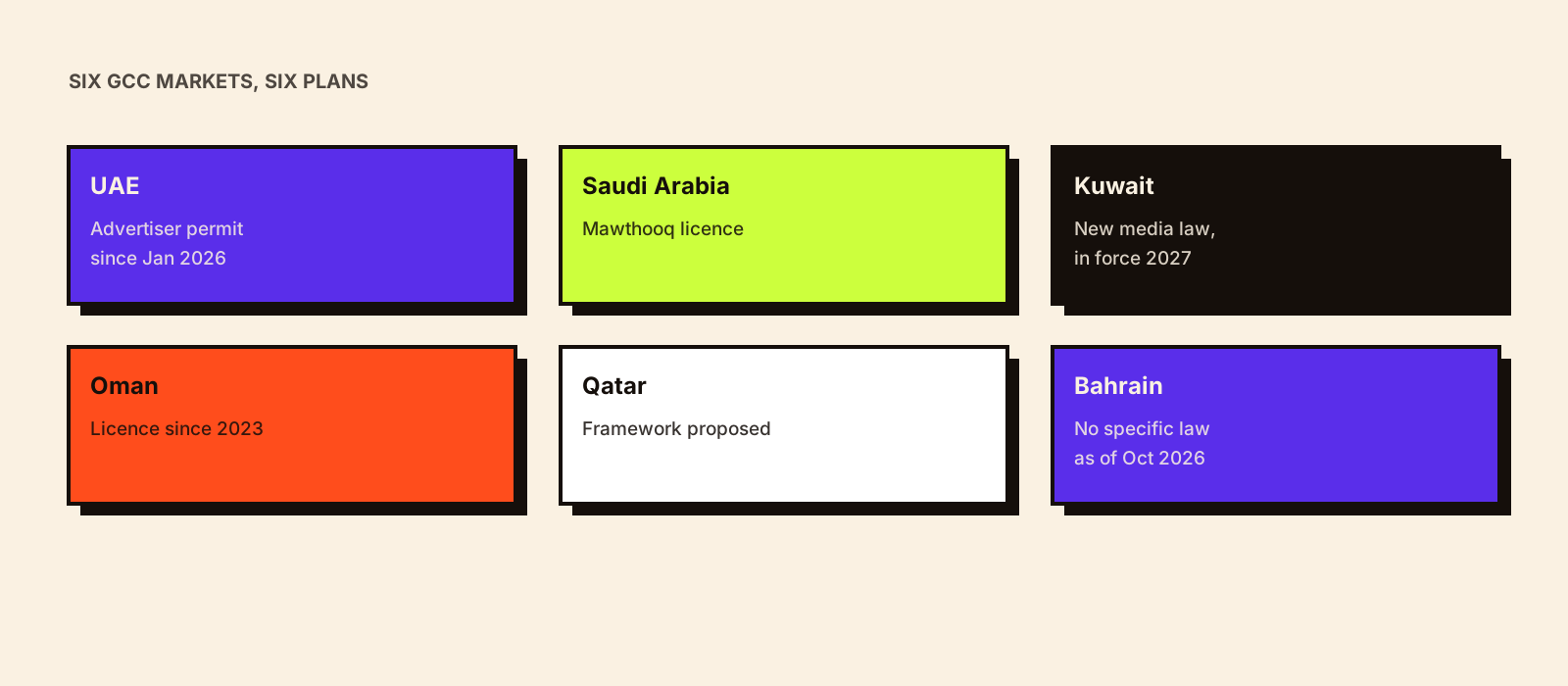
'The GCC' is a useful phrase for a regional office and a misleading one for a creator campaign. The six member states share a language family, a religious calendar and many cultural traditions, but their audiences, media rules and creator markets differ enough that one regional campaign rarely fits all of them. This playbook is a framework for deciding where to start, what can be shared and what each country needs of its own.
Reviewed 9 October 2026. Licensing rules across the Gulf are changing quickly; Kuwait published a new media law in October 2026, for example. Treat the regulatory summary below as a starting point and confirm each country's current requirements with its authorities or local counsel.
Quick answer
Treat each GCC country as its own market. Share strategy, brand guidelines and learning across the region, but plan audience research, creators, language and dialect, licensing checks, sector approvals and measurement per country. Most brands start in the UAE or Saudi Arabia, depending on whether they need a multilingual expatriate audience or a large, mostly national, Arabic-speaking one, then test smaller markets with local creators before scaling. Influencer licensing exists in the UAE, Saudi Arabia and Oman, has just been legislated in Kuwait, is proposed in Qatar and has no specific law in Bahrain, so compliance checks differ in each.
Six markets, six plans
| Market | Audience notes | Language | Planning note |
|---|---|---|---|
| UAE | Large expatriate majority from many countries | English widely, Arabic, many community languages | Segment by community and emirate; a regional media and creator hub, but not a proxy for the region |
| Saudi Arabia | Largest population; majority Saudi nationals | Arabic in Saudi dialects | Arabic-first, city-by-city; Snapchat and X carry more weight |
| Qatar | Small national population and large expatriate majority | Arabic and English | Smaller creator pool; check audience location carefully |
| Kuwait | Large expatriate share; an influential national creator scene | Arabic in Kuwaiti dialect, English | New licensing law takes effect in 2027 |
| Bahrain | Roughly balanced national and expatriate populations; close ties with Saudi Arabia's Eastern Province | Arabic, English | Smaller market; regional creators can overlap with Saudi audiences |
| Oman | Majority Omani nationals | Arabic in Omani dialect, English | Licensing has been in place since 2023; local creators matter |
Audience shares by nationality vary by source and year, so we've described them qualitatively. Check current official statistics for any market you're budgeting for.
Where creator licensing stands
| Market | Status as reviewed | Source |
|---|---|---|
| UAE | Advertiser Permit required (registration deadline 31 January 2026); visitor permit through accredited agencies | UAE Media Council FAQ; Gulf News; Pinsent Masons |
| Saudi Arabia | Mawthooq licence from GAMR for paid promotional content; additional steps for non-Saudis | GAMR; Saudipedia; Arab News |
| Kuwait | Decree-Law No. 102 of 2026 (Media Regulation Law) published 4 October 2026, in force six months later; introduces licences for influencers and paid advertisers on social platforms; executive regulations pending | WEFAQ legal update |
| Oman | Licence for marketing and promotion on social media under Ministerial Decision 619/2022, in force since March 2023 | Oman Observer |
| Qatar | A licensing framework for content creators has been proposed; general advertising licensing applies; check current status | Sultan Al-Abdulla & Partners |
| Bahrain | No specific influencer law as of October 2026; general advertising and commercial rules still apply | GDN |
Sources: the UAE rules are summarized with links in our UAE influencer marketing guide; Saudi Arabia's in Saudi Arabia vs UAE influencer marketing; Kuwait from WEFAQ's summary of the new law; Oman from Oman Observer's report on the licence; Qatar from Sultan Al-Abdulla & Partners on the proposed framework; and Bahrain from GDN's October 2026 report.
Two practical implications. First, a licence in one country doesn't cover another, so a creator with a cross-border audience may raise questions in more than one jurisdiction. Second, sector rules for health, food, finance and promotions are national too; a UAE health advertising approval says nothing about Kuwait or Oman.
Country guides cover each market in more depth: influencer marketing in Saudi Arabia, influencer marketing in the UAE, influencer marketing in Qatar, influencer marketing in Kuwait and influencer marketing in Oman. Bahrain is covered below.
Bahrain
Bahrain is the smallest GCC market, with about 1.65 million people according to DataReportal's Digital 2026 Bahrain report. Its late-2025 advertising-audience figures show unusually high reach for Instagram (1.10 million, 66.6% of the population) and Snapchat (1.10 million, 66.3%), alongside YouTube (1.23 million, 74.5%) and TikTok (1.31 million users aged 18+, above the adult population). As elsewhere, these aren't active-user counts.
- Regulation: as of October 2026 there is no specific influencer law, according to GDN, and an influencer licence is under discussion; general advertising, consumer protection and commercial rules still apply
- Promotions: the Ministry of Industry and Commerce licenses promotional and discount campaigns for businesses, so check before a creator announces an offer or giveaway
- Audience: close ties with Saudi Arabia's Eastern Province mean some Bahraini creators reach Saudi audiences too, and vice versa; check audience location against your goal
- Scale: a small market saturates quickly, so rotate creators and watch frequency
- Currency: contract in Bahraini dinars (BHD), which are pegged to the US dollar
We haven't published a separate Bahrain guide: with no influencer-specific regime yet and a small market, most planning questions are answered here. The ministry's promotional campaign service is listed on the Ministry of Industry and Commerce site.
What to share, and what to localize
| Element | Usually shared across the region | Usually per country |
|---|---|---|
| Strategy | Brand positioning, objectives framework, measurement principles | Objective and target per market |
| Research | Category insight that applies widely | Audience, competitors, platform habits, price expectations |
| Creative | The core idea and brand guidelines | Dialect, references, casting, offers |
| Creators | Occasional regional names for reach | Local creators for relevance and conversion |
| Compliance | A shared checklist format | Licences, sector approvals, promotion permits, disclosure wording |
| Commercial | Contract templates | Currency, VAT, payment and tax handling |
| Measurement | KPI definitions and reporting format | Tracking, baselines and results per country |
When a country needs its own plan
- Separate research: when you don't have sales or audience data for that country, or the category is new there
- Separate creative: when the audience speaks a different dialect, the offer or price differs, or cultural references don't travel
- Separate creators: almost always for conversion goals; regional creators may be enough for broad awareness
- Separate approvals: whenever licensing, sector or promotion rules apply, which is most of the time
- Separate measurement: always; blended GCC numbers hide which market worked
Choosing where to start
| If your situation is | Consider starting in | Why |
|---|---|---|
| A multilingual or expatriate-focused product | UAE | The broadest mix of communities; English-language campaigns can work |
| A mass-market product for Arabic-speaking nationals | Saudi Arabia | Scale; Arabic-first creative |
| A premium product with limited distribution | The market where you have retail or delivery coverage | Creators can't sell what people can't buy |
| A brand already in one GCC market | The neighboring market with the most similar audience | Reuse learning; adapt the creative |
| A regulated category | The market where you already hold approvals | Approvals often drive the timeline |
If you're an Indian brand entering the Gulf
Indian brands often start in the UAE because of its large Indian community and familiar languages, but a campaign that works in India rarely transfers unchanged. Some experience carries over, such as managing many creators, disclosure discipline under ASCI's guidelines and planning across languages. Other things change:
| Area | In India | In the Gulf |
|---|---|---|
| Creator licensing | No creator licence; disclosure rules apply | UAE advertiser permit; Saudi Mawthooq licence; Oman and Kuwait have their own regimes |
| Creators based in India | Normal practice | The UAE regulator's FAQ says advertisers should contract with permitted UAE residents or visitors for UAE audiences; take advice before paying India-based creators to target the UAE |
| Language | Hindi, English and regional languages | Arabic for nationals; English, Hindi, Malayalam, Tamil and others for expatriate communities; UAE disclosure in the language of the ad |
| Audience | Mostly domestic | Check audience country: an Indian creator's Gulf followers may be a small share of their audience |
| Calendar | Diwali, wedding season, sale events | Ramadan and Eid, plus community festivals such as Diwali |
| Pricing and payments | INR, GST | Local currency, local tax and contracts in the market's law |
Start with one market, usually the one where your product is already sold or delivered, and test local creators against creators from the Indian community there. For the detail, see the UAE advertiser permit guide, Saudi influencer advertising rules, influencer marketing to expatriate communities in the UAE and Ramadan influencer marketing in the UAE. For campaigns that keep running in India at the same time, the international influencer campaign playbook covers contracts, currencies and reporting across markets.
A test-and-scale approach
- Test: a small group of local creators per market, two or three content angles, tracked separately
- Learn: compare cost per result by market, language and creator type; read comments for objections
- Adapt: keep the idea, adjust dialect, casting, offer and platform mix
- Scale: increase budget where results justify it, and move strong creators into longer arrangements
- Review: re-check licensing and sector rules before each new campaign, since they're changing
Running a multi-country campaign
Once markets and roles are set, the work is operational. These are the areas that most often go wrong when one team runs several Gulf countries at once.
Creator contracting and deliverables
- One contract template, localized per country for currency, language, licence clauses and governing terms
- Deliverables per creator in writing: platform, format, number, posting window, how long posts stay live
- Licence or permit number recorded per creator, per country
- For contracts that run into a regulatory change, such as Kuwait's licensing from 2027, a clause requiring compliance once rules apply
Local regulatory checks
- Creator licensing per country (see the table above)
- Promotion and discount permits per country, owned by the business running the offer
- Sector approvals per country for health, food, financial and other regulated products
- Disclosure wording in every language the campaign uses
Budgets and currencies
- Contract in AED, SAR, QAR, KWD, BHD or OMR as appropriate
- Convert to a reporting currency only at a stated, dated rate; never add currencies together
- VAT differs (for example 5% in the UAE and 15% in Saudi Arabia), and not every GCC country applies it
- Cross-border creator payments may need specific invoicing and tax handling
How to split spend between markets is covered in GCC influencer marketing budgets.
Content rights and paid amplification
- Define territory in every licence: one country, several, or the GCC; regional rights cost more
- Content made for one market may need re-voicing or re-casting before it works in another
- Agree paid amplification through creator accounts per platform and per market, since tools and availability differ
- Track which assets are licensed for which markets and until when
Tracking, attribution and reporting
- Separate links, codes and landing pages per market and language
- The same reporting window across markets unless a buying cycle justifies a difference
- Report per market in local currency, then compare cost per result in a reporting currency at a stated rate
A full framework for comparing countries is in GCC influencer campaign reporting, and the profitability test to apply per market in break-even ROAS for influencer campaigns.
Coordination and market-by-market optimization
- One owner per market, plus one person accountable for the regional view
- A shared tracker of creators, deliverables, approvals, licences and posting dates across markets
- A weekly check-in during live campaigns, with decisions recorded per market
- Decision rules agreed upfront: when to rebook a creator, pause one, or move budget between markets
- A debrief per market before the regional summary, so local learning isn't averaged away
Sector and format guides
Several categories have their own GCC guides: retail brands, automotive brands, fitness and wellness brands and technology brands. Livestream planning, where commerce features differ by country, is covered in influencer livestream campaigns in the GCC. Franchise networks have their own guide in franchise influencer marketing in the GCC, awareness measurement is covered in measuring influencer brand lift in the GCC, and annual planning in the 2027 GCC planning guide. Further category guides cover FMCG brands, sustainable brands, film and streaming launches, sports clubs and events, watches and jewellery and nonprofit campaigns, and AI-generated content has its own governance guide.
Common mistakes
- Running one Dubai-made campaign across the region
- Assuming one country's licence covers creators' posts aimed at another
- Using Modern Standard Arabic everywhere, or one Gulf dialect for every market
- Reporting a single GCC total
- Booking regional celebrities when local creators would convert better
- Planning around regulatory rules that changed since the last campaign
Conclusion
A good GCC creator program looks like one strategy with six local executions. Share the idea, the brand and the learning; give each country its own research, creators, approvals and numbers. Start where your product and data are strongest, test before scaling, and re-check the rules each time, because across the Gulf they're still being written.