GCC Influencer Marketing Budgets: How to Allocate Spend Across Markets
How to split an influencer budget across the UAE, Saudi Arabia, Qatar, Kuwait, Bahrain and Oman: allocating by objective and market role, the cost lines each market needs, handling six currencies honestly, and reallocating after a test.
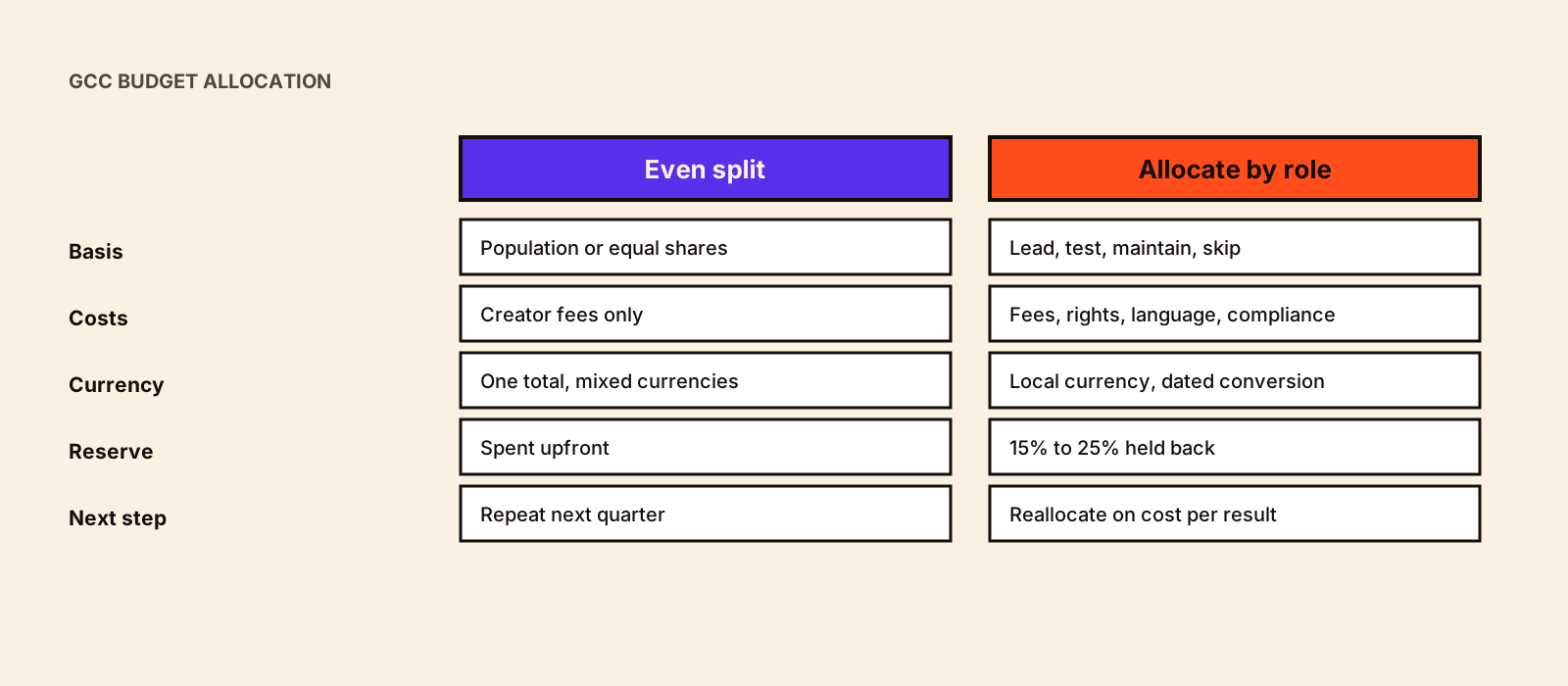
A GCC influencer budget often starts as one number and a list of six countries. Splitting it evenly, or by population, almost always misallocates it. Markets differ in what you're trying to achieve there, how much it costs to reach the right audience, and what else you need to pay for to operate properly: Arabic production, licence checks, promotion permits, paid amplification and measurement.
Quick answer
Allocate a GCC influencer budget by giving each market a role (lead, test or maintain) based on your objective and commercial priority, then build each market's budget bottom-up from creator quotes plus the costs that market needs: rights, production, Arabic or other language work, paid amplification, compliance and measurement. Keep each market in its own currency, convert to a reporting currency only at a disclosed, dated rate, hold back a reserve to move to whatever works, and reallocate after a test phase based on cost per result, not on reach.
Step 1: Give each market a role
| Role | When to use it | Budget behavior |
|---|---|---|
| Lead | Your biggest commercial opportunity, where you already sell or have distribution | Largest share; full creator mix, amplification and measurement |
| Test | A market you're entering or unsure about | Small, fixed budget with clear success criteria |
| Maintain | A market where you need presence but not growth this period | Smaller always-on spend with a few trusted creators |
| Skip for now | No distribution, no approvals, or no clear audience | Zero; creators can't sell what people can't buy |
Smaller markets often start in the test role. What a test needs in each is covered in the country guides for Qatar, Kuwait and Oman, including how licensing works in each.
Step 2: Build each market bottom-up
| Cost line | What it covers | Market-specific notes |
|---|---|---|
| Creator fees | Content and posting | Quote per market; no universal GCC rate exists |
| Usage rights and exclusivity | Using content in ads; barring competitors | Define territory: one country or the GCC |
| Production | Shoots, travel, hosting, events | Higher where events or venues are central |
| Language work | Briefs, captions, subtitles, native review | Saudi, Kuwaiti, Omani and other dialects; community languages in the UAE and Qatar |
| Paid amplification | Ad spend behind creator content | Platform availability and costs vary by market |
| Compliance | Licence checks, promotion permits, product approvals | Each country has its own regime |
| Measurement | Tracking set-up, landing pages, reporting | Separate set-up per market |
| Management | Agency or internal team time | Multi-market coordination takes more time |
| Tax | VAT where applicable | Rates differ, and not every GCC country applies VAT |
Saudi cost drivers and a worked worksheet in SAR are in how much influencer marketing costs in Saudi Arabia. The general method for budgeting across creators within one market is in influencer budget allocation.
Step 3: Handle currencies honestly
Budget and contract each market in its own currency: AED, SAR, QAR, KWD, BHD and OMR. Don't add amounts in different currencies together. When you need a single regional total, convert each market's figure into one reporting currency at a stated rate and date, and record it in the plan.
- Five GCC currencies are pegged to the US dollar: as listed by MEED, AED 3.6725, SAR 3.75, QAR 3.64, BHD 0.376 and OMR 0.3845 per US dollar
- The Kuwaiti dinar is managed against an undisclosed basket of currencies, so its rate moves; use your finance team's rate for a stated date
- Pegs can be adjusted, so confirm current rates with the central banks or your bank before finalizing
- Note whether each figure includes VAT before converting
The peg rates are summarized by MEED. A worked conversion, for illustration: a UAE budget of AED 183,625 is USD 50,000 at 3.6725, and a Saudi budget of SAR 225,000 is USD 60,000 at 3.75, giving a USD 110,000 reporting total for the two markets at those stated rates. The figures are hypothetical.
Step 4: Hold a reserve and reallocate
- Keep part of the total, often 15% to 25%, unallocated until test results are in
- Define in advance what success looks like per market: cost per delivered order, per qualified lead, per activated user
- After the test phase, move the reserve to the markets and creators beating their targets
- Compare markets on cost per result in a common currency at a stated rate, not on reach or engagement
- Account for differences in market size and objective when comparing; a small market with a test role won't match a lead market's volume
An illustrative allocation
| Market | Role | Budget (local currency) | Notes |
|---|---|---|---|
| Saudi Arabia | Lead | SAR 300,000 | Arabic creators in two regions; paid amplification; licence checks |
| UAE | Lead | AED 150,000 | Arabic and English segments; separate tracking per language |
| Kuwait | Test | KWD 6,000 | Contracts reference the new licence requirement |
| Qatar, Oman, Bahrain | Not funded this quarter | - | Revisit after the test |
| Reserve | - | Held in USD, 20% of the converted total | Moved after week four |
Hypothetical, for illustration only; not a recommendation for any brand and not Kudozz client data. Kuwait's figure would be converted at a dated rate before any regional total is calculated.
What not to do
- Split the budget by population or evenly across six markets
- Apply one 'GCC rate' to every creator
- Add AED, SAR and KWD together without converting
- Forget language production, compliance and measurement costs
- Spend everything upfront with nothing left to move to what works
Conclusion
A good GCC budget is six local budgets with a shared logic: roles set by commercial priority, costs built from real quotes and real operating needs, currencies kept separate until converted at a stated rate, and a reserve that follows the results. How results should be compared across markets is covered in GCC influencer campaign reporting.