How to Allocate Your Influencer Marketing Budget Across Creators
How to plan an influencer campaign with a fixed budget: reserving money for non-creator costs, splitting the creator budget by objective and tier, working out how many influencers you can afford, test-and-scale allocation, and an allocator that turns your budget and quoted fees into a creator count.
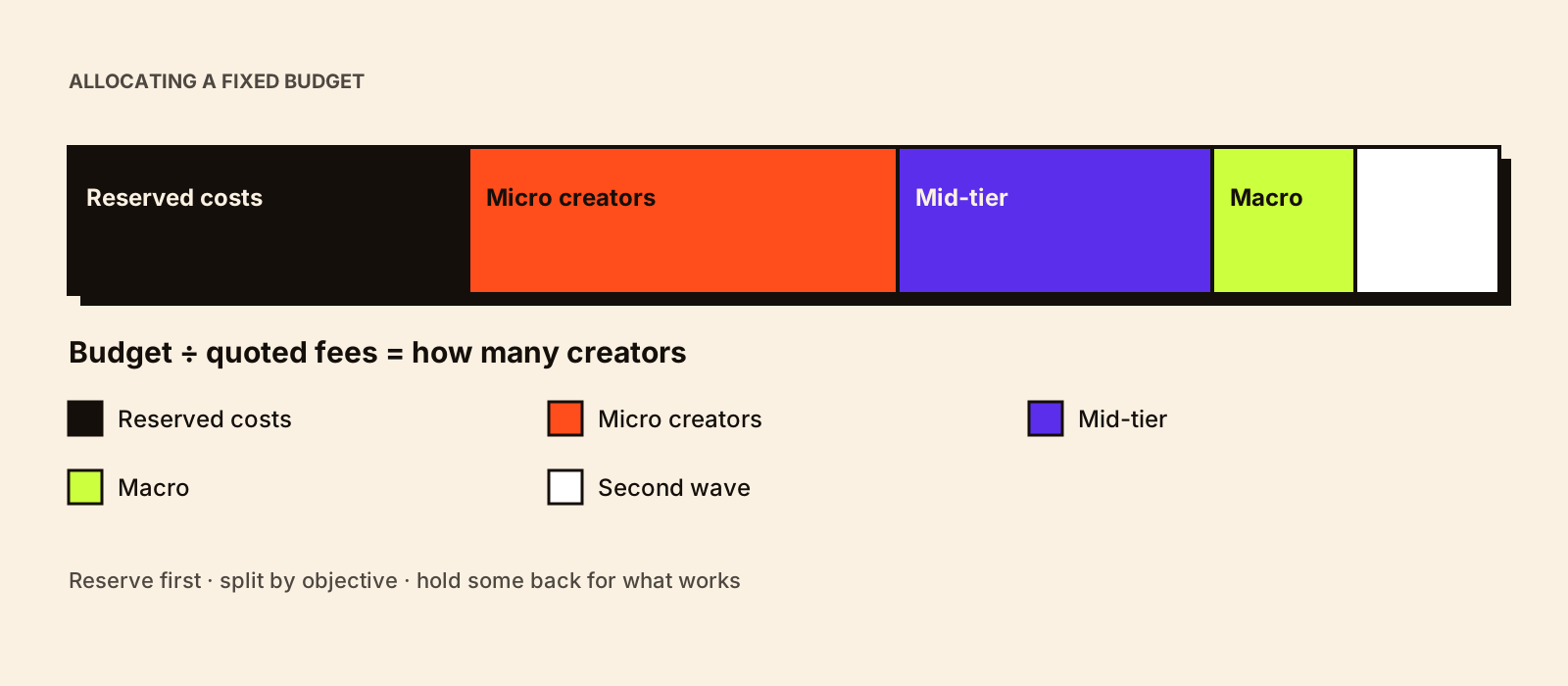
Most brands don't start from a blank budget. They start from a number finance has approved and a question: what's the best campaign we can run with this? That's an allocation problem, and it's different from calculating a budget from scratch, which is covered in how to calculate an influencer marketing budget.
Quick answer
To allocate a fixed influencer budget: first reserve money for everything that isn't a creator fee (agency or management, production, usage rights, paid amplification, product and shipping, tracking, contingency). Then split what's left across creator tiers based on your objective: more to larger creators for reach, more to micro-creators for trust, conversions and content volume, and a slice for testing. Divide each tier's budget by the realistic fee you've been quoted to see how many creators you can afford. The right number of influencers is the number your budget, objective and management capacity can support well, not the largest number you can fit.
Step 1: Reserve non-creator costs first
| Cost | Why it's easy to forget |
|---|---|
| Agency or campaign management | Coordination time scales with creator count |
| Production | Shoots, editing, UGC beyond creators' own posts |
| Usage rights and whitelisting | Needed if content will run as ads |
| Paid amplification | Media spend behind the best creator content |
| Product, shipping and returns | Seeding many creators across cities adds up |
| Tracking | Landing pages, codes, affiliate tools |
| Contingency | Replacements, extra rounds, price changes |
Brands that allocate the whole budget to creator fees often discover the extras when it's too late to cut creators. Full budget components are in influencer campaign costs in India.
Step 2: Split the creator budget by objective
| Objective | Leans towards | Why |
|---|---|---|
| Awareness and reach | More to macro and mid-tier creators, some micro for frequency | Reach concentrated in fewer, larger accounts |
| Launch buzz | A few larger creators for launch day, many micro-creators around it | Visibility plus volume of conversation |
| Consideration and trust | More to micro and mid-tier specialists | Credibility in a niche |
| Sales and conversions | Micro and mid-tier with codes or links; test before scaling | Measurable, cheaper to test |
| Content for ads | UGC creators and micro-creators | Many assets to test in paid media |
| Regional reach | Regional-language creators per market | Local trust and language |
Tier trade-offs are covered in micro vs macro influencers.
Step 3: Work out how many creators you can afford
Divide each tier's budget by the realistic fee for the deliverables you need, using quotes you've actually received rather than published averages. Then check the count against capacity: every creator needs sourcing, negotiation, briefing, review and payment.
Influencer budget allocator
Split a fixed budget using your own shares and the fees you've been quoted. It runs in your browser and nothing is saved or sent anywhere.
Approved amount, before GST
Management, production, usage, media, product, contingency
Of what's left after reserves; 0 if none
Creator tiers
Any numbers; they're converted to proportions
For the deliverables and rights you need
Any numbers; they're converted to proportions
For the deliverables and rights you need
Any numbers; they're converted to proportions
For the deliverables and rights you need
Enter the total budget, tier shares and at least one quoted fee to see how many creators it funds.
Counts are rounded down; leftover money can go to contingency or amplification. Check the count against your team's capacity to manage every creator well.
How many influencers does a campaign need?
There's no universal number. Use these questions instead:
- Reach: roughly how many people in your target audience need to see the campaign, and what's each creator's typical reach (not follower count)?
- Frequency: will the same people see several creators, which helps recall?
- Segments: how many audience segments, cities or languages must be covered? Each may need its own creators.
- Testing: do you have enough creators to learn which types work, typically several per creator type you're testing?
- Capacity: can your team or agency manage each creator properly?
- Budget: does the count leave enough per creator for good content and rights?
A campaign of five well-chosen creators can outperform one of fifty spread thin. For product launches specifically, see the creator-count section in how to find the right influencers for a product launch.
Test, then scale
| Phase | Share of creator budget (illustrative) | Purpose |
|---|---|---|
| Test | A smaller first slice | Several creator types, formats or messages; learn what works |
| Scale | The larger remainder | Rebook winners, add similar creators, amplify top content |
Holding back part of the budget for a second wave means you spend most of it on what's proven, not on guesses. It needs time in the timeline; see influencer campaign timeline.
Illustrative allocation
Illustrative example with hypothetical numbers: a skincare D2C brand has ₹10,00,000 for a consideration-led campaign in four metro cities.
| Line | Amount | Notes |
|---|---|---|
| Management, production, usage, tracking, product, contingency | ₹3,00,000 | Reserved first |
| Mid-tier skincare educators | ₹3,00,000 | Divided by quotes received: e.g. 5 creators |
| Micro-creators across four cities | ₹3,00,000 | e.g. 15 creators at the fees quoted |
| Held for second wave | ₹1,00,000 | Rebook best performers or amplify top content |
The creator counts depend entirely on the fees you're quoted for the deliverables and rights you need. Influencer rates are explained in how much to pay influencers.
Common mistakes
- Allocating everything to creator fees.
- Maximizing creator count rather than fit and content quality.
- Using published rate averages instead of real quotes.
- No money held back for scaling what works.
- Too many creators for the team to manage properly.
Conclusion
A fixed budget goes furthest when non-creator costs are reserved first, the creator budget follows the objective, creator counts come from real quotes and real capacity, and part of the money waits for evidence. That turns a number from finance into a plan you can defend.