Influencer Marketing ROI Forecasting: How Brands Can Estimate Potential Campaign Outcomes
How to forecast influencer campaign outcomes before launch: building scenarios from realistic views, click and conversion assumptions, where the assumptions come from, a forecast calculator, presenting ranges to finance, then comparing forecast with actuals to decide where to increase, hold or cut spend.
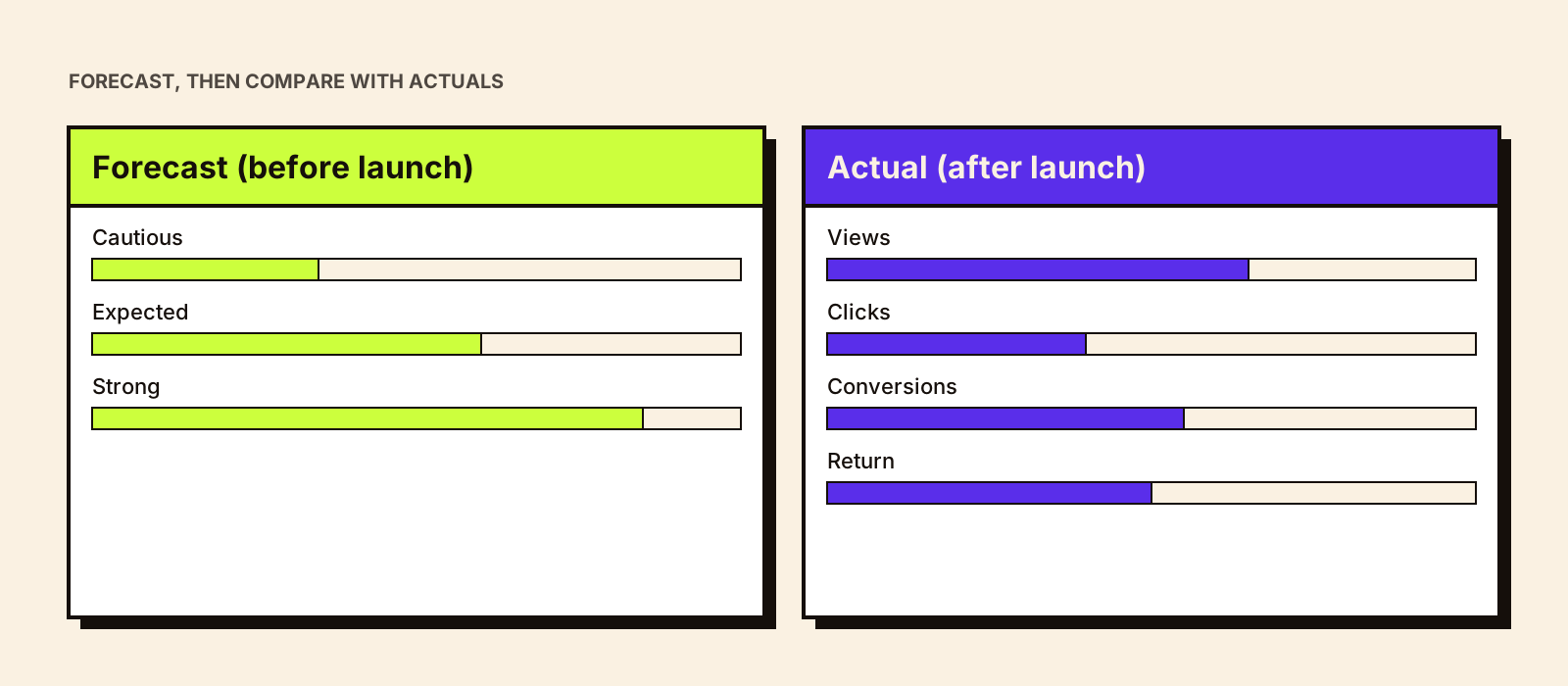
Finance teams rarely approve creator budgets on enthusiasm alone. They want to know what the money might return. Nobody can predict creator results precisely, but a good forecast makes the assumptions visible, gives a sensible range, and sets up a clean comparison after launch so the next budget decision is based on evidence.
Quick answer
Forecast influencer ROI by building three scenarios (cautious, expected, strong) from explicit assumptions: expected views per creator, click-through rate, conversion rate, average order value and gross margin, plus total campaign cost. Take assumptions from your own past campaigns first, then creator-provided insights, then paid social benchmarks from your own ad account. Present a range, not a single number, include value that won't show in tracked sales, and compare actuals with the forecast after launch to decide where to increase, hold or cut spend.
The forecast chain
Expected views (sum across creators)
× click-through rate   = visits
× conversion rate      = orders (or leads)
× average order value  = revenue
× gross margin         = gross profit
− total campaign cost  = return
Return ÷ cost          = ROI
For lead campaigns, replace orders with qualified leads and apply your lead-to-customer rate and customer value. For awareness campaigns, forecast reach in the target audience and cost per thousand reached instead of revenue.
Where assumptions should come from
| Assumption | Best source | Fallback |
|---|---|---|
| Views per creator | Creator-provided insights for similar recent content | Median of recent posts, not the best one |
| Click-through rate | Your past creator campaigns | Your own paid social click rates, adjusted down for organic |
| Conversion rate | Your site or app conversion for similar traffic | Your paid social conversion rate |
| Average order value | Your data for the promoted product | Price of the hero product |
| Gross margin | Finance | Product-level margin estimate |
There are no reliable universal benchmarks for creator click-through or conversion rates in India; categories, formats and offers vary too much. Use your own numbers where you have them, and say clearly where you don't.
Forecast calculator
Influencer ROI forecast calculator
Build three scenarios from your own assumptions. It runs in your browser and nothing is saved or sent anywhere.
Cautious scenario
Across all creators
Views to site visits
Visits to orders
Expected scenario
Across all creators
Views to site visits
Visits to orders
Strong scenario
Across all creators
Views to site visits
Visits to orders
Shared inputs
For the promoted product
From finance
Creators, agency, production, media
Enter campaign cost, average order value and at least one scenario to see the forecast.
Tracked sales only. Content reused in ads, search lift, marketplace sales and later purchases won't appear here, so treat the result as a floor and compare it with actuals after launch.
Presenting the forecast
- Show all three scenarios and the assumptions behind each.
- Say which assumptions are measured and which are estimates.
- Separate tracked return from value that won't be tracked: content reused in ads, search lift, marketplace sales.
- Agree the decision rule in advance: what result would lead to scaling, holding or stopping.
- Set the measurement window to the product's buying cycle.
How to measure the result afterwards is covered in how to measure influencer marketing ROI for Indian brands.
Forecast vs actual: where to increase spend
After launch, compare each assumption with what happened. The gap tells you what to change, and it's more useful than the headline ROI.
| What happened | Likely meaning | Budget decision |
|---|---|---|
| Views on plan, clicks low | Weak call to action or unclickable format | Fix the brief and link placement before adding budget |
| Clicks on plan, conversions low | Landing page or offer problem | Fix the site, not the creators |
| A few creators far above plan | Strong creator-audience fit | Rebook them; amplify their content with paid media |
| Most creators below plan | Selection or targeting problem | Hold budget; revisit audience fit |
| Above plan on every step | Ready to scale | Increase spend in steps, watching efficiency |
Scale in steps rather than all at once: results from a few creators don't always hold as you add more. Budget splitting is covered in how to allocate your influencer marketing budget, and paid amplification of winners in influencer marketing for performance marketing.
Illustrative forecast
Illustrative example with hypothetical numbers. A skincare brand plans 10 creators for a new serum, expecting about 3,00,000 total views in the expected case. It uses a click-through rate and site conversion rate from its own last campaign, an average order value of ₹900 and a 60% gross margin, against a campaign cost of ₹4,00,000. The expected case shows a modest return on tracked sales alone; the cautious case shows a loss. The team agrees to proceed because the content will also be used in ads, and sets a rule: rebook and amplify creators whose tracked sales beat the expected case, and stop those below the cautious case.
Common mistakes
- Using a creator's best-ever post as the view assumption.
- Borrowing benchmark conversion rates from other markets or categories.
- Presenting one number instead of a range.
- Forgetting margin, so revenue is mistaken for return.
- Never comparing forecast with actuals, so forecasts never improve.
Conclusion
A useful influencer ROI forecast is a set of visible assumptions, three scenarios and a decision rule agreed before launch. Afterwards, the gaps between forecast and actual tell you where to fix, hold or scale, and each campaign makes the next forecast more reliable.