How Many Influencers Does a Brand Need for a Campaign?
Four ways to work out how many influencers a campaign needs (reach, learning, coverage and budget), how to combine them into one number, and a worked example you can copy.
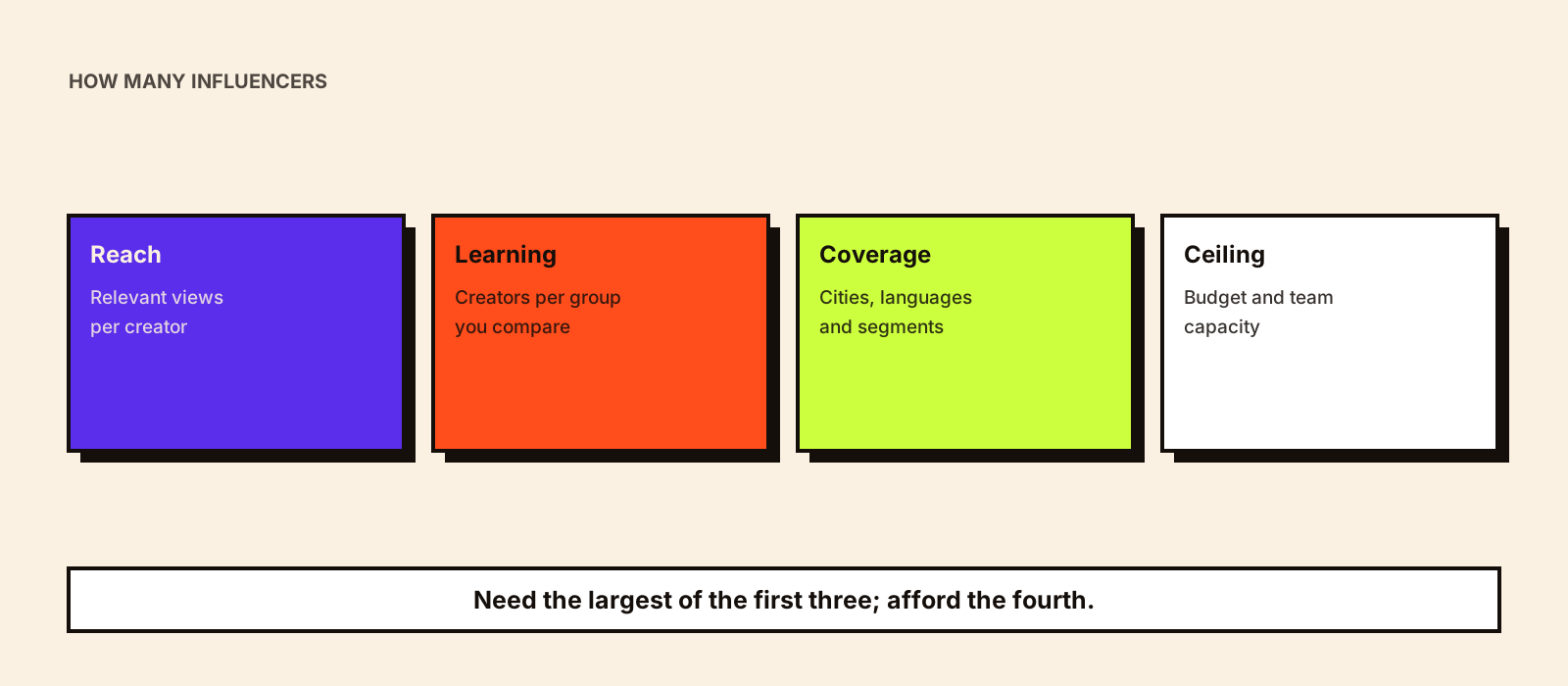
Ask an agency how many influencers you need and you'll hear anything from three to three hundred. They aren't necessarily guessing; they're each answering a different question. A launch that has to reach a city in one week, a test that has to show which creator type sells, and a regional campaign covering four languages all need different counts, even on the same budget.
Quick answer
There's no standard number. Work out four counts: how many creators it takes to reach enough of your target audience, how many you need to learn which creator types work, how many it takes to cover every city, language or segment you're targeting, and how many your budget and team can properly fund and manage. The campaign needs at least the largest of the first three, and can afford at most the fourth. If what you need is more than you can afford, narrow the scope (fewer markets, fewer creator types, one platform) rather than spreading the money thinner.
Count 1: reach
Use this when the objective is awareness or a launch window. Estimate from typical views per post, not followers, and only count viewers who match your customer.
Creators needed ≈ target audience reach ÷ (average views per post × share of viewers who match your customer)

Average views per post: from the creator's recent posts or insights screenshots, not follower count.
Share who match: from audience insights (location, age, gender, language) against your customer profile.
Add a margin for overlap: creators in the same niche often share followers.
Hypothetical example: you want about 1,50,000 views from women aged 25 to 40 in Bengaluru. Shortlisted micro-creators average about 30,000 views per Reel, and about half their viewers fit that profile, so each delivers roughly 15,000 relevant views. You need around ten creators, plus one or two more to allow for audience overlap. These numbers illustrate the arithmetic; use your own creators' figures.
Count 2: learning
Use this when the campaign has to tell you something: which creator type, message or format works. One creator per variable tells you about that creator, not about the type. Book enough creators per group that a single unusual post can't decide the result; three to five per group is a sensible planning minimum for a first test.
Creators needed = number of groups you're comparing × creators per group

Example: comparing educators, reviewers and lifestyle creators = 3 groups × 4 creators = 12 creators.
Testing fewer groups is usually better than testing many groups with one creator each.
How to design the comparison so the result means something is covered in influencer marketing testing.
Count 3: coverage
Use this when you sell in several cities, states, languages or customer segments. A Hindi-language creator in Lucknow and an English-language creator in Mumbai rarely reach the same buyers, and in the Gulf a Saudi creator seldom substitutes for an Emirati one. Each segment needs its own creators.
Creators needed = number of segments × minimum creators per segment

Segments: the cities, languages or customer groups the campaign must reach.
Minimum per segment: enough for the reach or learning goal in that segment, usually at least two so one creator isn't a single point of failure.
Regional planning in India is covered in regional and vernacular influencer marketing, and multi-market planning across the Gulf in the GCC influencer marketing playbook.
Count 4: budget and capacity
This is the ceiling. Budget sets how many creators you can pay properly, and team capacity sets how many you can manage properly.
- Budget ceiling = (budget minus non-creator costs) ÷ real cost per creator. Real cost per creator is the fee plus usage rights, product, shipping, production and that creator's share of management time, not the quoted fee alone.
- Capacity ceiling = hours available ÷ hours per creator. Time how long one creator takes your team from first message to final payment (sourcing, negotiation, contract, brief, review, publishing checks, payment, reporting) and divide your team's available hours by it.
- The lower of the two is your ceiling. If you use an agency, the capacity ceiling moves to them, and so does part of the cost.
How to work out the real cost per creator, with a calculator for your own quotes, is in influencer campaign costs in India. Splitting the budget across tiers and creator types is covered in how to allocate your influencer marketing budget.
Putting the four counts together
| Count | Hypothetical skincare launch, Instagram, two cities | Result |
|---|---|---|
| Reach | 1,50,000 relevant views per city; about 15,000 per creator | About 10 per city, 20 in total |
| Learning | Compare dermatology educators with skincare reviewers, 4 each | 8 |
| Coverage | 2 cities × at least 2 creators | 4 |
| Need | The largest of the three | 20 |
| Budget ceiling | ₹6,00,000 after non-creator costs ÷ about ₹40,000 real cost per creator | 15 |
| Capacity ceiling | Agency managing the campaign | Not the constraint |
| Decision | Need (20) exceeds budget (15) | Launch in one city with 10 creators plus learning groups, or lower the reach target |
Hypothetical figures, for the method only. The decision row is the point: when the counts disagree, cut scope rather than buying twenty creators' worth of reach with fifteen creators' worth of money. Keep a short reserve list of approved creators too, because some will decline, miss dates or drop out.
One big creator or many small ones?
The same money can buy one larger creator or several smaller ones. One larger creator gives concentrated reach on one date with one approval cycle; several smaller creators give more voices, more content, more segments and a way to compare. Neither is better in general. Choose by the count that matters most for your objective: reach favours fewer, larger creators if their audience genuinely matches; learning and coverage favour more, smaller ones. Micro vs macro influencers compares the tiers in detail.
Typical campaign shapes
| Campaign | Which count usually decides | Shape |
|---|---|---|
| First test | Learning | Two or three creator groups, several creators each, one platform |
| Product launch | Reach in the launch window | A few larger creators for visibility plus a wider group for proof after launch |
| Regional or multi-city | Coverage | A small cluster of creators per city or language |
| UGC for ads | Learning, applied to creatives | Enough creators and hooks to test in paid social; their audience size matters less |
| Always-on program | Budget and capacity | A small core rebooked monthly, a rotating group and a test slot |
Common mistakes
- Counting followers instead of typical views from the right audience.
- Booking one creator per creator type, then drawing conclusions about the type.
- Picking a creator count first and fitting the budget to it.
- Ignoring the hours each creator takes, so content review and payments slip.
- No reserve list, so a dropout leaves a gap in a launch window.
Conclusion
The right number of influencers is the smallest count that meets your reach, learning and coverage needs, within what your budget and team can handle well. Work out all four, let the binding constraint decide, and narrow the scope when the numbers don't fit rather than spreading a budget across more creators than it can support.