Creator Campaign Testing: How Brands Can Test Different Creators, Content and Approaches
A practical experimentation framework for creator campaigns: hypotheses, one variable at a time, baselines, test and comparison groups, success criteria, measurement windows, what can realistically be tested and the limits of influencer testing.
'Micro creators work better for us.' 'Hindi content converts better.' 'Unboxings don't work.' Most brands carry beliefs like these from one or two campaigns where many things changed at once. Testing is how you find out which beliefs are true for your brand, without pretending every creator campaign is a laboratory.
Quick answer
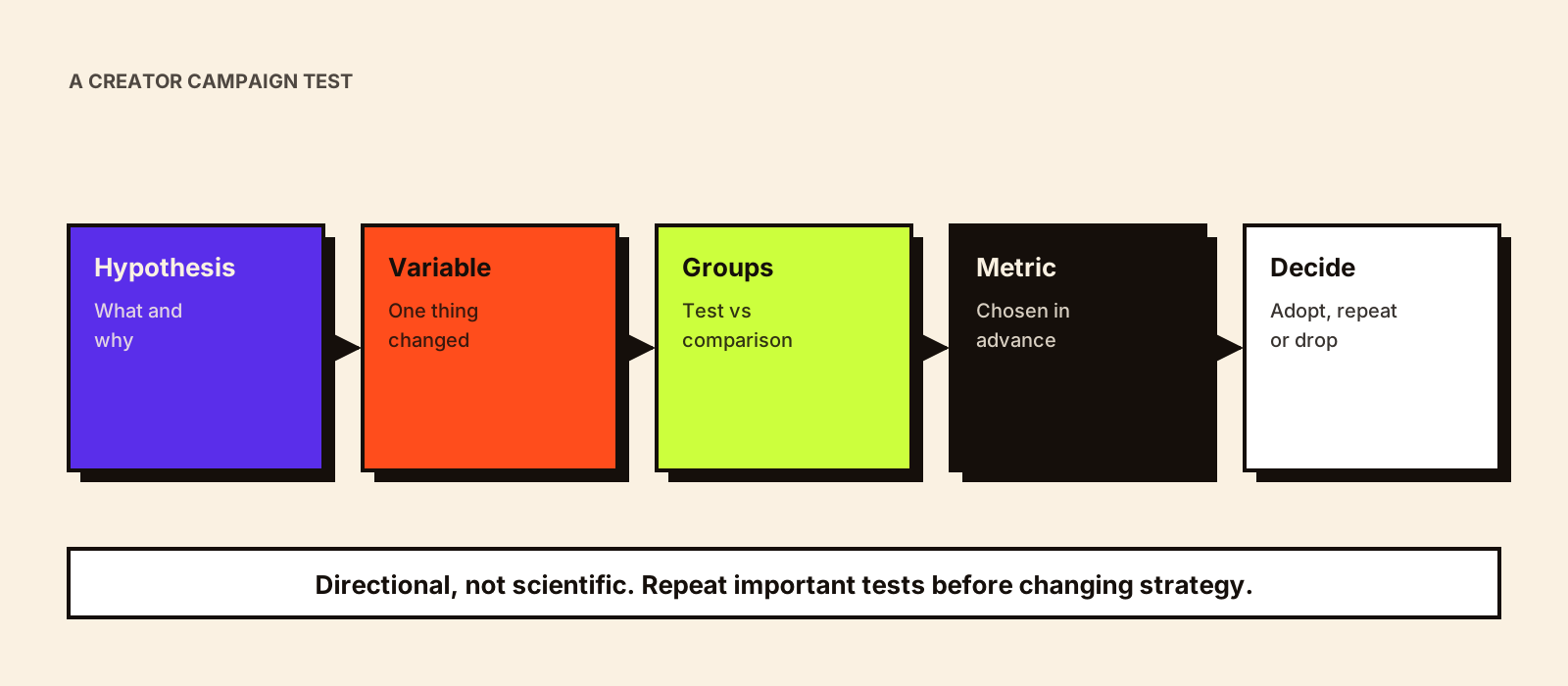
To test in influencer marketing, write a specific hypothesis, change one main variable (creator tier, creator type, format, hook, angle, CTA, platform or timing) while keeping others as similar as possible, run it across enough creators to see a pattern, compare against a baseline or comparison group on a success metric agreed in advance, measure over a fixed window and decide what to do next. Creator tests are rarely statistically rigorous: creators differ, audiences differ and samples are small. Treat results as directional evidence and confirm important ones with a repeat test.
The anatomy of a creator test
| Element | What it means | Example |
|---|---|---|
| Hypothesis | What you expect and why | Showing the product in the first 3 seconds will raise saves per view, because viewers know immediately what it is |
| Variable | The one thing you change | Product timing in the hook |
| Baseline / comparison | What you compare against | Similar creators briefed with the usual structure |
| Test group | Creators who get the change | 6 micro skincare creators, Hindi |
| Comparison group | Similar creators without the change | 6 similar creators, usual brief |
| Success metric | One metric, decided in advance | Median saves per 1,000 views at day 7 |
| Measurement window | Fixed capture days | Day 7 for all posts |
| Decision rule | What result leads to what action | If clearly higher, make it the default brief suggestion |
What you can test
| Variable | How to test it | Watch out for |
|---|---|---|
| Creator tier | Comparable budgets across tiers in the same niche | Different roles; judge on matching metrics |
| Creator type | Experts vs everyday users vs entertainers on one brief | Audience differences |
| Language / region | Same brief in different languages or states | Offer and delivery differences by region |
| Format | Reel vs carousel vs long-form, same creators where possible | Platform algorithms treat formats differently |
| Hook or opening | Two suggested openings across similar creators | Creators interpret suggestions differently |
| Product angle | Price vs results vs routine vs problem-solution | One angle per creator |
| CTA and offer | Code vs link; discount vs bundle | Offer changes affect everything downstream |
| Platform | Instagram vs YouTube for the same objective | Different metrics and timelines |
| Timing | Before vs during a sale or festival | External factors |
Practical ways to run tests
Split a campaign
Divide a campaign's creators into two similar groups and give each a different version of one variable. Keep tiers, niches and regions as balanced as you can.
Wave testing
Run a first wave with two approaches, then brief the second wave with the winner. This uses the campaign itself to learn, though timing differences between waves can affect results.
Creator-led variations
Some creators can test variations on their own channels; Instagram's Trial Reels let creators show a Reel to non-followers first and see how it performs before sharing with followers. Agree with the creator before asking for variations, as it's extra work.
Paid testing of creator content
Running several creator assets as ads with the same budget and audience is the most controlled test available, because distribution is held roughly constant. UGC for paid social covers ad testing.
The limits of influencer testing
- Creators aren't identical; their audiences, style and credibility differ, so creator differences can swamp the variable you're testing.
- Samples are small: six creators per group is a lot for a campaign and very little for statistics.
- Platform distribution varies post by post in ways you can't control.
- External factors (festivals, news, competitor activity) affect results.
- Attribution gaps mean some effects don't show in your tracking.
So use medians rather than averages, look for large and consistent differences rather than small ones, record confidence honestly and repeat important tests before treating the result as a rule.
A test plan template
TEST NAME: [ ]
HYPOTHESIS: If we [change], then [metric] will [improve] because [reason].
VARIABLE: [one thing]
KEPT CONSTANT: [tier, niche, region, offer, timing, capture day]
TEST GROUP: [creators]   COMPARISON GROUP: [creators or baseline]
SUCCESS METRIC: [one metric]   MEASURED AT: [day 7 / day 30]
DECISION RULE: If [clearly better], we [action]. If similar, we [action]. If worse, we [action].
CONFIDENCE AFTER RESULT: high / medium / low
NEXT STEP: [repeat / adopt / drop]
Hypothetical example
Hypothetical: a snack brand believes regional-language creators convert better than Hindi-national creators. It books eight Gujarati and Marathi creators and eight Hindi creators of similar tier and niche, with the same offer and timing, and compares median cost per delivered order at day 14. Regional creators come out clearly lower, but with only eight per group the brand labels it medium confidence and repeats the test in the next campaign with Tamil and Telugu creators before shifting most of its budget.
Reading test results fairly
- Compare on the metric chosen in advance, at the same capture day for every post.
- Use medians, so one viral post doesn't decide the result.
- Index each creator against their own usual performance before comparing groups.
- Check whether creator differences (audience, credibility, style) explain the gap better than the variable does.
- Record the result in your learnings register with an honest confidence level.
Influencer benchmarking and influencer performance data explain baselines and indexes, influencer content performance covers tagging content variables, and influencer data analytics includes the learnings register.
Testing in Indian campaigns
- Language and region are often the most useful variables to test; national results can hide large regional differences.
- Keep the offer and delivery coverage identical across regions you compare.
- Avoid comparing festival-period posts with normal-period posts.
- For cash-on-delivery-heavy categories, compare delivered orders, not placed orders.
Common mistakes
- Changing several variables at once.
- Choosing the success metric after seeing the results.
- Declaring winners from tiny differences.
- Ignoring creator differences that explain the result.
- Never repeating tests before changing strategy.
Conclusion
Testing replaces assumptions with evidence. Write a hypothesis, change one variable, compare against a baseline on a metric chosen in advance, measure at a fixed point, and be honest about confidence. Influencer tests are directional rather than scientific, but a sequence of well-designed tests is how a creator programme gets better campaign after campaign. Influencer campaign optimization shows how tests fit the wider cycle.