How to Decide Whether to Scale, Pause or Stop an Influencer Marketing Campaign
A decision framework for creator campaigns: rules to set before launch, the evidence for scaling, fixing, pausing or stopping at creator, campaign and program level, and how to turn a report into decisions someone owns.
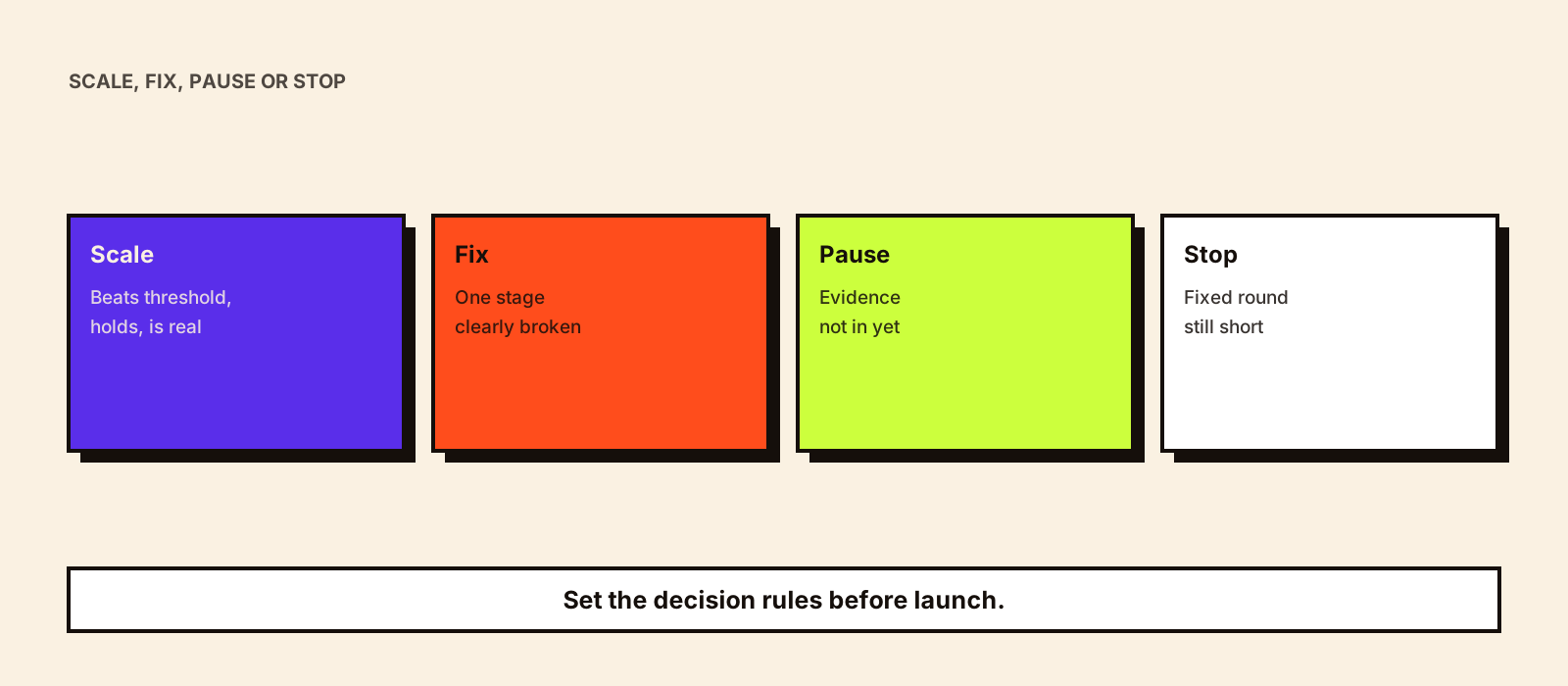
Most creator campaigns end with a report and no decision. The numbers are mixed, nobody agreed beforehand what 'good' looked like, and the next campaign gets planned on instinct. The fix is to decide the decision rules before launch, so the report has something to answer.
Quick answer
Set decision rules before launch: the primary KPI, the threshold that counts as success (usually your break-even cost per result), the minimum sample and the measurement window. At the review, scale when results beat the threshold, hold across more than one creator and survive a comparison with a baseline. Fix when one identifiable stage is broken. Pause when the evidence isn't in yet or something outside the campaign is distorting it. Stop when a well-measured, fixed round still falls clearly short. Make the decision at creator, campaign and program level separately, and write down who owns each action.
Set the decision rules before launch
| Rule | Example |
|---|---|
| Primary KPI | Cost per delivered first order |
| Success threshold | At or below break-even cost per order, including returns |
| Minimum evidence | At least 8 creators and 100 orders before judging the approach; individual creators judged on their own results only after 2 posts |
| Measurement window | Day 14 after each post, and campaign total at day 30 |
| Comparison | Last 8 weeks of baseline sales in the same regions |
| Who decides | Growth lead, with finance sign-off above a stated budget |
These example thresholds are illustrative; set yours from your margins and history. Break-even ROAS for influencer campaigns shows how to calculate the threshold, and creator campaign testing covers designing the first round as a test.
Scale, fix, pause or stop
| Decision | When the evidence shows | What to do |
|---|---|---|
| Scale | Results beat the threshold; hold across several creators or rounds; look real against a baseline or holdout; unit costs stay within margin | Increase in steps, add similar creators, keep a comparison group |
| Fix | Most stages work but one is clearly broken (tracking, call to action, landing page, offer) | Change that one thing and run another round |
| Pause | Too little data yet, a stock or delivery problem, a sale or festival distorting results, or a brand-safety issue being investigated | Hold new bookings; keep measuring; set a date to decide |
| Stop | A fixed, well-measured round is still clearly below threshold; or creators don't fit the brand or rules | Finish contracted work properly, record the learnings, move budget |
Decide at three levels
- Creator: rebook, rebrief or drop each creator on their own results against the threshold, with a minimum sample. Creator performance scorecards keep this consistent.
- Campaign: was the approach (format, offer, audience, market) worth repeating, judged on the whole group of creators rather than the best one?
- Program: is creator marketing earning its share of the budget against other channels? This needs incrementality evidence, not just attributed sales.
A campaign can fail while two creators in it succeed, and a program can be worth funding even when one campaign misses. Keep the three decisions separate. The program-level evidence is covered in influencer marketing incrementality.
Turning a report into decisions
A report describes what happened. A decision log says what you'll do about it, how sure you are and who's responsible. Add one to the end of every campaign report.
Finding | Evidence (measured / estimated / assumed) | Sample | Decision (scale / fix / pause / stop) | Owner | Review date

Example (hypothetical):
Regional-language creators delivered orders at 30% lower cost than Hindi-national creators | Measured, codes and links deduplicated | 8 vs 8 creators, 210 orders | Scale regional to 60% of next budget, keep 40% as comparison | Growth lead | After next campaign's day-30 read
- Every finding gets a decision, even if the decision is 'no change'.
- Label evidence honestly: measured, estimated or assumed.
- Name an owner and a date, or the decision won't happen.
- Read last campaign's log before planning the next one.
Reporting itself is covered in how to create an influencer marketing report, and the review meeting in influencer campaign post-mortems.
Before a big step up in budget, an influencer marketing audit checks that results, tracking, rights and compliance can carry the extra weight.
Scaling without breaking what worked
- Increase in steps, for example doubling rather than multiplying by ten, and re-read results after each step.
- Expect diminishing returns: the best-fit creators are booked first, so the next ones may perform less well.
- Check creator supply: are there enough similar creators in the market and language?
- Watch frequency: as more creators reach overlapping audiences, the same people see the message repeatedly.
- Keep a comparison group or region so you can see whether results still hold.
- Check operations: briefing, approvals, payments and rights must handle more creators.
Pausing and stopping properly
- Check contracts before pausing: posting dates, cancellation terms and fees already earned.
- Pay creators for completed work on time; a stopped campaign is not a reason to delay payment.
- Track usage rights, so paused or stopped content isn't run beyond what was licensed.
- Retire codes and update landing pages, so old links don't lead to dead offers.
- Tell creators why, briefly; good creators will want to work with you again.
Cancellation terms and how to end a campaign fairly are covered in influencer campaign cancellation.
Hypothetical example
Hypothetical. A home-fragrance brand runs 12 micro-creators for four weeks with a break-even cost per delivered order of ₹900. Overall cost per order is ₹1,150, above threshold. But five creators who showed the product in use in a real room came in at ₹700, while seven who posted styled flat-lays came in at ₹1,500. The campaign-level decision is 'fix': the next round briefs every creator for product-in-use content. The creator-level decision is 'rebook' for four of the five and 'stop' for the flat-lay creators with no sign of improvement. The program decision waits for the second round and a regional comparison.
Common mistakes
- Setting the success threshold after seeing results.
- Scaling on one viral post.
- Stopping a campaign whose tracking was broken.
- Judging a program on one campaign, or a campaign on one creator.
- Reports with findings but no owners or dates.
Conclusion
Decide the decision rules before launch, then let the evidence choose between scale, fix, pause and stop, separately for creators, campaigns and the program. End every report with a decision log, so the next campaign starts from what you learned rather than from scratch.