How to Calculate Break-Even ROAS for Influencer Campaigns in the GCC
How to work out the return on ad spend an influencer campaign needs just to cover its costs: defining revenue, attributable revenue, spend and contribution margin; how VAT, discounts, returns, cash-on-delivery refusals, shipping and commissions change the answer; and worked examples in AED and SAR.
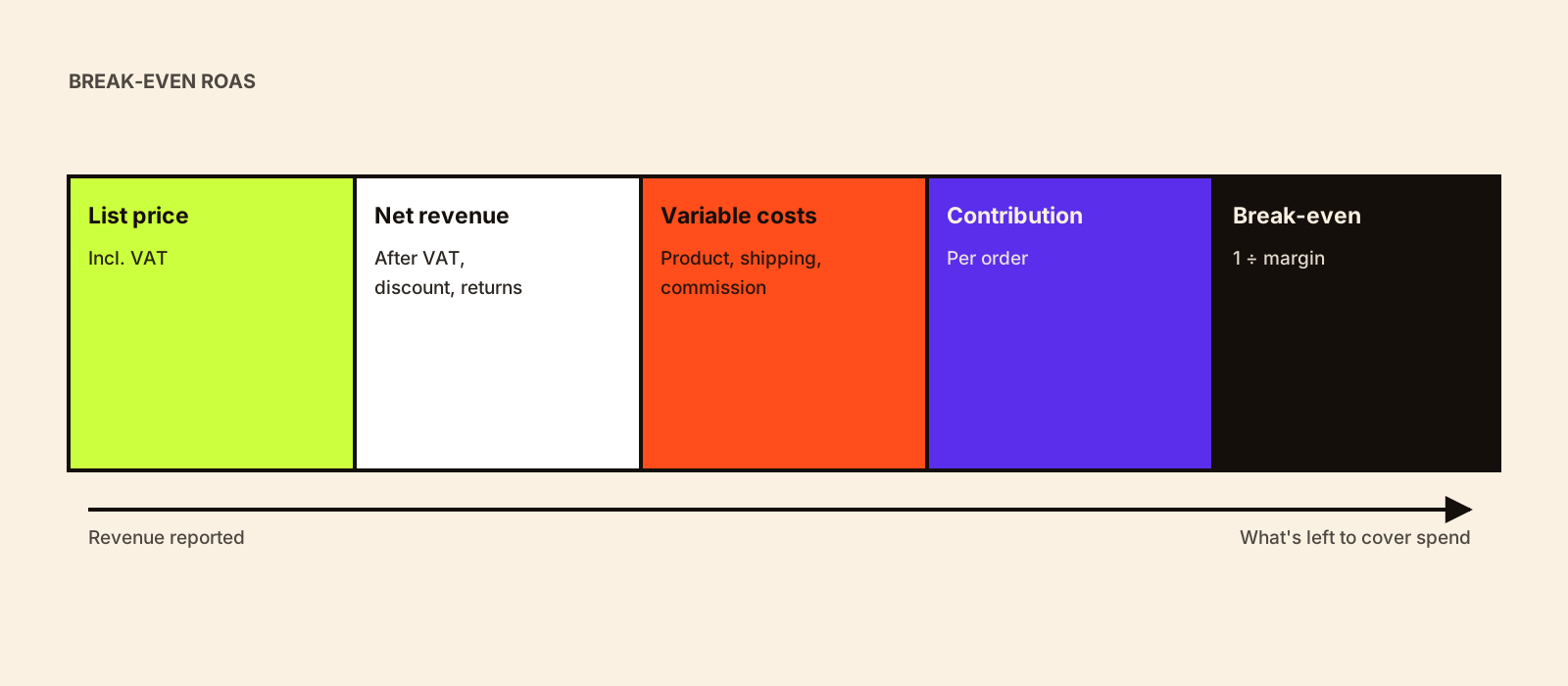
A creator campaign reports a 3x ROAS and everyone is pleased. Whether that's actually profitable depends on what 'revenue' included, what was left after product costs, delivery, returns and commissions, and which costs counted as 'spend'. Break-even ROAS answers a simpler question first: how much attributed revenue does each dirham or riyal of spend need to bring back before the campaign stops losing money?
Quick answer
Break-even ROAS is the return on ad spend at which a campaign's contribution exactly covers its spend. Calculate it as 1 divided by your contribution margin, measured on the same revenue basis your ROAS uses. If each AED 1 of net revenue (after VAT, discounts and returns) leaves AED 0.40 after product, delivery, payment and commission costs, break-even ROAS on net revenue is 1 ÷ 0.40 = 2.5. If your reports use revenue including VAT or placed cash-on-delivery orders, the break-even figure is higher. ROAS above break-even means the campaign contributes profit before overheads; it isn't the same as ROI.
Define the terms first
| Term | Definition for this calculation |
|---|---|
| Gross revenue | What customers paid, including VAT and before returns |
| Net revenue | Revenue excluding VAT, after discounts and after returns and refunds |
| Attributable revenue | Net revenue from orders credited to the campaign under your attribution method (links, codes, window) |
| Spend | Fixed campaign costs: creator fees, production, usage rights, paid amplification and agency fees |
| Variable costs per order | Product cost, shipping, payment fees, returns handling and any commission paid per sale |
| Contribution per order | Net revenue per order minus variable costs per order |
| Contribution margin | Contribution per order ÷ net revenue per order |
| ROAS | Attributable revenue ÷ spend (state which revenue basis you use) |
Commissions are a variable cost because they rise with each sale; flat creator fees are spend. Mixing them up is one of the most common reasons break-even calculations are wrong.
The formula
- Break-even ROAS (on net revenue) = 1 ÷ contribution margin
- Break-even ROAS (on any other revenue basis R) = R per order ÷ contribution per order
- Campaign contribution = attributable net revenue × contribution margin − spend
- Campaign ROI = campaign contribution ÷ spend
Worked example: UAE online store (AED)
Illustrative figures only, not benchmarks or client data. A product lists at AED 315 including 5% VAT, so AED 300 excluding VAT. The creator's code gives 10% off, leaving net revenue of AED 270 per order. Product cost is AED 90, shipping and payment fees AED 25, an allowance for returns of 8% of net revenue (AED 21.60), and a 10% affiliate commission on net revenue (AED 27).
| Line | AED per order |
|---|---|
| Net revenue (after VAT and code discount) | 270.00 |
| Product cost | −90.00 |
| Shipping and payment fees | −25.00 |
| Returns allowance (8%) | −21.60 |
| Affiliate commission (10%) | −27.00 |
| Contribution per order | 106.40 |
| Contribution margin | 39.4% |
- Break-even ROAS on net revenue: 270 ÷ 106.40 = 2.54
- If ROAS is reported on revenue including VAT (AED 283.50 per order after the discount): 283.50 ÷ 106.40 = 2.66
- If 10% of cash-on-delivery orders are refused and each refusal costs AED 15 in return shipping, expected contribution per placed order is 0.9 × 106.40 − 0.1 × 15 = AED 94.26, so break-even ROAS on placed-order revenue is 270 ÷ 94.26 = 2.86
The same campaign has three different break-even figures depending on how revenue is counted. Agree the basis before anyone reports ROAS.
Worked example: Saudi online store (SAR)
Illustrative figures only. A product sells for SAR 230 including 15% VAT, so SAR 200 excluding VAT, with no discount code. Product cost is SAR 70, shipping and payment SAR 22, and a returns allowance of 5% (SAR 10). Contribution per order is SAR 98, a 49% margin, so break-even ROAS on net revenue is 1 ÷ 0.49 = 2.04, or 230 ÷ 98 = 2.35 on revenue including VAT.
Now the campaign: spend of SAR 20,000 (creator fees, rights and boosting) produces SAR 50,000 of attributable net revenue. ROAS on net revenue is 2.5, above the 2.04 break-even. Contribution is 50,000 × 0.49 = SAR 24,500; minus SAR 20,000 spend leaves SAR 4,500 before overheads, an ROI of 4,500 ÷ 20,000 = 22.5%.
What moves break-even ROAS
| Factor | Effect |
|---|---|
| Bigger discount codes | Lower net revenue per order, so break-even rises |
| Higher return or refusal rates | Lower contribution, so break-even rises |
| Commission instead of flat fees | Moves cost from spend into variable costs; lowers margin but also lowers fixed spend |
| Free shipping thresholds | Can raise order value, or add cost to small orders |
| VAT basis | Reporting on VAT-inclusive revenue makes ROAS look higher than on net revenue |
| Repeat purchases | Not in first-order break-even; account for them in customer value |
ROAS, profit and ROI aren't the same
- ROAS: attributable revenue ÷ spend; says nothing about costs
- Break-even ROAS: the ROAS at which contribution equals spend
- Contribution or profit: what's left after variable costs and spend
- ROI: profit ÷ spend (or total investment), usually as a percentage
A campaign can have a high ROAS and still lose money if margins are thin or returns are high. The full ROI method, including incrementality, is in how to measure influencer marketing ROI, and forecasting before launch in influencer marketing ROI forecasting.
Attribution limits
Tracked revenue usually undercounts creator impact, because some buyers search later, buy on marketplaces or buy in store. Use break-even ROAS as a floor test on tracked revenue, and look at overall sales and branded search for the wider effect. When comparing several GCC markets, calculate break-even per market in its own currency with its own VAT and costs; see GCC influencer campaign reporting.
Common mistakes
- Calculating ROAS on VAT-inclusive revenue and break-even on net revenue
- Counting placed cash-on-delivery orders as revenue
- Treating commissions as spend, or leaving them out
- Forgetting usage rights and boosting in spend
- Calling a ROAS above 1 'profitable'
Conclusion
Break-even ROAS turns a vague 'is 3x good?' into a clear test. Define revenue and spend, calculate contribution margin honestly, including VAT, discounts, returns, refusals and commissions, and agree the basis before reporting. Then judge every creator and every market against the line that actually matters.