How to Run a Pilot Influencer Campaign Before Committing a Full Budget
A pilot is a small campaign designed to answer one question before you spend more: does this work for us, with these creators, on this platform? How to scope it, set pass marks before launch, measure it and decide whether to scale, change or stop.
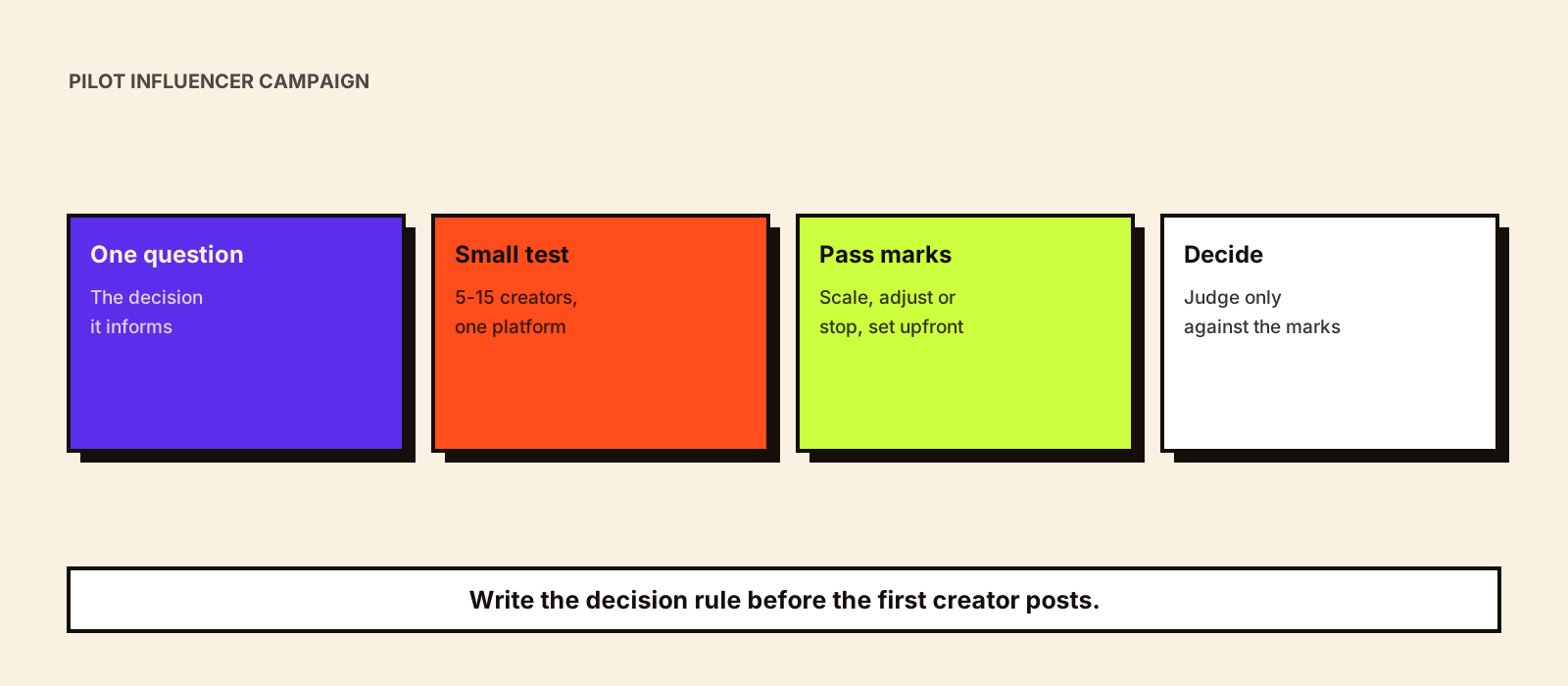
Most brands that try influencer marketing once and give up didn't run a test. They ran a small campaign with no agreed question and no pass mark, then argued about the results afterwards. A pilot is different because the decision rule is written down before the first creator posts.
Quick answer
A pilot influencer campaign is a deliberately small campaign built to answer one business question before you commit a larger budget. Pick the question (for example, 'can micro-creators drive first orders at a cost we can afford?'), choose enough creators for the answer to mean something, usually somewhere between five and fifteen, and run it long enough to capture delayed purchases. Before launch, write down the result that would make you scale, the result that would make you change something, and the result that would make you stop. Then judge the pilot only against those marks.
What a pilot is, and what it isn't
A pilot is a test with a decision attached. It isn't a cheaper version of a full campaign, and it isn't a single post from one creator. One creator tells you about that creator, not about influencer marketing for your brand. A pilot also isn't the place to test everything at once: if you change the platform, the creator tier, the offer and the landing page together, a good or bad result can't be traced to any of them.
- One primary question, with one primary metric that answers it.
- A creator group large enough that a single outlier doesn't decide the result.
- A fixed budget, timeline and creative approach agreed before outreach starts.
- Pass marks written down in advance and shared with whoever approves the next budget.
- A measurement setup that works before the first post, not after it.
When a pilot makes sense
| Situation | Pilot? | Why |
|---|---|---|
| First influencer campaign for the brand | Yes | You have no baseline, so the pilot creates one |
| New platform, market or creator tier | Yes | Past results on another platform or market don't transfer reliably |
| New agency or new in-house team | Usually | Tests the working process as well as the results |
| Product launch with a fixed date | Rarely | A launch can't wait for test results; plan a launch campaign and learn from it instead |
| Always-on program that already works | No | Use ongoing creator and content tests inside the program instead |
For tests inside a running program, such as comparing hooks or creator types, see creator campaign testing. The difference is scope: a pilot decides whether to invest, ongoing tests decide how to invest better.
Step 1: Choose the one question the pilot must answer
Write the question as a decision the business will actually make. 'Does influencer marketing work?' is too broad to answer. 'Can Instagram micro-creators in Bengaluru and Pune bring first-time customers at a cost per first order below what we pay on Meta ads?' can be answered, and it tells you what to measure.
| Business question | Primary metric | Typical supporting metrics |
|---|---|---|
| Will creators bring new customers profitably? | Cost per new customer (or per first order) | Code and link orders, new vs returning split, average order value |
| Will creators build awareness in a new market? | Brand lift or branded search change against a comparison market | Unique reach, completed views, saves and shares |
| Can creator content beat our current ad creative? | Cost per result when the content runs as ads | Thumb-stop rate, hold rate, click-through rate |
| Can we generate qualified B2B leads? | Cost per qualified lead or meeting | Form fills, demo requests, lead-to-meeting rate |
Step 2: Size the pilot so the answer means something
There's no universal minimum, but a few rules keep a pilot honest. Use enough creators that removing your best performer doesn't flip the conclusion; for most consumer brands that means at least five, and more if you're testing low-cost micro or nano creators. Keep creators within one tier and one platform unless the comparison between them is the question. Run long enough to catch delayed purchases: two to four weeks of tracking after the last post is a sensible floor for most consumer products, and longer for considered purchases.
Shortlisting for a pilot follows the same rules as any campaign. Build the list from audience fit, then check audience quality before you pay anyone; see building a creator shortlist and how to vet influencers.
Step 3: Set the pass marks before launch
Pass marks turn an argument into a decision. Base them on numbers you already trust, such as what a new customer is worth to you or what you pay per customer on other channels, rather than on industry averages. Write three outcomes:
| Outcome | Example rule (illustrative) | What happens next |
|---|---|---|
| Scale | Cost per first order at or below ₹900, from at least four of the eight creators | Roughly double the next wave, keep what worked, add similar creators |
| Adjust | Cost per first order between ₹900 and ₹1,400, or results driven by one or two creators | Change one thing (offer, creator type or brief) and run a second, similar-sized wave |
| Stop | Cost per first order above ₹1,400 with no creator below ₹900 | Pause; review audience fit and the offer before spending more |
The figures above are hypothetical and only show the shape of a rule. Yours should come from your own margins and channel costs.
Step 4: Budget the whole pilot, not just creator fees
Creator fees are only part of the cost. Include product and shipping for every creator, any paid usage or boosting, discount cost on tracked orders, agency or team time, and tools. If a pilot looks profitable only because team time was left out, the full campaign won't be. For what drives creator fees and how to build a budget from quotes, see influencer marketing campaign costs in India and how to plan an influencer marketing budget.
Step 5: Set up measurement before the first post
- A unique code and a tagged link for every creator, tested end to end before posting.
- A way to separate new customers from existing ones in your order data.
- A baseline: sales, sign-ups or branded search for the same weeks before the pilot, or a comparison city or segment that gets no creator activity.
- A cut-off date for counting results, agreed in advance, so late orders aren't argued about.
- Screenshots or exports of each creator's post insights, requested in the contract.
Codes and links undercount, because many people see a post and buy later without them. That's why the baseline or comparison group matters; influencer marketing incrementality explains how to estimate the sales creators actually added.
A worked example
Hypothetical. A D2C snack brand spends ₹3,00,000 in total on a pilot with eight Instagram micro-creators in two cities, including fees, product, shipping and team time. Over the posting window and three weeks after it, tracked codes and links bring 260 first orders. A comparison city with no creator activity shows no change in first orders, so the brand treats the tracked orders as a fair, if conservative, estimate.
| Measure | Calculation | Result |
|---|---|---|
| Cost per first order (tracked) | ₹3,00,000 ÷ 260 | About ₹1,154 |
| Creators below ₹900 per first order | Count from the per-creator table | 3 of 8 |
| Share of orders from top creator | Top creator's orders ÷ 260 | 38% |
| Decision against the pass marks | Between ₹900 and ₹1,400, and concentrated | Adjust |
The brand keeps the three best-performing creators, replaces the other five with creators closer to their audience profile, tests a stronger first-order offer and runs a second wave of the same size. That's what a pilot is for: a clear next step instead of a vague 'it sort of worked'.
Reading the results: scale, adjust or stop
- Look at the spread across creators, not just the total. A good total driven by one creator is a finding about that creator.
- Separate the creator from the content. If a creator's post did well as an ad but not organically, the content may be the asset, not the audience.
- Check what customers did next. If pilot customers rarely reorder, a good cost per first order may still be a poor investment.
- Scale in steps. Moving straight from eight creators to eighty changes the creator pool, the management load and the measurement; scaling, pausing or stopping a campaign covers how to grow in stages.
If you're deciding whether to scale an existing program rather than a pilot, run an influencer marketing audit first.
Pilot plan template
Business question: [the one decision this pilot informs]
Primary metric: [e.g. cost per first order]
Supporting metrics: [2-4 only]

Creators: [number], [tier], [platform], [cities or audience]
Creative approach: [one brief, one offer]
Budget: fees ₹[ ] + product and shipping ₹[ ] + paid usage ₹[ ] + discounts ₹[ ] + team or agency ₹[ ] = ₹[ ]

Timeline: posting window [dates]; results counted until [date]
Baseline or comparison: [previous period, or comparison city or segment]
Tracking: [codes, links, landing page, how new customers are identified]

Pass marks
- Scale if: [rule]
- Adjust if: [rule]
- Stop if: [rule]

Decision owner: [name]; review meeting on [date]
Common mistakes
- Running a pilot with one or two creators and treating the result as a verdict on the channel.
- Changing the brief, offer or creators halfway through, so the pilot no longer answers its question.
- Judging the pilot a week after posting, before delayed purchases arrive.
- Setting pass marks after seeing the results.
- Leaving product, shipping and team time out of the cost.
Conclusion
A pilot earns its budget by making the next decision obvious. Keep it to one question, use enough creators that the answer isn't luck, set your pass marks before launch and count results over a fair window. Then scale, adjust or stop, and write down why. If you want help setting one up, Kudozz plans pilots with the tracking and pass marks agreed upfront through its influencer campaign strategy service.