Influencer Campaign Optimization: How Brands Can Improve Campaign Performance
A practical optimization system for creator campaigns: the levers brands control before, during and after a campaign, how to decide what to change, the optimization cycle that improves each campaign, and a repeatable playbook.
Most influencer reports end with a page called 'learnings' that nobody acts on. The next campaign starts with a new brief, a new shortlist and the same assumptions. Optimization is the discipline of changing something on purpose because of what the last campaign showed, and checking whether the change worked.
Quick answer
Influencer campaign optimization means using what a campaign shows to change the things that most affect results: creator selection, the brief and creative angle, format and platform, the offer and call to action, timing, amplification and the landing experience. Some changes can be made while a campaign is live; most of the biggest gains come between campaigns. Work in a cycle: measure what happened, analyse why, change one or two levers, test where you can, and record what you learned for the next campaign.
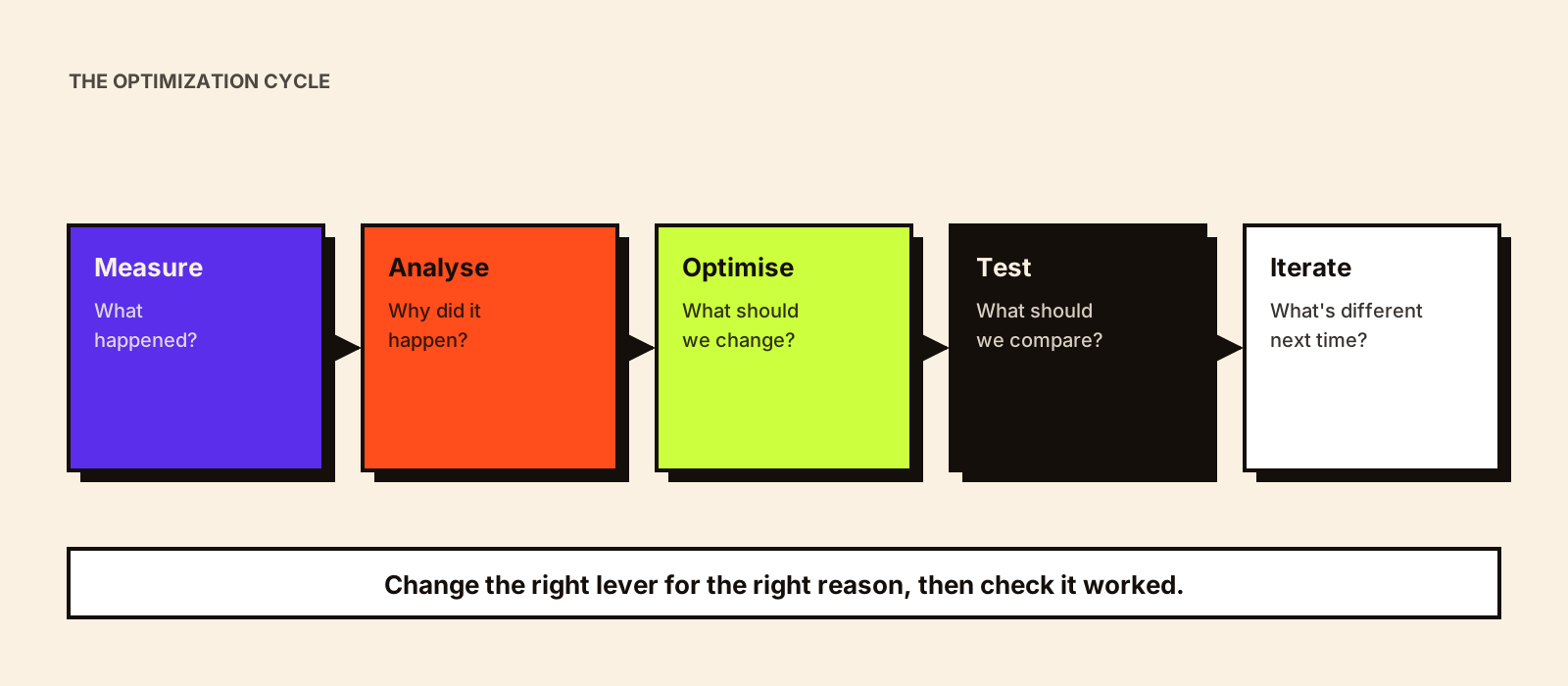
Measure, analyse, optimise, test, iterate
| Step | Question | Guide |
|---|---|---|
| Measure | What happened? | Influencer marketing KPIs; influencer marketing report |
| Analyse | Why did it happen? | Influencer data analytics; influencer content performance |
| Optimise | What should we change? | This guide; mid-campaign optimization |
| Test | What should we deliberately compare? | Influencer marketing testing |
| Iterate | What do we do differently next time? | Influencer campaign post-mortem |
Each step has a guide: influencer marketing KPIs, influencer data analytics, influencer content performance, mid-campaign optimization, influencer marketing testing and influencer campaign post-mortem. Measurement tells you what happened; optimization is about what you do with it.
The levers you control
| Lever | What it changes | When you can change it |
|---|---|---|
| Creator selection and mix | Who reaches which audience; role balance | Mostly before booking; reserve slots during |
| Brief and creative angle | What creators say and how | Before production; adjustments for later creators |
| Hook and opening | Whether people stop scrolling | Before production; reshoots only by agreement |
| Format and platform | Reels vs long-form vs Stories; Instagram vs YouTube | Before booking; extra deliverables by agreement |
| Offer and CTA | What people are asked to do and why now | Often during (codes, landing pages, offer terms) |
| Timing and sequence | When content lands relative to sales, festivals, launches | Before and during (go-live windows) |
| Amplification | Paid reach behind the best organic posts | During and after, with usage permissions |
| Landing experience | Page, price, stock, delivery | Any time; often the fastest fix |
| Tracking | Whether you can see what's working | Before launch; fixes during |
The last two levers sit outside the creator relationship and are often where weak results really come from. A great Reel sending people to a slow, English-only page with a sold-out product will look like a creator problem in the report.
How to decide what to change
1. Is the problem real? Compare with your baseline, same capture day, same objective.
2. Where in the funnel does it break? Reach → attention → engagement → click → conversion.
3. What's the likeliest cause at that point? (creator, content, strategy, distribution, measurement, offer)
4. Which lever addresses that cause, and can you change it now without breaking an agreement?
5. Change one or two things, not everything.
6. Decide in advance how you'll know if it worked.
When results are weak, influencer campaign underperformance has a diagnostic table for separating creator, content, strategy, distribution, measurement and offer problems.
Optimizing across campaign cycles
The biggest improvements usually come from changing the next campaign, not rescuing the current one. Treat each campaign as a version of the last:
| Carry forward | Change | Test |
|---|---|---|
| Creators who performed in their role | Creators who underperformed for reasons in their control | One new creator segment |
| Angles and hooks that worked | Brief points that confused creators | One new angle or format |
| Offer mechanics that converted | Landing pages or offers that leaked | One offer or CTA variation |
| Timing that worked | Approval or shipping steps that caused delays | A different timing window |
Keeping most things stable while changing a few is what lets you learn what actually caused a difference. Influencer marketing testing covers how to structure those comparisons.
A repeatable optimization playbook
BEFORE LAUNCH
□ One primary KPI and baseline agreed
□ Tracking (links, codes, capture days) set up and tested
□ Reserve creators and flexible budget identified
□ One or two test variables chosen deliberately

FIRST DAYS LIVE
□ Daily check of early signals: views, saves, shares, comments, clicks
□ Fix leaks: links, codes, landing page, stock
□ Identify standout content for amplification (if rights allow)
□ Adjust brief notes for creators who haven't posted yet

MID-CAMPAIGN
□ Rebalance remaining budget towards what's working, within agreements
□ Answer recurring audience questions in remaining content

AFTER
□ Results at fixed capture days; scorecards
□ Post-mortem: what to keep, change, test
□ Learnings register updated; next brief and shortlist adjusted
Mid-campaign optimization covers the live-campaign steps in detail, and influencer campaign post-mortem covers the after-campaign review.
Optimization in Indian campaigns
- Analyse by language and state: a campaign that looks average nationally may be strong in one region and weak in another.
- For cash-on-delivery-heavy categories, optimise on delivered orders, not placed orders.
- Marketplace sales may rise without showing in your link tracking; compare marketplace sales in campaign periods and regions against a baseline.
- Festival and sale periods distort comparisons; compare like with like.
- Regional landing pages and creator codes often lift conversion more than changing creators.
Measuring influencer campaign ROI covers attribution for marketplace sellers.
Common mistakes
- Changing creators, brief, offer and timing all at once, so nothing is learned.
- Judging content on day one when some formats build over weeks.
- Optimising for a vanity metric that isn't the campaign's objective.
- Blaming creators for landing page, offer or stock problems.
- Writing learnings nobody uses in the next brief.
Conclusion
Optimization is changing the right lever for the right reason and checking it worked. Know which levers you control at each stage, find where the funnel breaks before deciding what to change, change a few things at a time, test deliberately and carry learnings into the next campaign. Each cycle should make the next one better.