International Influencer Campaigns: A Repeatable Playbook for Localization, Contracts, Payments and Reporting
A repeatable process for running creator campaigns in several countries: what to keep global and what to localize, market rules and creator licensing, cross-border contracts, paying creators in multiple currencies, and one reporting framework that compares markets fairly.
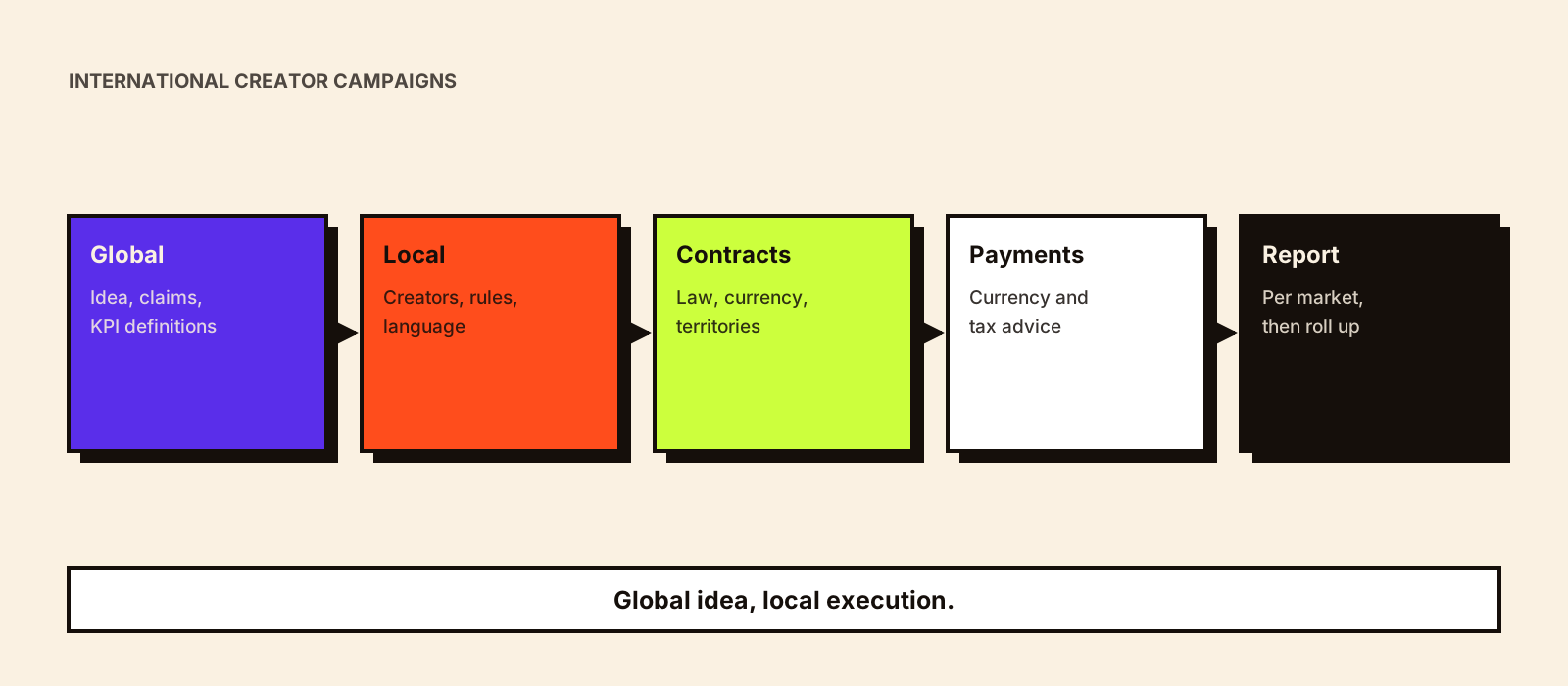
Running creators in several countries multiplies everything: creators, languages, rules, contracts, currencies and reports. Brands that do it well keep a small set of things global and localize the rest through a repeatable process. This playbook sets out that process. Market-specific comparisons, such as Australia, India and the UAE side by side, are in our cross-market guide.
Quick answer
Keep the objective, product truth, creative idea, KPI definitions and reporting template global. Localize creator selection, briefs, claims, disclosure wording, contracts, payments, timing and channel mix. Check each market's advertising and creator-licensing rules before booking. Contract in a clear governing law and currency, name territories in usage rights, take tax advice on cross-border payments, and report market by market against the same definitions.
Choosing which markets first
Most brands can't enter every market at once, and spreading a first international budget thinly across five countries rarely teaches anything. Score candidate markets on a few factors you can evidence, start with one or two, and add markets as each proves it works.
| Factor | Questions to answer | Evidence |
|---|---|---|
| Demand | Are people already searching for, buying or asking about the product there? | Site traffic and orders by country, marketplace data, enquiries |
| Ability to sell | Can you price, deliver, take payment and serve customers locally? | Logistics, payment and returns set up |
| Rules | Do product claims, sector rules or creator licensing make it slow or costly? | Market rules checked; licences such as the UAE permit or Saudi Mawthooq |
| Creator supply | Are there enough creators with audiences in the market and your category? | A test shortlist with audience-location data |
| Team capacity | Can someone brief, approve and moderate in the local language and time zone? | Named owner and reviewer |
| Cost to learn | Can a test of several creators fit the budget, with fees, tax and currency costs? | A costed test plan |
Market guides: influencer marketing in the UAE, the UK, Australia and Singapore, the GCC playbook for Saudi Arabia, Qatar, Kuwait and Oman, and diaspora creators for reaching communities abroad.
Global vs local
| Keep global | Localize |
|---|---|
| Objective and KPI definitions | Targets for each market |
| Product truth and approved claims (adjusted per market rules) | Wording, language and cultural references |
| Creative idea | Creators, formats and platforms |
| Brand safety standards | Disclosure wording and platform labels |
| Reporting template | Seasonal timing and posting times |
| Rights and record-keeping system | Contracts, currency and tax |
Translate meaning, not words: a joke or claim that works in one market can confuse or mislead in another. Local creators usually adapt the idea better than a translated script. For Australia, India and the UAE specifically, see influencer marketing across Australia, India and the UAE.
Local or international creators?
| Creator choice | Strengths | Check |
|---|---|---|
| Local creators in the market | Language, culture, credibility and audience location | More contracts and briefs to manage |
| International creators with a following in the market | One relationship, consistent content across markets | Audience-country share; local licensing rules (some markets require local permits or local contracting) |
| Diaspora creators (for example, Indian creators for Indian communities abroad) | Shared language and culture with a specific community | Where the audience actually lives; market rules |
For a market launch, local creators usually do the persuading and international creators add reach. Decide from audience-country data, not follower counts.
Creator partnerships across markets
A one-off international campaign can be run centrally. A creator partnership program that runs for a year across several countries needs a clear split of who decides what, or markets drift apart and reporting fragments.
| Operating model | Who does what | Fits when | Watch for |
|---|---|---|---|
| Central | One team sources, briefs, contracts and reports for every market | Two or three markets, similar languages, modest volume | Weak local judgment on creators, language and culture |
| Hub and spoke | Centre owns strategy, brand standards, rights, contracts template and reporting; each market sources creators, adapts briefs and reviews language | Several markets, an always-on roster, local partners or staff | Unclear decision rights; agree in writing who approves creators and content |
| Local-led | Each market runs its own program inside global guardrails | Large markets with their own teams and budgets | Inconsistent definitions and duplicated spend; keep one reporting template |
Local creator discovery and fit
- Set a minimum share of audience in the target country (from the creator's own insights) before shortlisting; a Dubai-based creator may have most followers elsewhere.
- Have a native speaker of the exact language variety review content: Gulf Arabic, Egyptian Arabic and Modern Standard Arabic are not interchangeable, nor are Hindi and regional Indian languages.
- Use the same selection scorecard in every market, with market-specific gates such as a valid licence or permit.
- Expect different platform mixes by market, and check platform availability (TikTok isn't available in India).
Market guides cover where to look: finding influencers in India, finding and vetting influencers in Australia, finding micro-influencers in Saudi Arabia and regional influencer marketing in the UK. The scorecard is in how to choose the right influencer.
The Middle East is several markets
The UAE and Saudi Arabia license creators differently: the UAE requires an advertiser permit, and Saudi Arabia a Mawthooq licence from GAMR. Audiences, languages, platforms, seasons and working weeks also differ from one Gulf country to the next. Plan, contract and report each country separately, even when one regional team runs them. See Saudi Arabia vs the UAE, and our guides to Qatar, Kuwait and Oman.
Pricing across markets
There is no reliable cross-market rate card, and fees don't convert by exchange rate: they reflect local demand, licensing, rights and the creator's own audience. Budget each market from quotes for your exact scope, and compare creators within a market before comparing markets. Market cost guides: India, the UK, Australia and Saudi Arabia.
Market rules and creator licensing
- Advertising rules and disclosure standards differ by market
- Some markets license creators: in the UAE, creators who advertise to UAE audiences need an advertiser permit, and visiting creators have a separate visitor permit
- Sector rules (health, finance, alcohol, food to children) vary widely
- Platform availability differs (for example, TikTok isn't available in India)
- Age rules differ (for example, Australia's under-16 account restrictions)
Sources and detail: the official visitor advertiser permit page, our UAE advertiser permit guide, and our market guides for the UAE, India and Australia.
For a UK launch, the rules, labels and sector restrictions are summarised in influencer marketing in the UK.
| Market | Disclosure and licensing to check | Guide |
|---|---|---|
| India | ASCI influencer guidelines: clear labels on paid, gifted or affiliate content | Influencer marketing in India |
| UAE | Advertiser permit for creators; visitor permit for visiting creators; clear ad disclosure | UAE advertiser permit |
| Saudi Arabia | Mawthooq licence; ads must be identifiable under the E-Commerce Law | Saudi influencer advertising rules |
| United Kingdom | CMA and ASA: ads must be obviously identifiable | UK influencer advertising rules |
| Australia | AANA code and Australian Consumer Law | Australian influencer advertising rules |
| Singapore | ASAS guidelines: identify marketing and disclose commercial relationships early | Singapore market page |
Guides: influencer marketing in India, the UAE advertiser permit guide, Saudi influencer advertising rules, UK influencer advertising rules, Australian influencer advertising rules and our Singapore market page. Rules change, so check each one before a campaign starts.
Cross-border contracts
- Governing law and dispute forum: say which country's law applies
- Currency and who bears exchange-rate movement
- Usage rights by named territory, not 'worldwide' unless you need it
- Market-specific disclosure and compliance obligations, including permits
- Tax clauses: who handles withholding or indirect tax, and what documents are needed
- Language: which version of the contract prevails
- Data: how personal data is shared across borders
Standard clauses are in the influencer marketing contract guide; local examples are in influencer contracts in Australia.
Paying creators in multiple currencies
- Agree the invoice currency in the contract; paying in the creator's currency is usually fairest
- Budget in each market's currency, and convert to a reporting currency at a stated rate
- Allow for transfer fees and exchange margins as a budget line
- Check withholding tax and indirect tax (GST or VAT) on cross-border services with a tax adviser; rules depend on both countries
- Collect tax and registration details at onboarding, not at invoice time
- Track payments in one system so finance can reconcile across markets
Payment operations are covered in the influencer payment process guide.
Global reporting
- Same KPI definitions in every market (what counts as a view, a click, a conversion)
- Report in local currency and a reporting currency, with the exchange rate stated
- Compare cost per result within each market before comparing markets
- Note differences that affect comparisons: platform mix, creator tier, season, price
- Keep one learnings log across markets
Converting everything to one currency doesn't make markets comparable. Prices, margins, media costs, platform mix, creator supply and seasons all differ, so a cost per order of ₹600 in India and AED 90 in the UAE can both be good or both be poor. Compare each market with its own benchmark first, then compare the indexes.
| Market (hypothetical) | Creator cost per order | Market benchmark: paid social cost per order | Index (creator ÷ benchmark × 100) |
|---|---|---|---|
| India | ₹600 | ₹750 | 80 (creators cheaper than the benchmark) |
| UAE | AED 90 | AED 80 | 113 (creators dearer) |
| UK | £18 | £20 | 90 |
Hypothetical figures. Read this as 'creators beat our own paid social in India and the UK, but not yet in the UAE', not as 'India is cheapest'. Also compare like with like: the same objective, the same attribution window, the same definition of an order (delivered and net of returns), and similar campaign maturity, since a first campaign in a new market rarely matches an established one. Engagement, reach, clicks, orders and revenue are different measures; don't rank markets on one and budget on another. A worked approach for Gulf markets is in GCC influencer campaign reporting.
The report structure is in how to create an influencer marketing report.
Working across time zones
Time zones cause more missed approvals than any other cross-border issue, mostly because deadlines get written as 'end of day' without saying whose day. The table shows how the markets brands most often combine with India line up.
| Market | Standard time (UTC) | Compared with India | Daylight saving | Usual weekend |
|---|---|---|---|---|
| India | UTC+5:30 | - | None | Sunday; Saturday varies by employer |
| UAE | UTC+4 | 1h 30m behind | None | Saturday and Sunday for government since 2022; many, not all, private firms follow |
| Saudi Arabia | UTC+3 | 2h 30m behind | None | Friday and Saturday |
| United Kingdom | UTC+0, or UTC+1 in summer | 5h 30m behind, or 4h 30m in summer | Late March to late October | Saturday and Sunday |
| Australia (Sydney, Melbourne) | UTC+10, or UTC+11 in summer | 4h 30m ahead, or 5h 30m in summer | Early October to early April in some states; not Queensland; Perth is UTC+8 | Saturday and Sunday |
| Singapore | UTC+8 | 2h 30m ahead | None | Saturday and Sunday |
The UAE government moved to a Saturday–Sunday weekend from January 2022, and Saudi Arabia moved to Friday–Saturday in 2013. Daylight-saving changes in the UK and Australia shift the gap with India by an hour twice a year, so check dates for campaigns that cross March, April, October or November.
- Write every deadline with a time and zone ('Thursday 17:00 GST'), never 'end of day'
- Schedule posts in each audience's local time, not head office time
- Set approval deadlines in the creator's time zone, and allow for working weeks and public holidays that differ by market
- Name an approver who is awake during each market's launch window, and a backup
- Use the overlap hours for live calls: an Indian morning overlaps with the Australian afternoon, and an Indian afternoon with the UK morning
- For a multi-market launch, go live in the easternmost market first and check each wave before the next market wakes up
- Keep one shared calendar showing every market's dates, holidays and blackout periods
- Agree response times for urgent issues, such as a disclosure correction, per market
Building the shared calendar is covered in the influencer campaign calendar.
Are you ready to expand?
- The product can be bought or delivered in the new market, with local pricing and customer service
- Creator campaigns already work in your home market, with measurement you trust
- You know the market's advertising, disclosure and creator-licensing rules, and any sector approvals
- Claims are approved for that market, not just translated
- Someone can brief, approve and moderate in the local language
- Budget covers a test with several creators, plus fees, tax and currency costs
- Contracts, payments and usage rights can be set up for the new country
If several of these are missing, fix them before booking creators. Market-entry detail is in the guides for brands entering the GCC and influencer marketing in Australia.
The repeatable process
- 1. Global brief: objective, idea, claims, KPI definitions
- 2. Market check: rules, licensing, platforms, timing
- 3. Local creator selection with audience-country data
- 4. Local briefs and contracts
- 5. Payments set up per market
- 6. Launch, monitor and moderate locally
- 7. Report per market, then roll up
- 8. Update the playbook with what you learned
Common mistakes
- One translated script for every market
- Missing a creator licensing requirement
- 'Worldwide' rights you don't need, priced in
- Comparing markets on cost per view without context
- No tax advice on cross-border payments
Conclusion
International creator campaigns scale when the process repeats: a global brief, local execution, fair cross-border contracts and payments, and reporting on shared definitions. Update the playbook after each market so the next launch is faster. This is general guidance, not legal or tax advice.