How to Choose the Right Influencer for Your Brand (Not Just the Biggest One)
Follower count is the weakest signal in influencer marketing. Here's the framework we use to evaluate audience fit, engagement quality, and brand alignment before a single dollar is spent.
Every brand eventually asks the same question: how many followers does this creator need to have for the campaign to work? It's the wrong question. Follower count tells you reach, not relevance, and relevance is what converts attention into action.
Quick answer
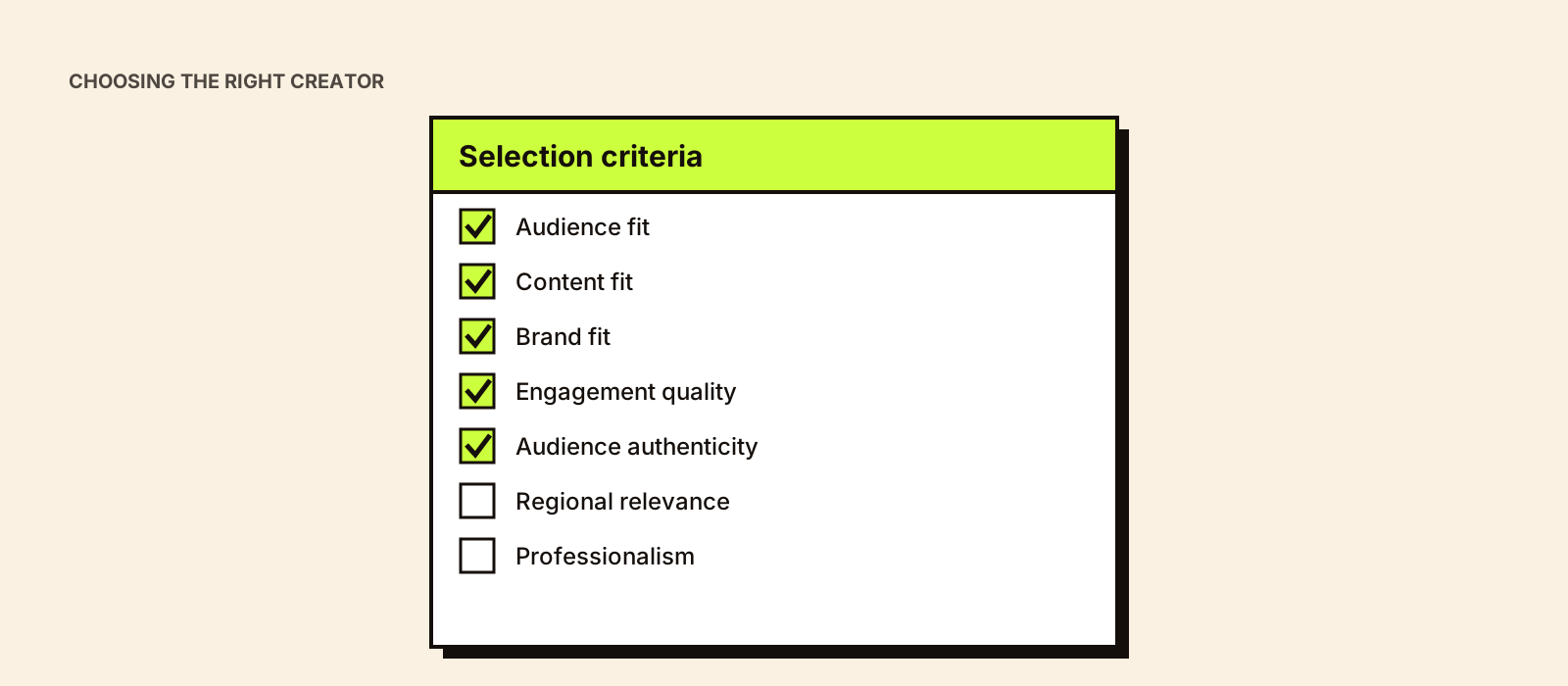
Evaluate creators on eight criteria: audience fit with your target customer, content fit with the format you need, brand fit (tone, values and visual style), engagement quality, audience authenticity, geographic and language relevance, professionalism, and commercial fit (rate and availability). Weigh them against your objective rather than ranking by follower count; a creator whose audience already cares about your category usually beats a bigger one whose audience doesn't.
Start with audience overlap, not audience size
Before evaluating any creator, we map their audience against your actual customer profile: age range, geography, interests, and purchase intent signals. A creator with 40,000 highly relevant followers will consistently outperform one with 400,000 loosely related followers on any conversion metric.
Platforms automate parts of this with filters and scoring; how that works, and where human review still matters, is covered in creator matching.
Engagement quality over engagement rate
Engagement rate is a useful filter, but it's easy to game and easy to misread. We look past the percentage and into the comments themselves. Are people asking genuine questions, tagging friends, and expressing intent to buy? Or are comments generic, repetitive, or bot-like?
- Comment sentiment and specificity, not just comment count
- Save and share rates where platform data allows
- Consistency of engagement across the last 10–15 posts, not just the best one
- Audience authenticity checks to rule out purchased followers
For the specific signals worth checking during an authenticity review, see how to identify fake followers and fake engagement.
Content style and brand fit
A creator can have the right audience and strong engagement and still be the wrong fit if their content style clashes with your brand voice. We review a creator's last several months of content the way a creative director would: for tone, pacing, visual style, and how naturally a product placement would sit inside it.
The best-performing partnerships rarely come from the creator with the largest audience. They come from the creator whose audience was already primed to care.— Kudozz Creator Strategy Team
How to review a creator's content before booking
A content review is quicker and fairer when everyone does it the same way. Use a fixed sample and the same questions for every creator on the shortlist, and write down what you saw rather than a general impression.
- 1. Sample: the last 12 to 20 posts or videos, covering at least three months, plus every sponsored post in the last six months.
- 2. Compare sponsored with organic: do sponsored posts keep the creator's usual voice and quality, and does the audience respond to them with questions or ignore them?
- 3. Check craft: hooks in the first seconds, clear audio, steady framing, captions or on-screen text, editing pace.
- 4. Check product integration: is the product shown in real use, explained in the creator's own words, and disclosed clearly?
- 5. Check range: can the creator make the format you need (demo, review, tutorial, story), or only one kind of post?
- 6. Check brand voice: read captions and listen to how they talk. Would your brand be comfortable being associated with that tone every week?
- 7. Note the evidence: link the two or three posts that most influenced your view, so a colleague can check the judgement.
| Signal | Encouraging | Worth a question |
|---|---|---|
| Sponsored vs organic quality | Sponsored posts look and sound like the creator's best organic work | Sponsored posts are visibly flatter, read from a script or get far less response |
| Disclosure | Clear labels on every paid or gifted post | Paid-looking posts with no label |
| Category credibility | Uses and talks about products like yours unprompted | First time touching your category |
| Sponsorship density | Sponsored posts are a minority of recent content | Several brands a week, including your competitors |
| Creative range | Has made the format you need, well | Only one format, and not the one you need |
| Comments on sponsored posts | Questions about price, use and results | Mostly emojis, or pushback about too many ads |
For a large or long partnership, a short paid concept (a few lines on how they'd approach the brief) shows creative fit better than any portfolio. Pay for it, and don't use the idea if you don't book them. After delivery, checking the finished content against the brief is a separate job, covered in the influencer content quality check.
Brand fit: more than aesthetics
| Brand-fit dimension | What to check |
|---|---|
| Tone and humor | Would your brand say it this way? Does sarcasm or edginess clash with your voice? |
| Values and past statements | Anything the creator has said or done that your customers would object to |
| Category credibility | Do they genuinely use products like yours, or is it a stretch? |
| Past partnerships | Competitors recently promoted; too many sponsorships in a short time |
| Audience trust | Do followers push back on sponsored posts or welcome them? |
| Visual world | Settings, styling and production that fit your brand's look |
Brand fit and audience fit are separate tests: a creator can match your aesthetic perfectly and still speak to the wrong customers. The audience side is covered in influencer audience quality and fit, and brand-safety screening in how to vet influencers.
An 8-factor creator scoring framework
No single factor below determines whether a creator is right for a campaign. Scoring a shortlist against all eight, even informally, gives a clearer picture than ranking by any one signal alone, including follower count.
| Factor | What it evaluates |
|---|---|
| Audience fit | Does the creator's audience genuinely overlap with your target customer, in age, interests, and intent? |
| Content fit | Does the creator's typical format and platform match what the campaign actually needs? |
| Brand fit | Does the creator's tone, values, and visual style align with how the brand wants to be represented? |
| Engagement quality | Do comments reflect genuine interest, not generic or bot-like activity? |
| Audience authenticity | Is the follower base free of obvious purchased-follower or engagement-pod signals? |
| Geographic relevance | Does the creator's audience concentration match the regions or cities the campaign targets? |
| Professionalism | Does the creator communicate clearly, meet deadlines, and handle past collaborations reliably? |
| Commercial fit | Does the creator's rate and availability fit realistically within the campaign's budget and timeline? |
Turn the factors into a selection scorecard
Published scorecards agree on the main criteria (audience fit, brand fit, content quality, authenticity) but not on weights, and there is no industry standard. Two design choices make a scorecard more useful than a single total:
- Gates first: some criteria are pass or fail, not points. A creator who fails a gate is out, however high the rest of the score. Typical gates are audience authenticity, brand safety, disclosure history and, for local campaigns, a minimum share of audience in your market.
- Weights by objective: score the remaining factors from 1 to 5 against written anchors, then weight them for the campaign. A conversion campaign weights audience fit and engagement quality more; an awareness campaign weights reach in the target market and content fit more.
| Factor | Conversion weight (example) | Awareness weight (example) |
|---|---|---|
| Audience fit | 25% | 20% |
| Content fit | 15% | 20% |
| Brand fit | 15% | 20% |
| Engagement quality | 15% | 10% |
| Geographic relevance | 10% | 15% |
| Professionalism | 10% | 5% |
| Commercial fit | 10% | 10% |
| Audience authenticity, brand safety, disclosure | Gate (pass/fail) | Gate (pass/fail) |
Hypothetical example, using the conversion weights. Creator A scores 5, 4, 3, 4, 5, 3 and 2 across the seven factors, a weighted score of 3.9 out of 5. Creator B scores 4, 5, 5, 4, 4, 5 and 4, a weighted score of 4.4. Creator C would score 4.75 but has several recent paid-looking posts with no disclosure, so fails the disclosure gate and isn't scored further. B is booked first; A is kept as an option if the fee can be brought within budget. The weights are illustrative; set your own before scoring, not after.
Creator | Platform | Objective
GATES (pass / fail, with evidence): authenticity | brand safety | disclosure history | audience in market ≥ __%
SCORES (1 to 5, with the post or data that justifies each): audience fit | content fit | brand fit | engagement quality | geographic relevance | professionalism | commercial fit
Weighted score: __ / 5     Reviewer: __     Date: __
Decision: book / hold / decline, and why
Have two people score the same three creators at the start, compare, and agree on anchors where they differed. Scores turn into a booking order in influencer ranking; the reusable quality components are in creator quality score; and the shortlist passes that come before scoring are in influencer shortlisting.
Creator selection checklist
- Audience demographics reviewed against the actual target customer profile, not just the general category
- Engagement checked for genuine sentiment, not just rate
- Content style reviewed for real brand-voice compatibility
- Authenticity checked for signs of purchased followers or artificial engagement
- Geographic concentration confirmed if the campaign has a regional or city-specific target
- Past collaborations reviewed for reliability and communication
- Rate and availability confirmed as realistic for the campaign's budget and timeline
Creators can see how to present these signals clearly in the creator media kit guide.
Bringing it together
Audience overlap, engagement quality, authenticity, and brand fit, weighed against your specific campaign goal rather than any single number, is the scoring approach behind our creator discovery service. It's slower than sorting by follower count, but it's built to surface the creator most likely to actually move your specific objective, not just the one with the widest reach.
If you haven't sourced a shortlist yet, see how to find influencers for your brand for where to actually look before applying this scoring framework.
For a reusable, brand-agnostic version of this scoring, see creator quality score; to turn scores into a priority order and a balanced creator mix, see influencer ranking.