Influencer Audience Quality: What Brands Should Check Before a Collaboration
How brands check whether an influencer's audience is real, active and matches their target customer: the audience data to request, reading location, age, gender and language against your customer profile, authenticity and activity signals, an audience-fit worksheet and when estimated data isn't enough.
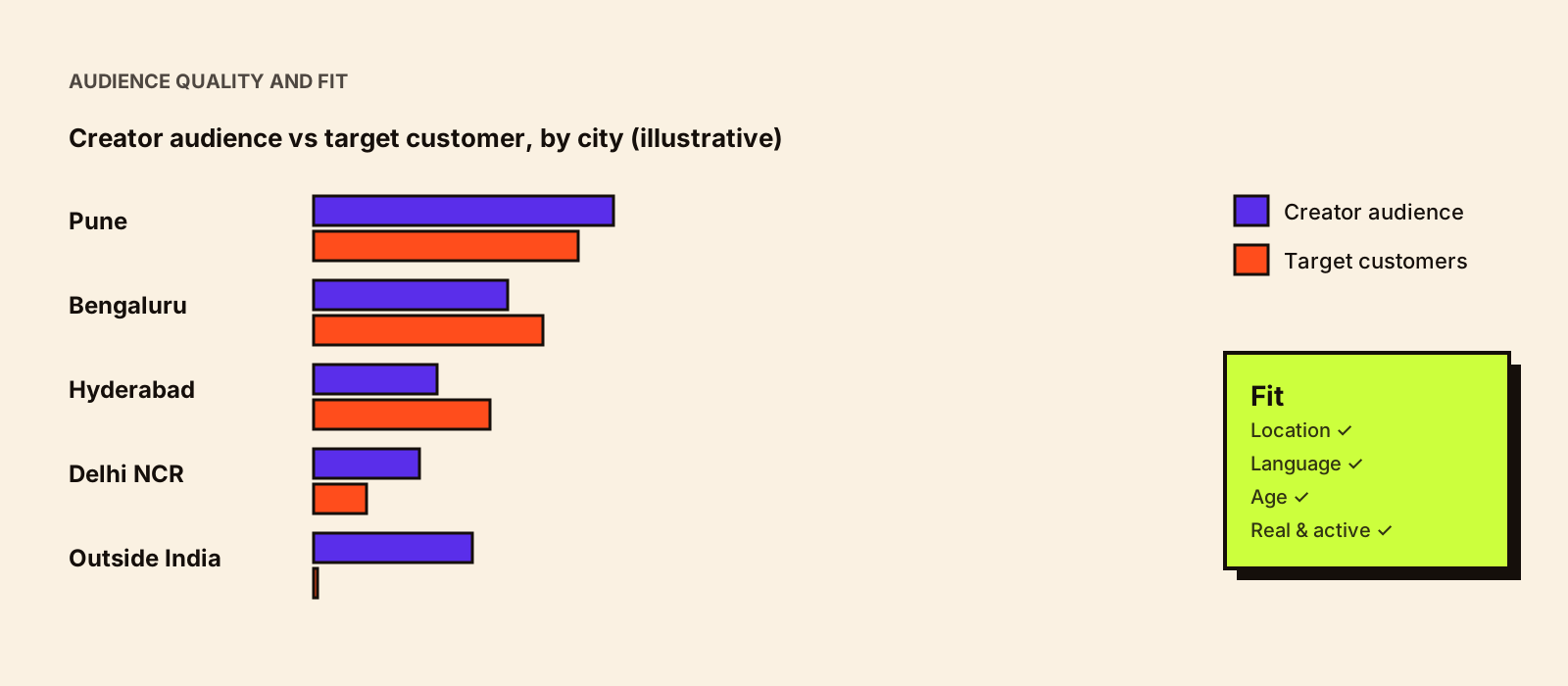
Two creators with the same follower count can deliver completely different results for the same brand. One's audience lives in the cities you ship to, speaks the language of your ads and buys in your category. The other's audience is mostly elsewhere, mostly inactive, or mostly other creators. Audience quality and fit decide which one you're paying for.
Quick answer
Check two things: quality (is the audience real and active?) and fit (does it match your target customer?). For quality, look at follower growth patterns, comment substance, views relative to followers and engagement consistency. For fit, ask creators for recent platform insights screenshots showing top cities, countries, age bands, gender and, where available, language, and compare them with your customer profile. Treat third-party estimates as estimates, date every number, and weigh fit above size.
Quality vs fit
| Audience quality | Audience fit | |
|---|---|---|
| Question | Are these real, active people who pay attention? | Are they the people we sell to? |
| Signals | Growth pattern, comment substance, views vs followers, consistency | Location, age, gender, language, interests, buying context |
| Main risk | Fake or inactive audiences | Real audience, wrong customers |
The audience data to request
- Recent insights screenshots (last 30–90 days): top cities and countries, age range, gender split.
- Reach and views on recent posts in the format you're buying (Reels, Stories, long-form video).
- For YouTube: audience geography, age and returning viewers from YouTube Analytics.
- Insights from two or three recent sponsored posts, if the creator is comfortable sharing.
- Date of each screenshot, so you know how current it is.
Creators own this data and share it voluntarily; ask politely, explain why, and handle it confidentially. Public profile numbers and third-party estimates can support the picture but shouldn't replace creator-provided insights for significant spends.
Reading audience fit against your customer
| Dimension | What to compare | Watch for |
|---|---|---|
| Location | Top cities and states vs where you sell and ship | Large share outside India for an India-only product |
| Tier of city | Metro vs tier 2 and 3 vs your distribution | Metro-heavy audience for a tier 2 and 3 push |
| Language | Content language and comment language vs your ad and pack language | Hindi audience for a Tamil Nadu launch |
| Age | Age bands vs your buyer (and payer, if different) | Teen-heavy audience for a product parents buy |
| Gender | Split vs your buyer | Skewed split for a gendered product |
| Interests and context | What they come to the creator for | Entertainment audience for a considered purchase |
Audience-fit worksheet
Target customer: [cities/states] · [age band] · [gender] · [languages] · [context]

Creator: [ ]   Data date: [ ]   Source: [creator insights / tool estimate]
Share of audience in target locations: [ ]%   → fit: strong / partial / weak
Share in target age bands: [ ]%              → fit: strong / partial / weak
Gender match: [ ]                              → fit: strong / partial / weak
Language match: [ ]                            → fit: strong / partial / weak
Content context fits the purchase? [yes/no, why]
Overall: strong / partial / weak: notes: [ ]
There's no universal threshold for "enough" overlap; set your own by category and objective. A regional launch needs a much tighter location match than a national awareness push.
Quality signals
| Signal | Healthy | Worth investigating |
|---|---|---|
| Follower growth | Steady, with explainable jumps (a viral post, a collaboration) | Sudden spikes with no visible cause |
| Comments | Specific, questions, conversation in the creator's language | Generic emojis, repeated phrases, unrelated languages |
| Views vs followers | Consistent with the creator's recent history | Very low views relative to followers |
| Consistency | Similar performance across recent posts | One outlier carrying the average |
| Sponsored posts | Engagement similar to organic posts | Sponsored posts ignored by the audience |
No single signal proves fraud; look for patterns. The detailed checks are in how to identify fake followers and fake engagement and how to avoid fake followers and influencer fraud in India.
India-specific considerations
- Language fit matters as much as location: a creator in Mumbai may have a largely Marathi-speaking or largely English-speaking audience.
- Regional creators often have tighter geographic audiences, which is ideal for city or state launches; see regional influencer marketing in India.
- Diaspora audiences can be large for some creators; valuable for some brands, wasted for India-only products.
- Tier 2 and 3 audiences may respond to different formats and price points; check the creator's content style, not just the numbers.
Regional strategy: regional influencer marketing in India.
Common mistakes
- Judging by follower count or engagement rate alone.
- Treating third-party estimates as fact.
- Undated audience screenshots.
- Ignoring language and city tier.
- Checking audience quality but not fit (a real audience of the wrong people).
Conclusion
Audience quality tells you the audience is real; audience fit tells you it's yours. Request recent creator insights, compare location, language, age and context with your customer, read quality signals as patterns, and weigh fit above reach. That's how a smaller creator becomes the better booking.