Creator Quality Score: How Brands Can Evaluate Influencers Beyond Follower Count
A brand-agnostic creator quality score built from six components (content craft, audience quality, engagement quality, consistency, credibility and professionalism), with signals, scoring anchors, worked examples and limits.
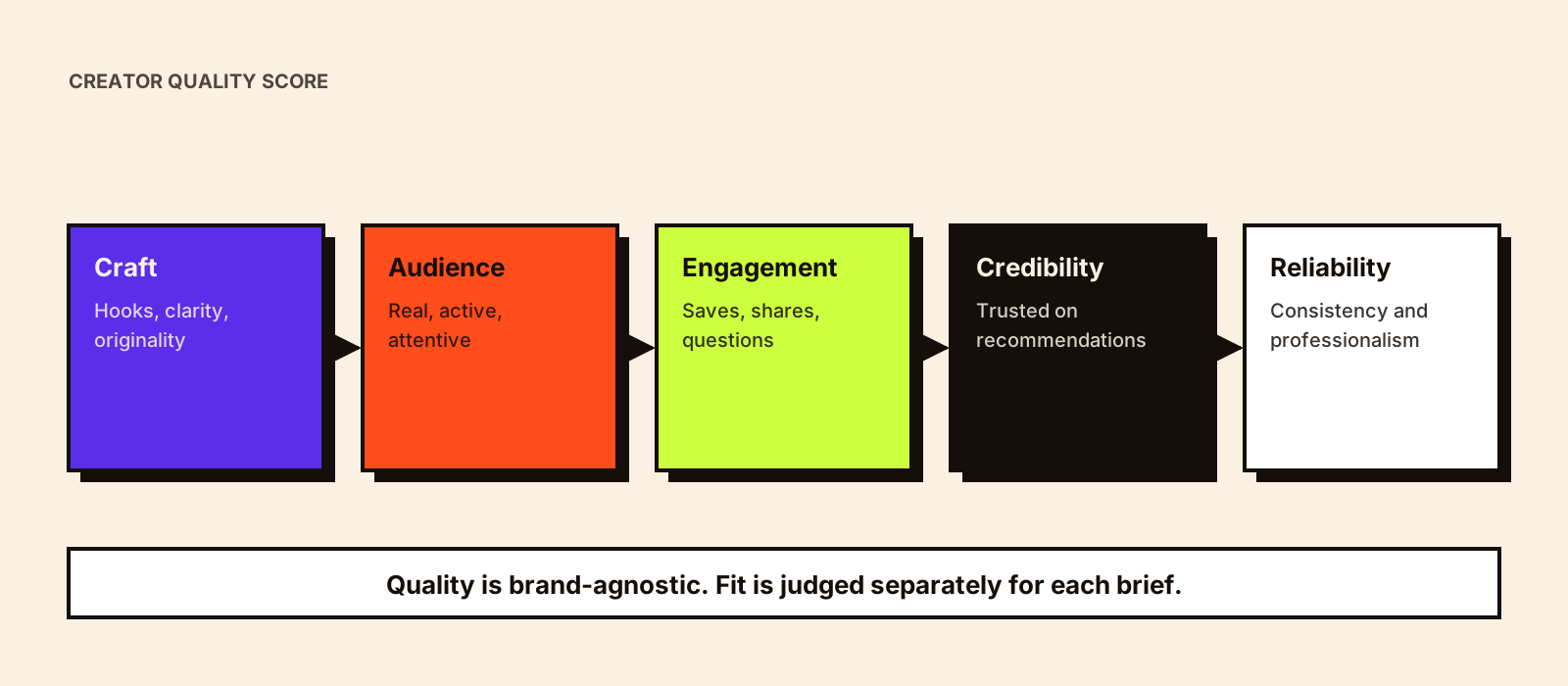
Follower count is the first number anyone sees and the least useful one for judging a creator. It doesn't say whether the content is good, whether the audience is real, whether people listen to the creator's recommendations or whether the creator is reliable. A quality score asks those questions directly, before you think about any specific campaign.
Quick answer
A creator quality score evaluates how good a creator is independently of any brand or brief, across six components: content craft, audience quality, engagement quality, consistency, credibility and professionalism. Score each 1–5 against written anchors, using a mix of data and review, then combine them with weights suited to how you plan to use creators. The score helps decide who's worth considering at all; whether they fit a particular campaign is a separate fit assessment.
Quality vs fit
| Creator quality | Campaign fit | |
|---|---|---|
| Question | Is this a strong creator? | Is this creator right for our brief? |
| Depends on brand? | No (mostly) | Yes |
| Changes how often | Slowly; review quarterly | Every campaign |
| Used for | Database curation, long-term partners | Shortlists and ranking |
A high-quality creator can be a poor fit (great finance educator, wrong audience for your snack brand). A creator with average quality scores can be the best fit for a narrow regional brief. You need both; fit is covered in AI influencer matching.
The six components
| Component | What it measures | Signals |
|---|---|---|
| Content craft | How well the creator makes content | Hooks, clarity, editing, sound, pacing, originality, format mastery |
| Audience quality | Whether the audience is real, active and attentive | Views relative to followers, growth pattern, authenticity checks, audience stability |
| Engagement quality | Whether people respond meaningfully | Saves, shares, specific comments, questions, conversations |
| Consistency | Whether quality and output are stable | Posting regularity, performance variance, niche focus over months |
| Credibility | Whether the audience trusts the creator's recommendations | Expertise shown, honest reviews, disclosure habits, audience reaction to sponsored posts |
| Professionalism | Whether the creator is good to work with | Media kit, response quality, past brand reliability, contract readiness |
Scoring anchors
| Score | Content craft | Credibility | Consistency |
|---|---|---|---|
| 5 | Distinctive style; strong hooks; recognisable even without the handle | Audience asks for and acts on recommendations; honest negatives shown | Steady output for 6+ months; narrow variance |
| 4 | Polished and clear; good hooks | Sponsored posts get real questions | Regular output; occasional dips |
| 3 | Competent; follows formats | Mixed response to sponsored posts | Some gaps or swings |
| 2 | Inconsistent quality | Sponsored posts mostly ignored | Irregular; niche drifting |
| 1 | Poor production or copied content | Audience sceptical; disclosure lapses | Long gaps or erratic performance |
Combine with sensible weights
How you weight components depends on how you use creators. A brand that mostly buys UGC for ads cares most about content craft and professionalism. A brand that relies on creator recommendations to sell considered purchases cares most about credibility and engagement quality. An illustrative general-purpose weighting: content craft 20%, audience quality 20%, engagement quality 20%, credibility 20%, consistency 10%, professionalism 10%. Treat audience authenticity as a gate: if fraud is likely, the creator is out regardless of score.
How to gather the evidence
- Watch 10–15 recent posts, including at least two sponsored ones.
- Calculate median views and quality engagement per view from those posts.
- Read 30–50 comments across several posts; note questions, purchase intent and generic patterns.
- Run an authenticity check and look at the growth history.
- Note how sponsored posts perform compared with organic posts.
- For professionalism, check past brand feedback if you have it, and how the creator handles the first conversation.
Audience quality has its own scoring framework in influencer audience quality, and engagement quality in influencer engagement quality.
Worked examples (hypothetical)
| Creator X: 900K followers, lifestyle | Creator Y: 45K followers, Tamil skincare | |
|---|---|---|
| Content craft | 4: polished, trend-driven | 4: clear demos, honest |
| Audience quality | 2: views around 3% of followers; spiky growth | 4: views often 40%+ of followers; steady growth |
| Engagement quality | 2: emoji comments, few questions | 5: detailed questions about skin types |
| Consistency | 3: frequent niche changes | 4: consistent for two years |
| Credibility | 2: many unrelated sponsorships | 5: shows products that didn't work for her |
| Professionalism | 4: managed, responsive | 3: no media kit, slower replies |
| Illustrative total | ≈ 2.7 | ≈ 4.3 |
Both creators are invented. The point is that the larger account scores lower on the things that make recommendations work. That doesn't make Creator X useless; for a reach-only objective, their views may still be good value. Quality is one input into ranking, not the decision.
Limits of a quality score
- Several components are judgments; two reviewers can differ. Calibrate on a few creators together.
- Scores go stale. Review quarterly for creators you use, and before every booking.
- A score can't capture a creator's chemistry with a particular product.
- Small creators with little history are harder to score; treat their scores as provisional.
- A high score doesn't predict a specific campaign's result.
Calibrate your reviewers
Quality scores depend on judgment, so different reviewers drift apart. A short calibration keeps them consistent:
- Pick five creators everyone knows. Each reviewer scores them independently.
- Compare scores component by component and discuss the biggest gaps.
- Rewrite anchors where people interpreted them differently.
- Repeat each quarter, or when new reviewers join.
Scoring different kinds of creator
| Creator type | What quality looks like | Watch for |
|---|---|---|
| UGC creator | Clean framing, strong hooks, clear product shots, fast turnaround | Their own audience matters little; don't penalise small followings |
| Expert creator | Accurate, clear explanations; credentials verifiable | Claims beyond their qualification |
| Regional nano creator | Strong local response; authentic voice; consistent posting | Lower production polish isn't low quality |
| Entertainer | Craft and audience attention | Credibility on product recommendations may be lower |
| Reviewer | Balanced reviews; shows negatives | Many brands in one category may reduce persuasion |
Keep scores fresh and stored
Record the date and reviewer with every score, and keep it on the creator's database record so it can be reused across briefs. Refresh before any booking and quarterly for active creators. Influencer database covers the record structure.
Hypothetical example: quality vs follower count
Hypothetical: a home-appliance brand compares three Kannada creators with 30,000, 150,000 and 600,000 followers. Quality scores come out at 4.2, 3.1 and 2.6, mainly because the smallest creator's demos are clear, her audience asks detailed questions and her sponsored posts perform like her organic ones. The brand still books the largest creator for launch-week reach, but gives the smallest one the explainer role and the code-led offer. Quality changed the roles, not just the list.
Common mistakes
- Mixing fit into quality, so scores change with every brief.
- Scoring from bios and follower counts without watching content.
- Treating a high engagement rate as high engagement quality.
- Not separating sponsored-post performance from organic.
- Never recalibrating anchors as platforms change.
Conclusion
A creator quality score evaluates what follower counts hide: craft, real audiences, meaningful engagement, consistency, credibility and professionalism. Keep it brand-agnostic, anchor every score, gather evidence from content and comments as well as metrics, and combine it with campaign fit and value when you rank creators. Influencer ranking shows how those pieces come together.