Influencer Engagement Quality: How Brands Can Separate Real Engagement From Vanity Metrics
How to judge engagement quality rather than quantity: an engagement hierarchy, a comment audit method, relevance and consistency checks, suspicious patterns, an Engagement Quality framework and what it means for sponsored posts.
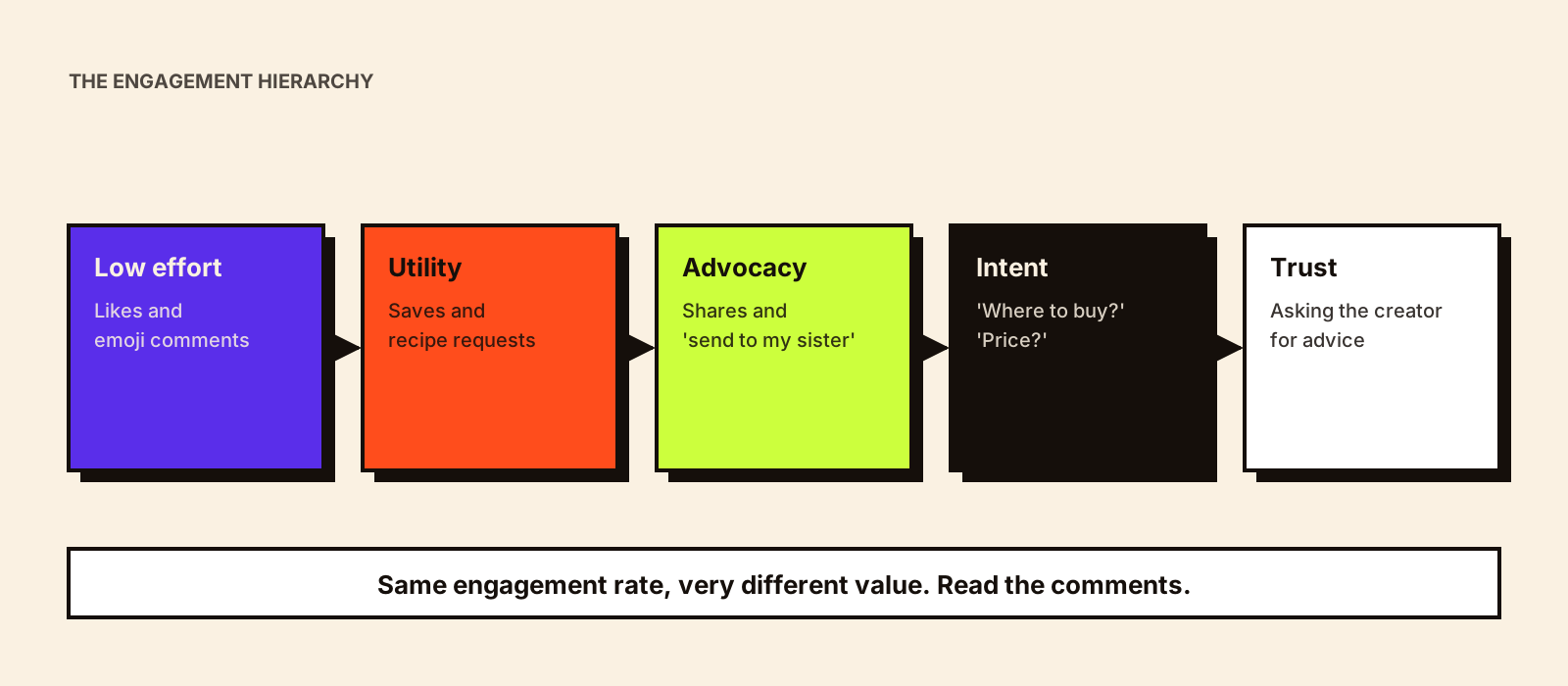
Two Reels each get 5,000 interactions. The first has 4,800 likes and 200 comments, mostly fire emojis and 'nice'. The second has 3,000 likes, 900 saves, 600 shares and 500 comments, many asking where to buy, whether it works for oily skin, or tagging a friend with 'we need this'. The engagement rate is identical. The commercial value isn't.
Quick answer
Engagement quality measures whether people respond to a creator's content in ways that signal attention, trust and intent, rather than how many interactions there are. Weight saves, shares, specific comments and product questions above likes and generic comments; check that engagement comes from relevant audiences in the right language and region; look for consistency across posts; and watch for suspicious patterns such as repeated phrases, the same accounts on every post or likes far out of line with views. Assess it with a structured comment audit, not engagement rate alone.
For engagement rate formulas, see influencer engagement rate. This guide is about what the engagement consists of.
The engagement hierarchy
| Level | Signals | What it suggests |
|---|---|---|
| Low effort | Likes, emoji-only comments, 'nice', 'wow' | Seen, briefly approved |
| Social | Tagging friends, short reactions | Content is shareable within a circle |
| Utility | Saves, 'saving this', recipe or routine requests | Content is useful; likely revisited |
| Advocacy | Shares, reposts, 'sending this to my sister' | People will spread it |
| Intent | 'Where can I buy?', 'price?', 'does it work for…?', 'ordered' | Consideration or purchase |
| Trust | Asking the creator for advice, referencing past recommendations | Audience relies on the creator's judgment |
The higher levels are harder to fake and closer to business outcomes. A sponsored post that generates intent and trust signals is doing its job even if the like count is modest.
Run a comment audit
SAMPLE: 50–100 comments across 5 recent posts (include 2 sponsored if available). Skip the creator's own replies.

CODE EACH COMMENT AS:
G  Generic (emoji, 'nice', 'wow')
S  Social (tag, short reaction)
Q  Question about the content or product
I  Purchase intent ('where to buy', 'ordered', 'price')
E  Experience ('I tried this', 'worked for me')
N  Negative or critical
X  Suspicious (repeated phrase, unrelated language, spam)
O  Off-topic

RECORD: share of each code · language of comments · whether commenters look like real, relevant accounts
COMPARE: sponsored vs organic posts
A creator whose comments are 60% generic and 2% questions is in a different position from one at 25% generic and 20% questions, even at the same engagement rate. There's no universal threshold; compare creators within the same category, tier and language.
Relevance: whose engagement is it?
- Language: do comments come in the language your campaign targets?
- Region: do commenters mention cities and contexts that match your market?
- Audience type: are commenters potential customers, or mostly other creators and engagement-group regulars?
- Topic: do comments engage with the subject, or only with the creator's personality?
Engagement from the wrong audience is real engagement with no value to you. That's why engagement quality and audience fit belong together; influencer audience quality covers the audience side.
Consistency
Look at engagement across 10–15 recent posts, not one. Natural engagement varies: some posts do better, some worse. Suspiciously uniform engagement (very similar like counts on every post regardless of content) and extreme dependence on one viral post are both worth investigating. For sponsored work, compare sponsored posts with the creator's organic median; a big drop means the audience tunes out ads.
Suspicious patterns
| Pattern | Possible cause | Innocent explanation to rule out |
|---|---|---|
| Same accounts commenting on every post | Engagement pods | Genuine superfans (look at what they say) |
| Repeated phrases across many comments | Bought or automated comments | Giveaway entry instructions |
| Likes far above what views suggest | Bought likes | Measurement differences between formats |
| Comments in unrelated languages | Bought engagement from other regions | Diaspora or international audience |
| Engagement arrives in a burst then stops | Automated or pod engagement | Post shared by a large account |
Automated tools can flag these patterns at scale; influencer fraud detection tools explains how to read their output. For the manual checks, see how to identify fake followers.
An engagement quality framework
| Dimension | Measure | Score 1–5 on |
|---|---|---|
| Depth | Saves + shares per view; share of Q, I, E comments | Relative to category and tier peers |
| Relevance | Share of comments in target language and context | Match to your market |
| Consistency | Variance across recent posts; sponsored vs organic | Stability |
| Authenticity | Suspicious patterns | Gate: fail excludes |
| Sponsored response | How audiences respond to paid posts | Questions and intent on sponsored work |
Weight these by objective. For awareness, depth and relevance matter less than reach; for consideration and sales, depth and sponsored response matter most. The score feeds the engagement component of a creator quality score.
Engagement quality in Indian campaigns
- Comments often mix Hindi, English and regional languages in Roman script. Code them by meaning, not by language purity.
- Regional creators may get fewer comments but more specific, local ones; don't penalise them for lower volume.
- WhatsApp sharing doesn't show up publicly but appears in share counts in creator insights; ask for them.
- Festival and cricket periods change engagement patterns across categories; compare within similar periods.
Hypothetical comment audit result
| Code | Creator A (macro, 2.8% ER) | Creator B (micro, 2.6% ER) |
|---|---|---|
| Generic | 64% | 28% |
| Social (tags) | 18% | 17% |
| Question | 4% | 22% |
| Purchase intent | 1% | 11% |
| Experience | 2% | 14% |
| Negative | 3% | 5% |
| Suspicious | 6% | 1% |
| Off-topic | 2% | 2% |
Invented figures from a 100-comment sample each. Engagement rates are almost identical; engagement quality isn't. Creator B's audience asks, tries and buys. Creator A's 6% suspicious share also warrants a closer authenticity look.
Platform differences
| Platform | Strongest quality signals | Caveat |
|---|---|---|
| Instagram Reels | Saves, shares, specific comments | Saves and shares are only visible in creator insights |
| Instagram Stories | Replies, link taps, sticker responses | Disappear after 24 hours; collect insights promptly |
| YouTube long-form | Watch time, comment depth, returning viewers | Comments arrive over weeks; check later |
| YouTube Shorts | Views vs subscribers, comment substance | Short attention; fewer detailed comments |
Use it after the campaign too
Engagement quality isn't only a vetting check. After posting, audit comments on each sponsored post and compare with the creator's organic baseline. A sponsored post that generated questions and intent did its job even with modest likes; one with plenty of likes and no product discussion probably didn't. Feed the result into the creator performance scorecard.
Common mistakes
- Treating engagement rate as engagement quality.
- Counting comments without reading them.
- Ignoring saves and shares because they're not public; ask creators for them.
- Judging sponsored posts by organic engagement norms.
- Assuming high engagement means the audience will buy.
Engagement quality is one input into judging which content worked; influencer content performance covers the full picture and what to do with winning posts.
Conclusion
Engagement quality is about what people do and say, not how many interactions there are. Prioritise saves, shares, questions and purchase intent; audit comments; check relevance and consistency; rule out suspicious patterns; and look closely at how audiences respond to sponsored posts. To go further into what audiences feel about creators and brands, see influencer sentiment analysis.