Creator Performance Scorecards: How Brands Can Evaluate Influencers Consistently
A post-campaign scorecard for every creator you work with: eight categories, scoring guides for each, how to weight them by objective, a template and how to use scores for rebooking without false precision.
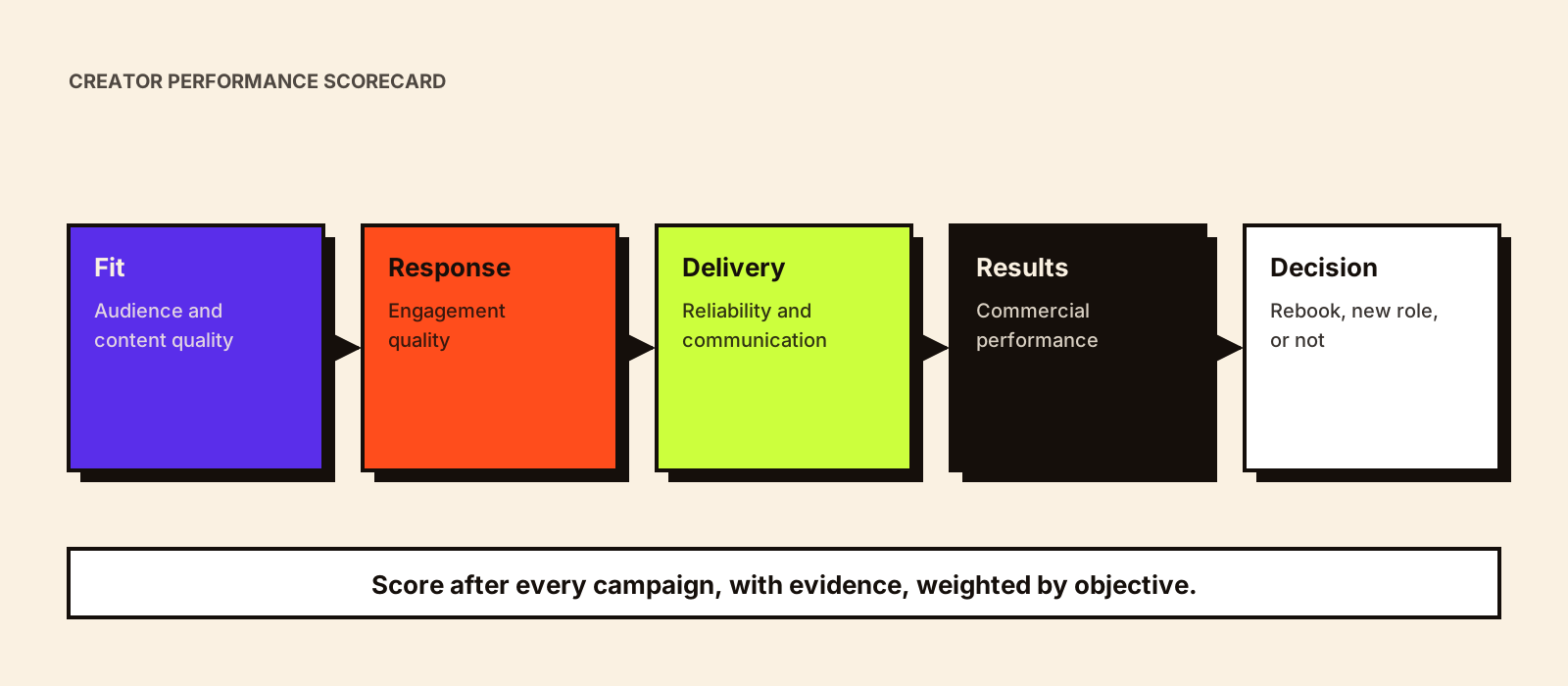
After a campaign, most brands judge creators by memory. The one whose Reel went viral is remembered as great; the one who submitted late is remembered as difficult; the one who quietly delivered strong orders is forgotten. A scorecard replaces memory with a short, consistent record, so the next rebooking decision is based on what actually happened.
Quick answer
A creator performance scorecard rates each creator after every campaign on the same categories: audience fit, content quality, engagement quality, brand safety and compliance, campaign reliability, commercial performance, communication and consistency. Score each 1–5 with written evidence, weight the categories by the campaign objective, and record a rebook decision with a reason. Use scorecards to compare creators and spot patterns over several campaigns, not to treat one number as a verdict.
This is an after-the-campaign evaluation. For judging creators before you work with them, see creator quality score; for choosing between candidates for a specific campaign, see influencer ranking.
The eight scorecard categories
| Category | Question | Evidence |
|---|---|---|
| Audience fit | Did the audience that saw the content match our target? | Post insights: cities, age, language; comment language |
| Content quality | Was the content well made, on-brief and in the creator's own voice? | The post itself; brief checklist |
| Engagement quality | Did people respond meaningfully? | Saves, shares, comment substance, questions about the product |
| Brand safety and compliance | Was disclosure correct and were claims approved? | Live post check; approval record |
| Campaign reliability | Were drafts and posts on time, with reasonable revisions? | Tracker dates; revision count |
| Commercial performance | Did they deliver against the campaign's primary metric for the cost? | Cost metric; campaign index |
| Communication | Were they responsive, clear and easy to work with? | Team notes |
| Consistency | Does this match their previous work with us? | Previous scorecards |
A scoring guide
Scores are only consistent if everyone means the same thing by a 2 or a 4. Write anchors for each category. An example for three of them:
| Score | Campaign reliability | Engagement quality | Commercial performance |
|---|---|---|---|
| 5 | Everything early or on time; one revision or none | Many specific product questions, high saves/shares for the format | Index ≥ 1.3 against campaign median |
| 4 | On time; two revisions | Clear product interest in comments | Index 1.1–1.3 |
| 3 | Minor delays, flagged in advance | Mixed: some product discussion, much generic | Index 0.9–1.1 |
| 2 | Missed a deadline without warning | Mostly generic; product ignored | Index 0.7–0.9 |
| 1 | Missed go-live or major rework needed | Negative or suspicious engagement | Index < 0.7 |
The index thresholds are examples to adapt, not standards. The campaign index (creator result divided by campaign median) is explained in influencer performance data.
Weight by objective
| Category | Awareness | Consideration | Sales | UGC for ads |
|---|---|---|---|---|
| Audience fit | 25% | 20% | 20% | 5% |
| Content quality | 15% | 20% | 10% | 35% |
| Engagement quality | 10% | 25% | 10% | 5% |
| Brand safety and compliance | 10% | 10% | 10% | 10% |
| Campaign reliability | 10% | 10% | 10% | 20% |
| Commercial performance | 20% | 5% | 30% | 10% |
| Communication | 5% | 5% | 5% | 10% |
| Consistency | 5% | 5% | 5% | 5% |
These weights are illustrations. Agree yours before the campaign, not after, so the scorecard isn't tuned to justify a decision already made. Brand safety can also be treated as a gate rather than a weight: a serious compliance failure should override any total.
Scorecard template
Creator: [ ]   Campaign: [ ]   Objective: [ ]   Role: [reach / trust / convert / regional / content]
Deliverables: [ ]   Total cost: ₹[ ]   Capture day: [7 / 30]

Category              Score (1–5)   Weight   Evidence (one line)
Audience fit           [ ]          [ ]%     [ ]
Content quality        [ ]          [ ]%     [ ]
Engagement quality     [ ]          [ ]%     [ ]
Brand safety/compliance [ ]         gate     [pass/fail + note]
Reliability            [ ]          [ ]%     [ ]
Commercial performance [ ]          [ ]%     [index: ]
Communication          [ ]          [ ]%     [ ]
Consistency            [ ]          [ ]%     [vs previous: ]

WEIGHTED SCORE: [ ] / 5
REBOOK: Yes · Yes, different role · Maybe · No
REASON: [one line]
NEXT TIME: [what we'd brief differently]
Using scorecards well
- Fill it within a week of the 30-day capture, while the team remembers.
- Have two people score independently for important creators and discuss differences.
- Judge creators in their role: a reach creator shouldn't lose points for low CPA.
- Look at trends over several campaigns, not one score.
- Separate creator problems from brand problems: a weak brief or broken landing page isn't the creator's fault.
- Share a summary with creators you rebook. Specific feedback improves the next campaign.
Store scorecards on the creator's record so history builds up; influencer marketing CRM covers the structure.
Avoiding false precision
A weighted score of 3.84 looks precise. It isn't. Several inputs are judgments, the weights are choices and a single campaign is a small sample. Read scores in bands (strong, solid, weak) and always with the evidence column. A creator with a 3.2 and a clear 'great converter, slow on drafts' note is often a better rebook than a 3.6 with no notes.
Variants for different creator roles
| Role | Add or emphasise | De-emphasise |
|---|---|---|
| UGC creator | Usable assets delivered, editing quality, revision speed, ad performance of assets | Audience fit, organic engagement |
| Ambassador | Consistency across months, brand knowledge, audience response over time | Single-post results |
| Expert creator (doctor, CA, trainer) | Accuracy, claims compliance, credibility in comments | Raw reach |
| Regional creator | Market concentration of audience, local language quality, local response | National reach comparisons |
Running a scorecard review
1. Campaign manager presents creators ranked by index on the primary metric (5 min)
2. For each creator: scores, evidence, disagreements (15 min)
3. Decide rebook status and role for each (5 min)
4. Note brief and process changes for next campaign (5 min)
OUTPUT: updated scorecards on creator records; 'next time' list
Share feedback with creators
Creators rarely hear how their work performed. A short, specific note builds trust and improves the next collaboration:
Hi [name], thanks again for [deliverable]. A few things from our side:
• What worked: [specific: e.g. 'showing the product in the first seconds drove most clicks']
• Numbers we can share: [e.g. 'your Reel had one of the lowest costs per order in the campaign']
• One thing for next time: [specific, brief-related]
We'd love to work together again on [next campaign/month].
From scorecards to a roster
After several campaigns, group creators into simple roster tiers: A (rebook first, consider ambassador roles), B (reliable for specific roles or markets), C (one-off; rebook only with a reason). Review the roster quarterly. It speeds up shortlisting, gives you a starting point for negotiation and shows where you lack strong creators. Influencer marketing CRM covers where the roster should live, and how to build a long-term partnership programme covers moving A-tier creators into ongoing deals.
Creator performance review: value beyond the headline numbers
A creator can be valuable even when one campaign's views or likes are unremarkable. Before marking a creator down, check whether they delivered on the dimensions that predict long-term value:
| Dimension | What strong looks like even with modest reach |
|---|---|
| Audience fit | Audience concentrated in your markets, language and customer profile |
| Content quality | Clear, credible content you could reuse in ads or on your site |
| Trust | Comments asking for advice; audience acting on recommendations |
| Brand alignment | Natural fit with your product and values |
| Execution | On time, on brief, easy to work with |
| Commercial outcomes | Code use, qualified clicks or orders, where measurable |
| Consistency | Similar results across campaigns |
Equally, a viral post from a creator whose audience isn't your customer may not deserve a rebook. Read the scorecard as a whole and in the creator's role. When a whole campaign underperforms, check influencer campaign underperformance before scoring creators down for problems they didn't cause.
Common mistakes
- Scoring only the creators who did badly.
- Changing categories every campaign, so scores can't be compared.
- Letting one viral post override weak reliability.
- No evidence column, so scores can't be challenged or learned from.
- Using the scorecard to judge creators on objectives they weren't briefed for.
Scorecards tell you who to rebook; repeat influencer collaborations explains how to turn that decision into ongoing work.
Add the creator's own perspective to the scorecard; creator feedback loop covers what to ask and how to use it.
Missed requirements belong in the reliability score; creator non-compliance covers how to handle and record them fairly.
Conclusion
A creator performance scorecard turns each campaign into a reusable record: eight categories, anchored scores, objective-based weights, evidence and a rebook decision. Over a few campaigns it shows who performs, in which role and under what conditions, which is exactly what you need before the next shortlist. To prepare the shortlist itself, see influencer shortlisting.