Influencer Marketing Costs in Australia: Creator Fees and Campaign Budgets
What drives influencer marketing costs in Australia and how to build a budget in AUD: creator fee factors, usage rights and exclusivity, production, paid amplification, agency fees, GST and the tax treatment of gifted products, plus a worksheet and a labelled hypothetical. No invented rate cards.
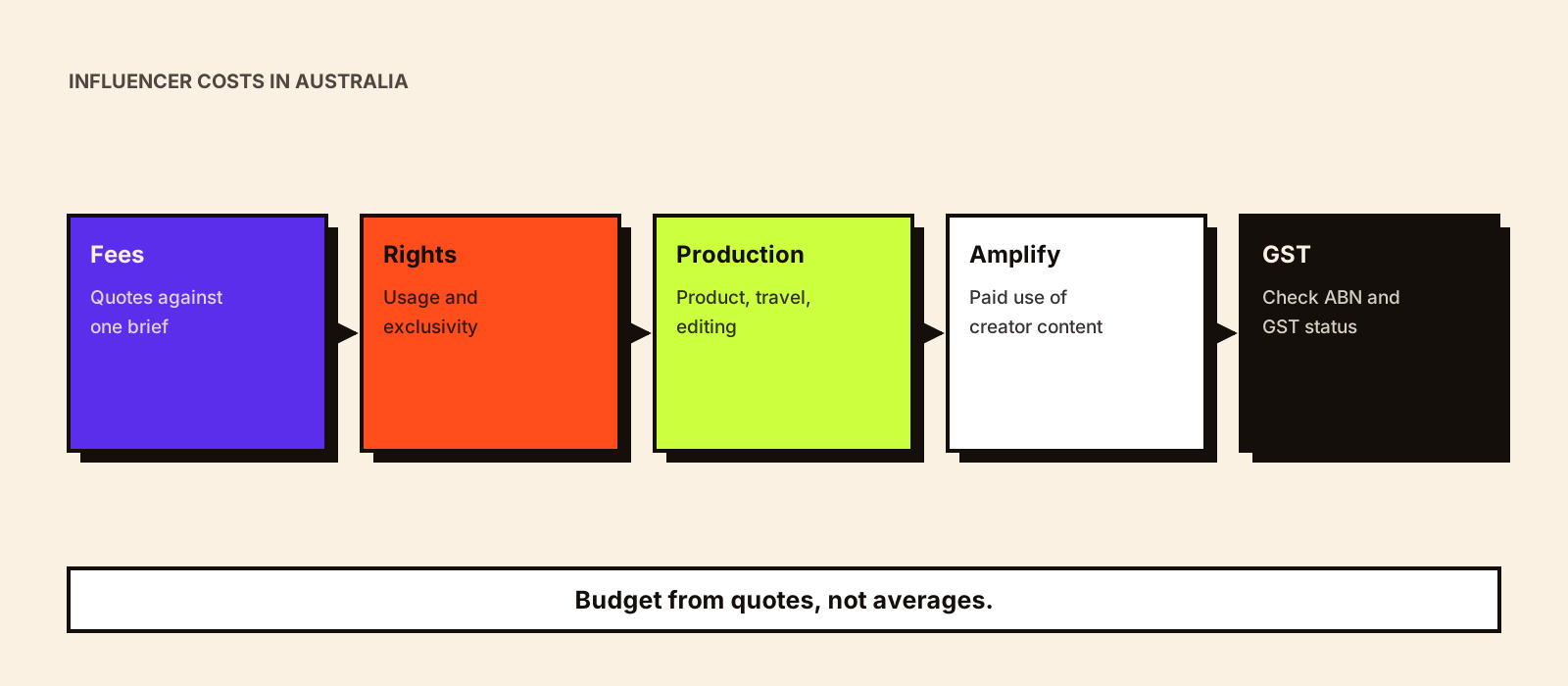
Most people searching for influencer costs want a number. The honest answer is that we found no independent, methodology-backed survey of Australian creator rates; published 'rate cards' are mostly modelled estimates from platforms selling services. This guide explains what actually drives cost, how to build an AUD budget from quotes, and the GST and tax points Australian brands should know.
Quick answer
Influencer marketing costs in Australia depend on the creator's audience and engagement, the platform and format, the number of deliverables, usage rights and exclusivity, production needs and any paid amplification. Build the budget bottom-up from several creator quotes, add agency fees and production, and remember GST: creators registered for GST add 10% to invoices. Gifted products count too: the ATO treats non-cash benefits received for work as income for the creator at market value.
What drives creator fees
| Factor | Effect on price |
|---|---|
| Audience size and engagement | Larger, more engaged audiences cost more; check how much of it is in Australia |
| Niche and expertise | Specialist creators (health, finance, trades, B2B) often charge more |
| Platform and format | Long-form YouTube integrations usually cost more than a Story |
| Deliverables | Each extra post, Story frame or revision adds cost |
| Usage rights | Using content in your ads, website or retail displays, and for how long |
| Exclusivity | Paying a creator not to work with competitors for a period |
| Production | Travel, locations, props, editing, talent |
| Timing | Peak seasons and short turnarounds |
Other budget lines
- Product and shipping for creators
- Paid amplification of creator content (ad spend plus usage rights)
- Agency or management fees
- Measurement: tracking set-up, brand lift studies where used
- Contingency for reshoots or extra creators
GST and tax
Checked 9 October 2026. General information, not tax advice. Businesses must register for GST once their GST turnover reaches $75,000, according to the ATO, so some creators will charge GST and others won't. Ask for each creator's ABN and GST status before contracting, and budget GST-inclusive. The ATO also says goods, services or other benefits received as payment for work count as income at market value, and gives an online influencer as an example; gifted products are therefore part of the commercial arrangement, not free.
A budget worksheet
Creator fees (ex GST):        A$ ______  (sum of quotes)
Usage rights / exclusivity:   A$ ______
Product and shipping:          A$ ______
Production:                    A$ ______
Paid amplification:            A$ ______
Agency or management fee:      A$ ______
Measurement:                   A$ ______
Contingency (e.g. 10%):        A$ ______
Subtotal (ex GST):             A$ ______
GST where charged:             A$ ______
Total:                         A$ ______
Budget by campaign goal
| Goal | Where the budget usually goes | What to hold back |
|---|---|---|
| Awareness | More creators or larger creators; reach-focused formats; paid amplification of the best posts | A share for amplifying what performs |
| Consideration | Fewer, more credible creators; longer formats such as reviews and tutorials | Usage rights to reuse reviews |
| Sales | Creators with proven audiences in your market; links, codes and landing pages; affiliate commission | A test budget before scaling winners |
| Launch | Seeding, embargoed content, a second wave of reviews, paid support in launch week | Contingency for delays and stock |
| Always-on | Retainers or ambassador fees; content rights; management time | Quarterly review points |
This shows where money tends to go, not how much to spend; we found no independent Australian benchmark for budget splits. Build each line from quotes. For timing, see influencer campaign timelines in Australia, and for licence costs, influencer content in paid ads in Australia.
Hypothetical example
Hypothetical, for illustration only; not market rates. A skincare brand plans six micro-creators on Instagram and TikTok. It collects quotes, which total A$9,000 ex GST for one Reel and three Stories each. It adds A$2,000 for 3 months' paid usage rights, A$600 for product and shipping, A$4,000 of amplification and a 10% contingency, then adds GST for the four creators who are registered. The point is the method: every line comes from a quote or a decision, not an average.
Getting better quotes
- Send a clear brief with deliverables, rights, exclusivity and timing; vague briefs get padded quotes
- Ask for the price of organic posting and paid usage separately
- Compare cost per expected result (reach in Australia, clicks or orders), not cost per post
- Negotiate on scope (fewer deliverables, shorter rights) rather than squeezing fees
Negotiation is covered in how to negotiate influencer rates, and fee structures in how much to pay influencers.
If you're comparing agency proposals, check that creator fees, agency fees and GST are shown separately; see how to choose an influencer marketing agency in Australia.
Common mistakes
- Budgeting from a rate card with no stated method
- Forgetting GST or usage rights
- Treating gifted products as free for the creator
- Paying for followers who live overseas
- No contingency
Conclusion
There is no reliable average price for an Australian influencer post. Build budgets from quotes against a clear brief, separate fees, rights, production and GST, and judge value by what each creator is likely to achieve for your objective.