Influencer Marketing and Marketing Mix Modeling: How to Get Creators Into Your MMM
How to include creator campaigns in a marketing mix model: why creators are hard to model, the data to collect each week, separating paid and organic creator activity, calibrating with experiments, comparing creators fairly with other channels, and when MMM isn't worth it.
Marketing mix modeling (MMM) estimates how much each channel contributed to sales using several years of aggregate data, without tracking individuals. As creator budgets grow, finance teams want creators in the same model as search, social and TV. That is harder than it sounds, and the reasons are mostly about data, not statistics.
Quick answer
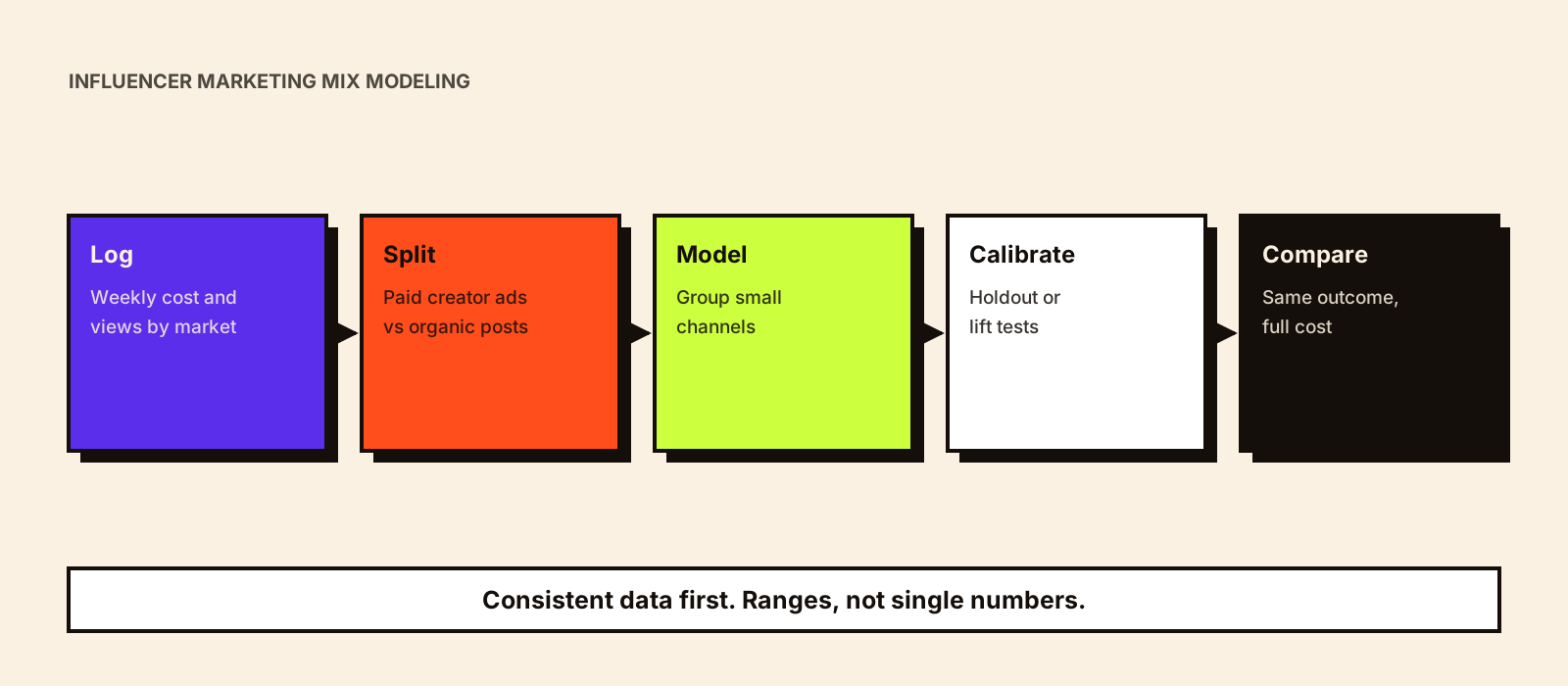
Creators can go into an MMM if you log their activity weekly, by market, with spend and exposure (views or impressions), and keep paid creator ads separate from organic creator posts. Small or irregular creator spend is hard for a model to read, so group it, run experiments to calibrate it, and treat the result as an estimate with a range. If you don't have about two to three years of consistent data, start with holdout tests instead.
MMM, attribution and incrementality
| Method | What it answers | Weakness for creators |
|---|---|---|
| Attribution (links, codes, platform reports) | Which tracked clicks and codes led to sales | Misses people who saw a post and bought later |
| Incrementality tests | What a specific campaign added, compared with a control | One test at a time; needs a clean control |
| Marketing mix modeling | How each channel contributed over time, and where the next budget should go | Needs long, consistent data; small channels get vague estimates |
These methods work best together. IAB Australia's September 2026 measurement review cites IAB US research finding that only 39% of US buy-side decision-makers use MMM, attribution and incrementality together, and the review's central finding is that data, not a lack of methods, is the constraint. IAB's January 2026 creator measurement report also says creators remain undervalued in cross-media planning and attribution models. How to run creator holdout tests is covered in influencer marketing incrementality.
Why creators are hard to model
- Low spend: small budgets give the model little signal to separate from noise
- Lumpy timing: a few big posts in one week, then nothing, gives the model little variation to learn from
- Hidden cost: gifted products, usage rights and agency fees often sit outside the media budget
- Double counting: creator videos run as paid ads may already sit inside 'paid social'
- Indirect effects: creators often show up as more brand search or direct traffic, which the model may credit to search
The low-spend problem is documented: Google's Meridian documentation advises combining low-spend channels with others to avoid issues with ROI estimation. Grouping all creator activity into one channel, rather than one per platform, is usually the first step.
The data to log every week
| Field | Why the model needs it |
|---|---|
| Week and market (country, state or city) | Regional data gives the model more variation to learn from |
| Creator fees, agency fees, product and rights costs | The true cost of the channel |
| Paid spend behind creator content (partnership ads, whitelisting) | Kept separate from brand-made paid social |
| Views or impressions of organic creator posts | Exposure, not just spend |
| Number of creators and posts live | Explains spikes |
| Promotions, launches, price changes | So creators don't get credit for a sale price |
Meridian, Google's open-source MMM, can model organic media: activity with no direct cost, such as social posts. Organic channels get contribution estimates, but no ROI or budget recommendations, because there is no spend. Its documentation suggests at least two years of weekly data for regional models and three years for national ones as a rule of thumb. Meta's open-source tool, Robyn, follows a similar logic. Check each tool's current documentation before you build a dataset around it.
Calibrate with experiments
Robyn's analyst guide recommends calibrating MMM with experimental results, such as lift studies, and running those experiments regularly. For creators, that means a regional holdout or a platform lift study for creator ads every few quarters. If the experiment says creators added 5% to sales and the model says 0.5%, the model needs work before anyone moves budget.
Comparing creators with other channels
- Use the same outcome (sales, qualified leads or new customers) for every channel
- Use full cost: fees, product, rights, production and management, not just media spend
- Compare marginal returns (what the next dollar buys), not averages
- Count content reused in ads, because brand-made ads need production budgets too
- Report ranges, not single figures, and say which method produced each number
Hypothetical example: a skincare brand spends $40,000 a quarter on creators and $200,000 on paid social. Its model credits creators with $60,000 in sales (range $20,000 to $100,000) and paid social with $380,000. The creator range is wide because the spend is small and irregular. The sensible decision is a geographic holdout next quarter, not a budget cut.
When MMM isn't worth it yet
If you're under two years of clean weekly data, spend in only a few channels, or creators are a small share of the budget, MMM will produce estimates too vague to act on. Use tracked links and codes, brand search and a 'how did you hear about us' question, plus a holdout test, and start logging creator data in MMM format now. Our guide to measuring influencer campaign ROI covers the simpler methods.
Common mistakes
- Leaving gifted product, rights and fees out of creator cost
- Counting creator ads twice, in creators and paid social
- Reading a vague estimate as proof that creators don't work
- Never calibrating the model with an experiment
- Changing how creator data is logged every quarter
Conclusion
MMM can give creators a fair seat in budget discussions, but only if the creator data is consistent, complete and checked against experiments. Start logging now, keep paid and organic separate, and present creator results as ranges. When the platform numbers and your analytics disagree along the way, see reconciling creator reports with website analytics.