Influencer Marketing for Study-Abroad Consultants and Language Schools
How study-abroad consultants and language schools in India can use student, alumni and educator creators to reach students and parents, avoid promises about admissions and visas, and measure qualified counselling bookings.
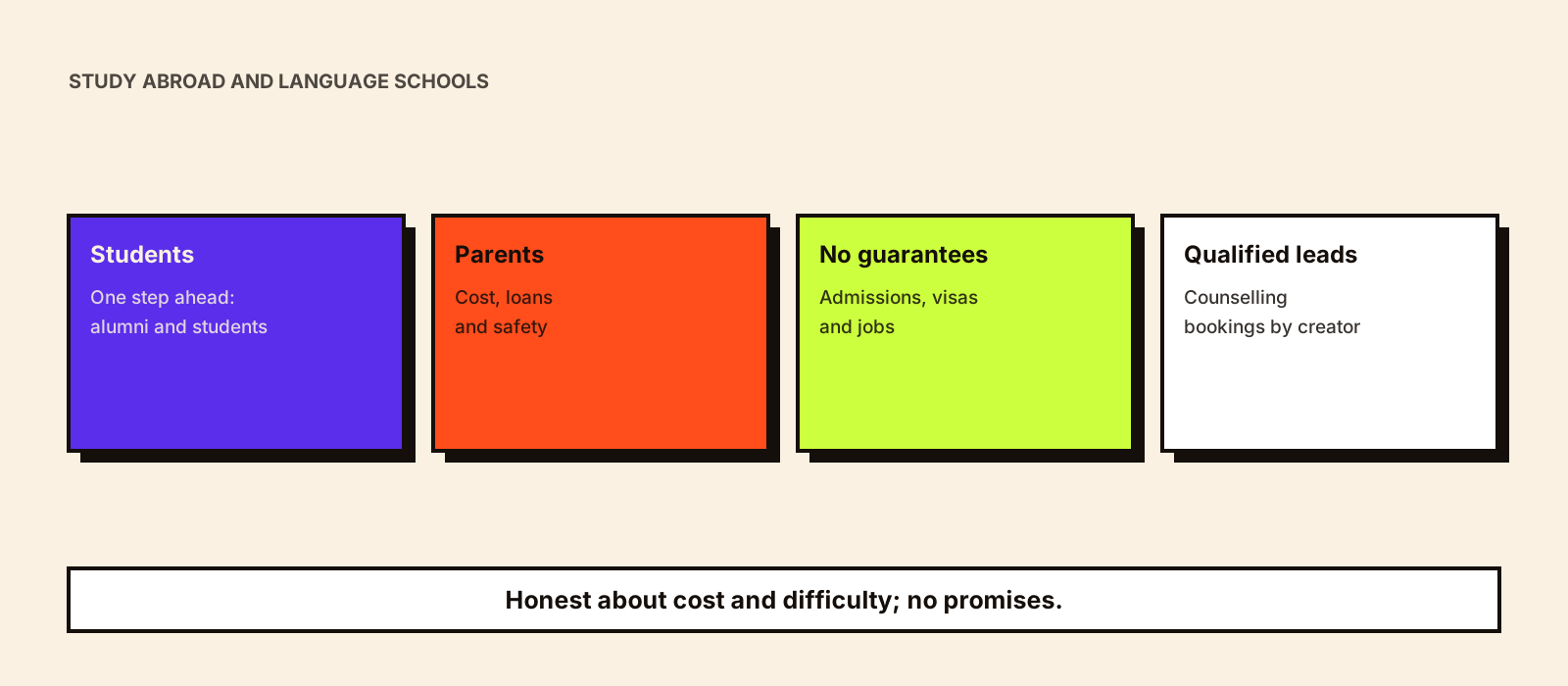
Choosing to study abroad is one of the most expensive decisions an Indian family makes, and it is usually made over many months, by a student and their parents together. Students now research it on Instagram and YouTube, watching people a year or two ahead of them. That makes creators useful to study-abroad consultants and language schools, and it also makes accuracy essential: a misleading promise about admission, a visa or a job can cost a family far more than the price of a course.
Quick answer
Influencer marketing for study-abroad consultants and language schools works best with creators the audience sees as one step ahead: current international students, alumni, test-prep educators and creators who explain costs and loans honestly. Use them for planning content, real cost breakdowns and campus life, and send viewers to a counselling session or trial class. Never let creators promise admission, visas, scholarships, jobs or migration outcomes, keep visa advice with authorised advisers, disclose every paid post, and measure qualified counselling bookings by creator rather than views.
Who you are really talking to
The student usually starts the research, but parents often pay and decide. Content that only shows campus parties reaches the student and loses the parent. Plan for both: student-facing creators for discovery, and finance, loan or family creators for the questions parents ask about cost, safety and return on the investment.
- Students in their final school or college years, often outside the largest metros, comparing countries and courses.
- Working professionals considering a master's degree.
- Parents weighing cost, loans, safety and whether the degree leads to work.
- Language learners, from IELTS, PTE or TOEFL candidates to people learning German, French or Japanese for study or work.
Which creators to work with
| Creator type | Best for | Watch for |
|---|---|---|
| Current international students and recent alumni | Day-to-day life, real costs, part-time work rules as they experienced them, honest regrets | Personal experience presented as a rule for everyone; out-of-date visa details |
| Test-prep and language educators | IELTS, PTE, TOEFL, GRE or language-level tips and study plans | Score guarantees; qualifications not stated |
| Personal finance and education-loan creators | Budgeting, loans, currency, total cost of study | Loan or return-on-investment claims the lender or brand can't support |
| Regional language creators | Families in tier 2 and tier 3 cities who prefer Hindi, Tamil, Telugu, Punjabi or Malayalam | Translation errors in technical terms |
| Parent and family creators | The parent's side: safety, cost, staying in touch | Fear-based messaging |
Diaspora creators already living in destination countries can add useful perspective; working with them is covered in how brands can work with diaspora creators.
Content that earns trust
- Application timelines worked backwards from a real intake, with the date the video was made.
- Cost breakdowns: tuition, living costs, insurance, travel and deposits, with the currency, city and date stated.
- 'What I wish I had known' videos from current students, including what went wrong.
- Test-prep explainers and practice sessions from qualified educators.
- Live Q&A sessions where a creator interviews a named counsellor, with questions about refunds, fees and timelines answered on camera.
- For language schools: a trial class filmed from the learner's side, showing level, class size and homework honestly.
Claims that need care
| Claim | Why it is risky | Safer version |
|---|---|---|
| 'Guaranteed admission' or '100% visa success' | Admission and visas are decided by universities and governments, not by the consultant | 'We help you prepare a complete application' |
| 'Scholarship worth ₹X' | Scholarships are competitive and conditional | Name the scholarship, its criteria and that it is competitive |
| 'Get a job or PR after your degree' | Post-study work and migration rules change and depend on individual circumstances | Link to the official government page and state when it was checked |
| 'Partner of 500 universities' | Hard to verify and often unclear what 'partner' means | State the type of agreement, or don't claim it |
| 'Fluent in 30 days' (language schools) | Promises an outcome the learner controls | Describe the course level, hours and what is covered |
In India, misleading advertisements are prohibited under the Consumer Protection Act, 2019, and endorsers can be held responsible too. The CCPA's November 2024 coaching-sector guidelines, which bar guaranteed ranks, admissions, jobs or salaries, clearly apply to test-prep coaching; legal commentary notes that their definition of coaching excludes counselling, so a pure admissions-counselling service may sit outside them. Don't rely on that distinction: the same promises are risky under the general law. The coaching rules are explained in influencer marketing for education and EdTech brands.
Visa advice is regulated in several destination countries. Canada's immigration department says an education agent who advises on immigration matters must be an authorised representative, in good standing with a Canadian law society, the Chambre des notaires du Québec or the College of Immigration and Citizenship Consultants. In the UK, immigration advice is regulated by the Immigration Advice Authority, formerly the OISC. Creators shouldn't give visa advice at all: they should share their own experience and point viewers to official government pages or an authorised adviser. This is general guidance, not legal advice.
Student testimonials and data
- Use a student's name, photo, score or admission result only with their written consent, and keep that consent on file.
- Don't present a creator's paid partnership as an independent student review; disclose it clearly.
- Ask for only the details you need in a lead form, explain how they will be used, and don't share them with universities or lenders without consent.
Measuring study-abroad campaigns
| Stage | What to measure |
|---|---|
| Interest | Saves, shares and questions in comments about the destination or course |
| Lead | Counselling or trial-class bookings by creator link or code, with destination, intake and budget captured |
| Qualified lead | Leads that meet your criteria (eligible scores, realistic budget, target intake) |
| Outcome | Applications submitted and enrolments, reported months later and matched back to the first creator touch |
Because enrolment can come six to eighteen months after the first video, judge creators on qualified bookings in the short term and report enrolments later. The approach to tracking leads across a long gap is set out in influencer marketing for lead generation.
Common mistakes
- Letting creators promise admissions, visas, scholarships or jobs.
- Working only with student creators and ignoring parents.
- Cost videos without a date, currency or city, which go out of date and mislead.
- Judging creators on follower count instead of qualified bookings.
- Creators answering visa questions in comments.
Conclusion
Study-abroad and language-school marketing works with creators when students and parents trust what they see. Choose creators who are honest about cost and difficulty, keep guarantees and visa advice out of the content, disclose partnerships, and measure qualified counselling bookings. Kudozz plans creator programmes like this through its campaign strategy service.