Barter Influencer Collaborations: How Brands Should Agree Terms, Tax and Disclosure
Product-for-content deals are the most common first collaboration for Indian brands, and the most loosely agreed. When barter works, what to put in writing, how GST and TDS can apply to products a creator keeps, disclosure, and when to move a creator to paid terms.
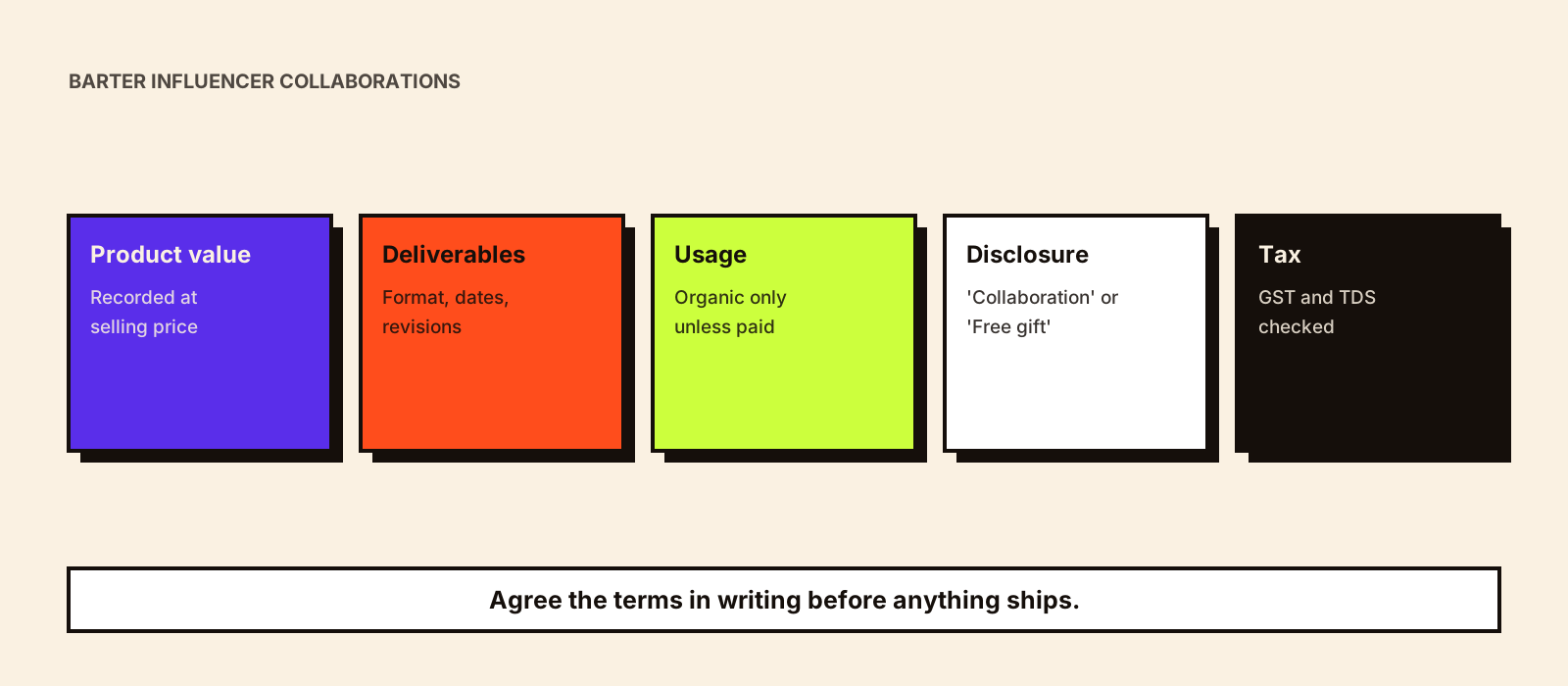
Barter is where many brands start: send a product, get a Reel. It can work well, especially with nano and micro creators who genuinely want the product. It also causes more disputes than paid work, because 'free product for a post' is rarely written down in enough detail.
Quick answer
A barter influencer collaboration is an exchange of products or services for agreed content, with no cash fee. It works best for products creators would choose anyway, with smaller creators and for simple deliverables. Agree the product and its value, the exact deliverables and dates, the number of revisions, how the brand may reuse the content, the disclosure label and what happens if the post doesn't go live, all in writing before you ship. In India a barter is still a supply for GST, and products a creator keeps can attract TDS as a business benefit, so record the value of everything you send.
Barter vs seeding vs paid
| Seeding (gifting) | Barter | Paid | |
|---|---|---|---|
| What the creator gets | Product | Product or service | Fee (often plus product) |
| Obligation to post | None | Yes, agreed deliverables | Yes, agreed deliverables |
| Brand control over content | None | Limited: key points and dates | Brief, approvals and revisions |
| Typical usage rights | None without separate permission | Organic reposting at most, unless agreed | Defined in the contract, often including paid usage |
| Disclosure if the creator posts | Required, e.g. 'Free gift' | Required, e.g. 'Collaboration' or 'Free gift' | Required, e.g. 'Ad' or 'Collaboration' |
| Best for | Discovering who likes the product | Smaller creators, simple deliverables | Specific outcomes, larger creators, ads |
If you want honest reactions with no obligation, run a seeding program instead; see influencer product seeding. Kudozz runs both through its barter campaigns and seeding and gifting services.
When barter works, and when it doesn't
| Works when | Struggles when |
|---|---|
| The product has real value to the creator (beauty, food, fashion, gadgets, experiences) | The product is low-value, niche or hard to show on camera |
| Creators are nano or micro and already post about the category | Creators are large, busy or full-time, with costs to cover |
| Deliverables are simple: one Reel or a Story set | The brand wants scripts, multiple revisions or paid ad rights |
| The brand can accept less control over timing and creative | There's a fixed launch date that every post must hit |
What to agree in writing
- The product or service, quantity and its value at your normal selling price.
- Deliverables: platform, format, number of posts or Stories, and any must-include points.
- Dates: when the product arrives, the posting window and any blackout dates.
- Revisions: usually none or one for barter; say so.
- Usage: whether you can repost organically, and that paid usage needs a separate paid agreement.
- Disclosure: the label to use in the post's language, placed at the start.
- If the post doesn't go live: return of the product, a replacement date, or no further collaboration.
- Whether the creator may also post about competitors in the same period; for barter, exclusivity is rarely reasonable.
Tax: GST and TDS on products in India
Barter doesn't take a collaboration outside the tax system. Under the CGST Act, 'supply' includes barter and exchange, so a creator who is GST-registered may need to account for GST on the value of services provided in exchange for products, and the brand's own GST position on the goods sent needs checking with its accountant.
On income tax, products a creator keeps can count as a benefit or perquisite arising from their business or profession, on which the provider may have to deduct TDS once the annual value crosses the threshold. This was section 194R of the Income-tax Act, 1961; from 1 April 2026 these TDS provisions sit in section 393 of the Income-tax Act, 2025. Because tax is deducted on value, keep a record of what each creator received and its value. The detail, including thresholds, is in TDS for influencers in India and GST for influencers in India.
This is general information, not tax advice. Treatment depends on the facts, such as whether a product is returned after use, so confirm the position with your accountant before running barter at scale.
Disclosure
A free product is a material connection, so a barter post needs a clear label. Under ASCI's guidelines in India, labels such as 'Collaboration' or 'Free gift' are accepted, placed where the audience sees them first. In the UAE, creators paid in products or stays also need an advertiser permit. Other markets are covered in influencer disclosure rules by country.
Barter agreement template
Brand: [name]   Creator: [name, handle]   Date: [ ]

Product(s) provided: [items, quantity]  |  Value at normal selling price: ₹[ ]
Shipping to: [address]  |  Expected delivery: [date]

Deliverables: [e.g. 1 Instagram Reel, 30-60 seconds, + 2 Stories with link sticker]
Must include: [1-3 points, product name, any code or link]
Posting window: [dates]   Blackout dates: [ ]
Revisions: [none / one round on the draft]

Disclosure: '[Collaboration / Free gift]' at the start of the caption and on screen; platform label switched on
Usage: brand may reshare organically on its own accounts for [period]. Paid ads, whitelisting or edits need a separate paid agreement.

If content isn't posted by [date]: [return product / agree a new date / end the collaboration]
Creator confirms they have used the product and the content reflects their honest view.

Tax: value recorded for GST and TDS purposes; creator to share PAN [and GSTIN if registered].

Signed / agreed by email: [brand]  [creator]
Measuring barter campaigns
Barter isn't free. Count the product at cost, shipping, packaging, any TDS you bear, and team time for outreach and follow-up. Then judge it on the same basis as paid work: posting rate (what share of creators posted on time), reach, engagement quality and any tracked sales. A barter program with a low posting rate can cost more per post than a small paid campaign.
Moving a creator from barter to paid
When a barter creator's content performs well, offer a paid follow-up rather than more product. It's fairer, it secures them before a competitor does, and it lets you ask for things barter can't: a brief, approvals, a fixed date and paid usage. For pricing, see how much to pay influencers.
Common mistakes
- Shipping first and agreeing terms afterwards.
- Expecting paid-level control, multiple revisions or ad rights from a barter deal.
- Using creator content in ads because 'they got free product'.
- Not recording product values, which complicates GST and TDS later.
- Offering barter to full-time creators who have made clear they work on paid terms.
Conclusion
Barter works when the product is genuinely wanted and the terms are clear. Agree deliverables, dates, usage and disclosure in writing, record the value of what you send, and treat good barter creators as candidates for paid partnerships. For the full set of contract clauses, see influencer marketing contracts.