Creator Affiliate Marketing in India: Complete Guide to Earning From Product Recommendations
How affiliate links, codes and commissions work for Indian creators, how affiliate compares with and combines with brand deals, which products to promote, and how to keep audience trust.
Every time someone comments "link?" under your video, there's an affiliate opportunity. Affiliate marketing pays you a share of sales you drive, which suits creators whose audiences already ask where to buy things. It rewards trust, not just reach.
Quick answer
Creator affiliate marketing means earning a commission when your audience buys through your unique link or code. In India, creators use retailer affiliate programmes, brand-run programmes, affiliate networks and platform tools such as YouTube Shopping. Income depends on your audience's buying intent, the commission rate, the retailer's conversion and return window. Affiliate content must be disclosed (ASCI lists "Affiliate" as an acceptable label). Affiliate works on its own, but often works best combined with a fixed-fee brand deal.
How affiliate marketing works
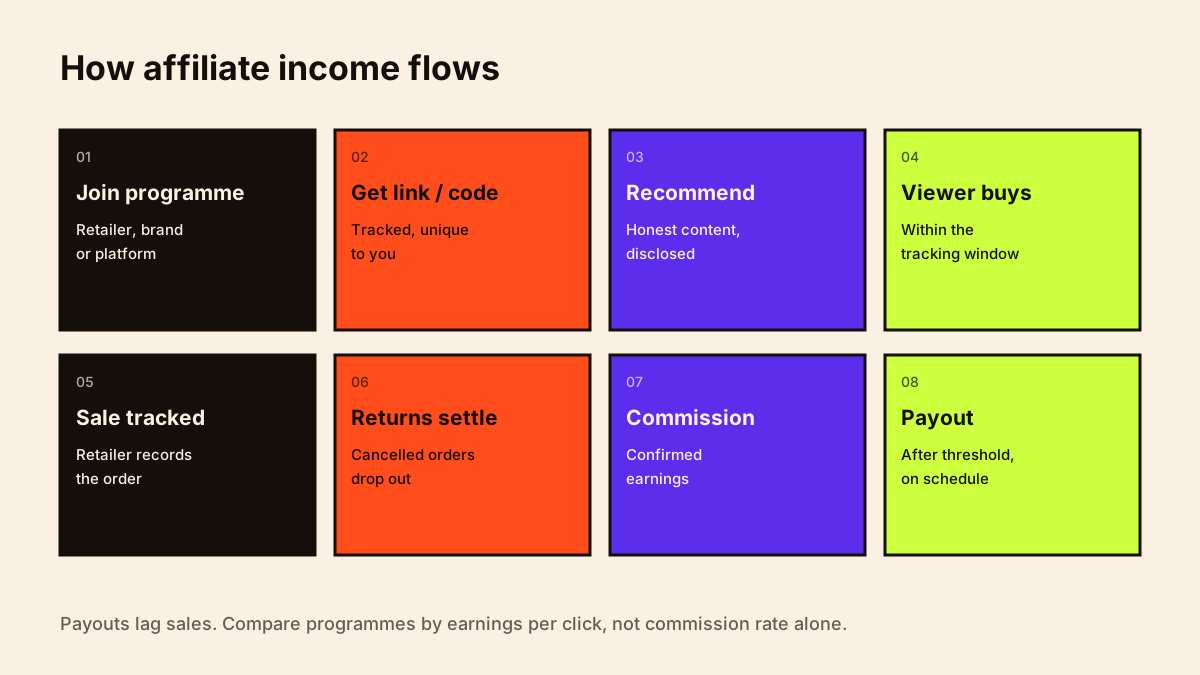
- Join a programme and get a tracked link or code.
- Feature the product in content and share the link (bio, description, Story link sticker, pinned comment, product tag).
- A viewer clicks and buys within the tracking window (often a cookie window).
- The retailer records the sale; commission is confirmed after returns and cancellations.
- You're paid once you pass the programme's payout threshold, on its payout schedule.
Key terms
| Term | Meaning |
|---|---|
| Commission rate | Percentage (or fixed amount) you earn per qualifying sale; often varies by category |
| Tracking or cookie window | How long after a click a purchase still counts |
| Conversion rate | Share of clicks that become purchases |
| EPC (earnings per click) | Total earnings ÷ clicks; useful for comparing programmes |
| Return window | Period before a sale is confirmed; returns cancel commission |
| Payout threshold | Minimum balance before you're paid |
| Discount code | Code that tracks sales and gives the buyer a discount |
Clicks: 2,000
Conversion rate: 3% → 60 orders
Average order value: ₹1,200 → sales ₹72,000
Commission rate: 5% → ₹3,600
Returns cancel 10% → confirmed ₹3,240
EPC = ₹3,240 ÷ 2,000 = ₹1.62 per click
Where Indian creators find affiliate programmes
- E-commerce and marketplace affiliate programmes run by large Indian retailers.
- Brand-run programmes, especially D2C brands, often with codes and higher commissions.
- Affiliate networks and link tools that aggregate many retailers.
- Platform shopping tools: YouTube Shopping lets eligible creators in India tag products from participating retailers and earn commission.
- Service and app referral programmes (finance, education, software), which often pay per sign-up rather than per sale. Finance-related promotion carries extra regulatory caution.
Read each programme's terms carefully: commission rates, cookie windows, prohibited promotion methods and payout rules differ. For YouTube specifically, see YouTube Shopping for Indian creators.
Brand deal vs affiliate deal
| Brand deal (fixed fee) | Affiliate deal | |
|---|---|---|
| You're paid for | Content and reach | Sales you drive |
| Who carries the risk | Mostly the brand | Mostly you |
| Income timing | Per agreed payment terms | After purchases and return windows |
| Creative control | Brief, approvals | Usually more freedom |
| Best for | Awareness, launches | Products your audience already wants |
| Disclosure | Required | Required |
Brand deal plus affiliate: the hybrid
A hybrid deal pays a fixed fee for the content plus commission on sales. It shares risk fairly: the brand gets content and reach at a lower fixed cost, and you're rewarded if your audience buys. Useful when a brand is testing creators, or when you're confident your audience converts.
Hi [Name],

My audience regularly asks where to buy the products I review, so I'd propose a hybrid: a ₹[X] fee for one Reel and a Story set, plus [Y]% commission on sales through my code for 60 days. That keeps your upfront cost lower while rewarding results. I'll share click and code data weekly.

[Name]
Choosing products to promote
- Products you've actually used and would recommend without a commission.
- Products your audience already asks about.
- Price points that match your audience.
- Retailers with reliable delivery and returns in your audience's cities.
- Avoid products with unsupported health, finance or "guaranteed results" claims.
Content formats that convert
- Comparisons: "three sunscreens under ₹500 tested".
- "What I actually use" routines and setups.
- Long-term reviews that show results over time.
- Sale-season buying guides (festive sales, year-end sales).
- Tutorials where the product is essential to the result.
Disclosure and trust
Affiliate links are a material connection. ASCI's influencer guidelines list "Affiliate" among acceptable disclosure labels; place disclosure upfront, not buried at the end of a description. Tell your audience plainly: "I earn a small commission if you buy through my link, at no extra cost to you." Audiences forgive commissions; they don't forgive feeling tricked.
Tracking and improving
- Track clicks, conversions and earnings per product and per piece of content.
- Compare EPC across programmes, not just commission rates.
- Update or remove links to discontinued or out-of-stock products.
- Note which formats and price points convert best, and make more of them.
- Keep records of affiliate income for tax purposes; commissions may have TDS deducted.
To give all your recommendations one shoppable home, see creator storefront, and for the wider strategy of turning content into sales, creator commerce in India.
Affiliate income fits into a wider mix; see creator monetization in India and how to turn brand content into multiple revenue streams. For the tax side, see TDS for creators.
Brands think about affiliate programmes differently; see Instagram influencer affiliate marketing and influencer marketing vs affiliate marketing.
Two guides go deeper: creator product recommendations for the trust standard behind every recommendation, and creator affiliate links for placement and clicks without spamming.
An affiliate content strategy that converts
Affiliate content converts best when it's planned around the decisions your audience is making, not around whichever products have the highest commission.
| Audience stage | Content that helps | Affiliate role |
|---|---|---|
| Discovering a need | Problem explainers, routines, setups | Light: link the tools you use |
| Comparing options | Comparisons, "best under ₹X", long-term reviews | Main: link each option and say who it suits |
| Ready to buy | Deals roundups, restocks, sale guides | Direct: current links and codes |
| After purchase | How-to and care guides | Accessories and refills, if genuinely useful |
Plan a monthly mix across these stages, keep commercial content within the share your audience accepts, and measure revenue per 1,000 views by format. Shoppable content for creators covers the formats, and creator conversion rate covers measurement.