Creator Burnout: How to Stay Consistent Without Posting Every Day
A practical, kind guide to creator burnout for Indian creators: the signs, why it happens, what the research says, a sustainable posting cadence, a weekly system, boundaries with brands and audiences, and taking breaks.
If opening your phone to check last night's Reel makes your stomach drop, or you've started dreading the content you used to love making, you're not alone and you're not lazy. Many creators reach a point where the pace they set early on is no longer something they can keep. This guide helps you recognise burnout, rethink what consistency actually means, and build a system that keeps your account alive without asking you to post every day.
Quick answer
You can stay consistent without posting daily by choosing a cadence you could realistically keep for six months, then protecting it with systems: recurring series formats, batch filming, a buffer of two or three ready posts and repurposing one idea across formats. Set boundaries with brands (realistic timelines and revision limits in writing) and with your audience (fixed hours for DMs). Plan breaks with scheduled evergreen content. If stress starts affecting your sleep, health or relationships, talk to a qualified mental health professional. This guide is practical advice, not medical advice.
What creator burnout looks like
Burnout usually builds slowly. Some common signs creators describe:
- You feel tired before you've started filming, even after rest.
- Ideas that used to come easily now feel impossible, and you keep copying trends you don't care about.
- Your mood rises and falls with each post's views.
- You check analytics or comments compulsively, including late at night.
- You dread brand emails, even for deals you wanted.
- You've stopped doing things you enjoy because "I should be making content".
- Small problems, like a failed upload or a rude comment, feel much bigger than they should.
Having one or two of these on a bad week is normal. If several have been true for weeks, treat it as a signal to change how you work, not as a personal failure.
Why it happens
| Cause | What it feels like |
|---|---|
| Algorithm anxiety | Believing that one missed day will "kill" your reach, so you never stop. |
| Comparison | Measuring your week against another creator's best Reel, often someone with a team. |
| Unpaid admin | Hours of emails, invoices, follow-ups and briefs that nobody sees and nobody pays for. |
| Brand deadlines | Several deliverables landing at once, especially around festive seasons, on top of your own content. |
| Always on in DMs | Replying to followers and brands at all hours, so work never really ends. |
| Juggling other commitments | Creating around a job, college, family responsibilities or exams, with very little slack. |
| Money worries | Irregular income makes every slow month feel like a crisis. |
Pressures many Indian creators know well
- The festive rush: brand briefs for Diwali, Navratri, Onam, Pongal, Durga Puja or wedding season often arrive together, right when family commitments peak. Plan festive content weeks earlier and cap how many brand deals you take in that window.
- Creating around a job or college: your content time is evenings and weekends, so a daily schedule leaves no time for rest. A smaller weekly cadence is not a weaker one.
- Family expectations: relatives may not see content as real work, or may expect quick results. Sharing a simple monthly plan and income record can make the work feel more concrete to them, and to you.
- Shared spaces: filming at home around family routines makes daily posting harder. Batching on the days when the house is quiet helps.
- Exam and admission seasons: if you or your siblings have exams, plan a lighter month and build a buffer beforehand.
What the research says
There isn't much recent India-specific research on creator burnout, so read these figures for what they are.
- India: a Spotify-commissioned study, reported by The Week in May 2024, covered 230 creators in Delhi, Mumbai and Bengaluru. Nearly 80% said they faced excessive stress or pressure at least once a week, almost 40% spent more than three hours a day making content, and nearly 65% felt inadequately supported by the creator community. It is a small, metro-only sample.
- US and UK (not India): Billion Dollar Boy surveyed 1,000 creators and 1,000 senior marketers in the US and UK in July 2025. 52% of creators said they had experienced burnout because of their career and 37% had considered leaving. Creative fatigue (40%), workload (31%) and screen time (27%) were the top causes.
- North America (not India): a Creators 4 Mental Health and Lupiani Insights study of 542 North American creators, reported by Tubefilter in November 2025, found 62% reported burnout, 69% said they obsess over content performance and 58% said their self-worth drops when content underperforms.
The Week's report on the Spotify study, Billion Dollar Boy's survey and Tubefilter's coverage of the Creators 4 Mental Health study all point to the same pattern: pressure, overwork and tying self-worth to numbers are common. You are not the only one feeling this.
What Instagram's head has said about posting frequency
In a Reel posted on 6 December 2024, Instagram head Adam Mosseri said: "Posting often generally helps with reach but it's important not to burn out." His advice was to "come up with a schedule that feels sustainable for you, and define a few patterns" so it's easier to come up with content when you hit a block. That's not a promise that posting less won't affect reach. It's a reminder that a schedule you can keep matters more than one you abandon.
Redefine consistency
Consistency doesn't mean daily. It means your audience can predict when and what you'll post, and you can keep doing it. A useful test: could you keep this cadence for six months, including during exams, a festive brand rush or a family function? If not, it's too much.
| Tool | How it reduces pressure |
|---|---|
| A sustainable cadence | Pick a number you can hit on a bad week, for example two Reels and one longer video, not your best-week output. |
| Series formats | Recurring formats ("Sunday street food", "one money myth a week") remove the blank-page problem, which is what Mosseri means by defining patterns. |
| Batching | Script, film and edit several pieces in dedicated blocks instead of creating from scratch every day. |
| A content buffer | Keep two or three finished posts ready so a sick day or a brand rush doesn't break your schedule. |
| Repurposing | Turn one long video or one shoot into Shorts, Reels, carousels and a Story, rather than inventing new ideas for each. |
For the detail, see our guides to content batching for creators, building a creator content series and content repurposing.
A weekly system you can copy
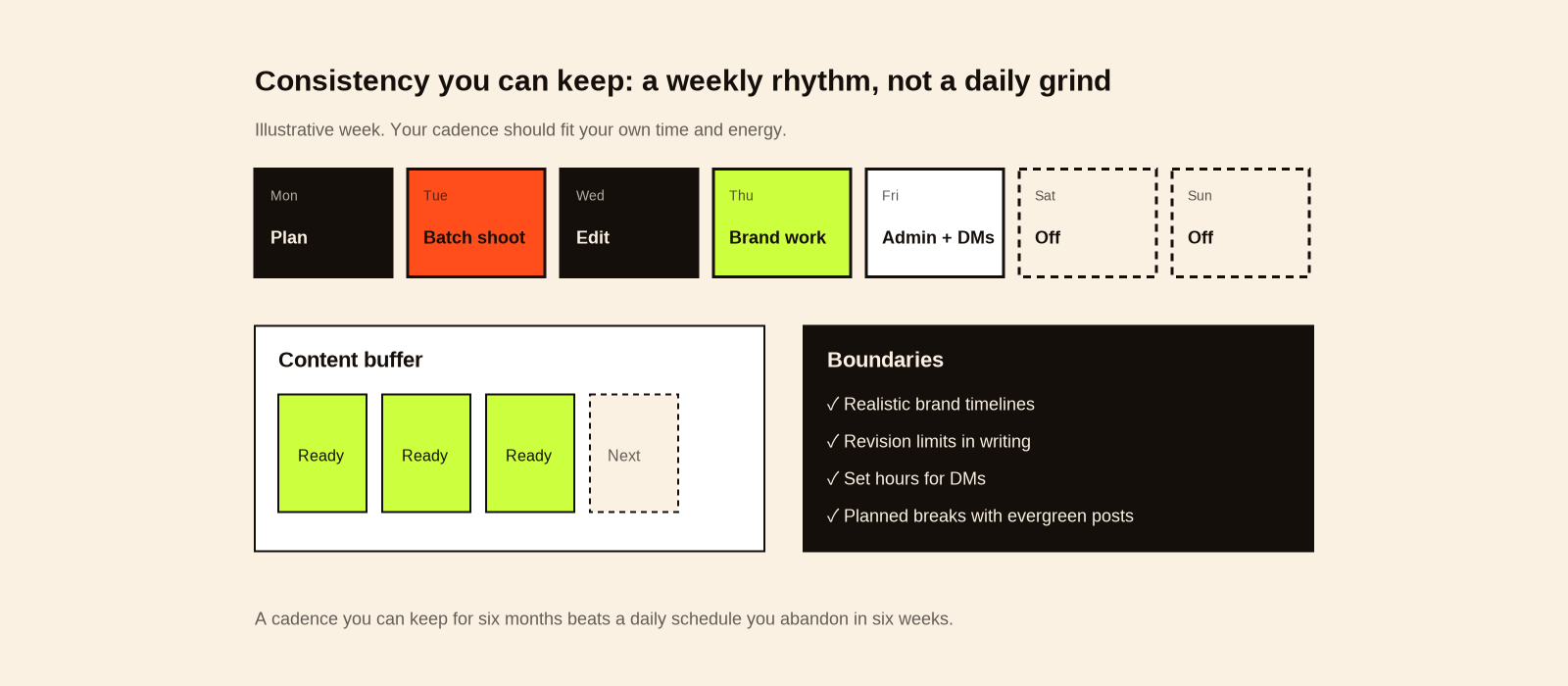
Here is an illustrative weekly template for a creator posting two or three times a week alongside a job or college. Move the blocks to fit your own life.
Monday (45 min): Plan the week. Pick 2–3 ideas from your series list, check brand deadlines, note one thing to repurpose.
Tuesday (2 hrs): Batch film everything for the week in one setup.
Wednesday (2 hrs): Edit. Export Reels, Shorts and one carousel from the same footage.
Thursday (1–2 hrs): Brand deliverables or a buffer post.
Friday (45 min): Admin. Invoices, emails, schedule posts, reply to DMs in one sitting.
Saturday and Sunday: Off. Posts go out on schedule. Check comments once, if at all.
Rule: if the buffer has fewer than 2 ready posts, next week's Thursday goes to the buffer, not new ideas.
Write your schedule into a simple creator content calendar so you can see brand deadlines and your own posts in one place.
Boundaries with brands
Brand work is often where burnout spikes: tight turnarounds, unclear briefs and endless rounds of changes. Most of this can be prevented before you say yes.
- Quote realistic timelines that include your own content, and add buffer days around festive seasons.
- Get the deliverables written down: how many pieces, which formats, which platforms and by when.
- Agree a revision limit in writing (for example, two rounds of changes) and what counts as a new request.
- Avoid stacking several brand deadlines in the same week. It's fine to offer a later date.
- Say no to deals that don't fit, especially when you're already stretched.
Our guides to defining creator deliverables and handling brand content approvals and revisions include clauses and wording you can reuse.
Boundaries with your audience
- Pick DM hours, for example 30 minutes after lunch and 30 minutes in the evening, and turn off notifications outside them.
- Use saved replies for common questions (product links, which camera you use, how to collaborate).
- Pin a comment or highlight with FAQs so you answer once, not hundreds of times.
- Keep a separate business email for brands so work messages don't arrive mixed with personal chats.
- Mute or restrict accounts that drain you. You don't owe everyone a reply.
Taking a break without losing everything
A planned break is very different from disappearing. Before you step away:
- Tell your audience briefly. A short Story saying you're taking two weeks off and will be back is enough.
- Schedule a few evergreen posts (guides, tutorials, best-of compilations) so your account isn't silent.
- Finish or reschedule brand deliverables in writing before you go.
- Set an auto-reply on your business email with your return date.
- If your account has Instagram's Trial Reels, you can use them after a break to test new ideas with non-followers before sharing to your main feed.
Some reach may dip while you're away. That's usually recoverable; a creator who has burnt out completely often isn't. For longer breaks, our guide to creator business continuity covers handing over tasks and keeping income steady, and our Trial Reels guide explains how that feature works.
Money anxiety
In Billion Dollar Boy's US and UK survey, 55% of burnt-out creators ranked financial instability as the most severe factor. Irregular income makes it hard to rest, because every week off feels like lost money. A few steps help: separate business and personal money, build an emergency fund that covers a few months of basic expenses, track what's owed to you, and avoid relying on a single brand or platform. Our guide to creator financial planning walks through a simple system for irregular income.
When to seek professional help
Burnout advice can only go so far. If you're struggling to sleep or eat, feel hopeless or numb most days, can't function at work or college, or have thoughts of harming yourself, please talk to a qualified mental health professional or someone you trust. In India, Tele-MANAS, the national tele-mental health helpline run by the Ministry of Health and Family Welfare, can be reached on 14416 or 1-800-891-4416. Its official website describes 24x7 tele-mental health services. If you are in immediate danger, contact local emergency services.
Conclusion
Creator burnout is common, and it's a sign that your system needs to change, not that you should quit. Choose a cadence you can keep for six months, lean on series, batching, a buffer and repurposing, and set clear boundaries with brands and your audience. Plan breaks instead of crashing into them. Your audience followed you for your voice, and protecting your energy is how you keep it.