AI Deepfakes and Creator Identity: How to Protect Your Face, Voice and Name
A calm, practical guide for Indian creators on AI deepfakes: what misuse looks like, how to prevent and detect it, how to report it under India's 2026 IT Rules, and how to use AI of yourself responsibly.
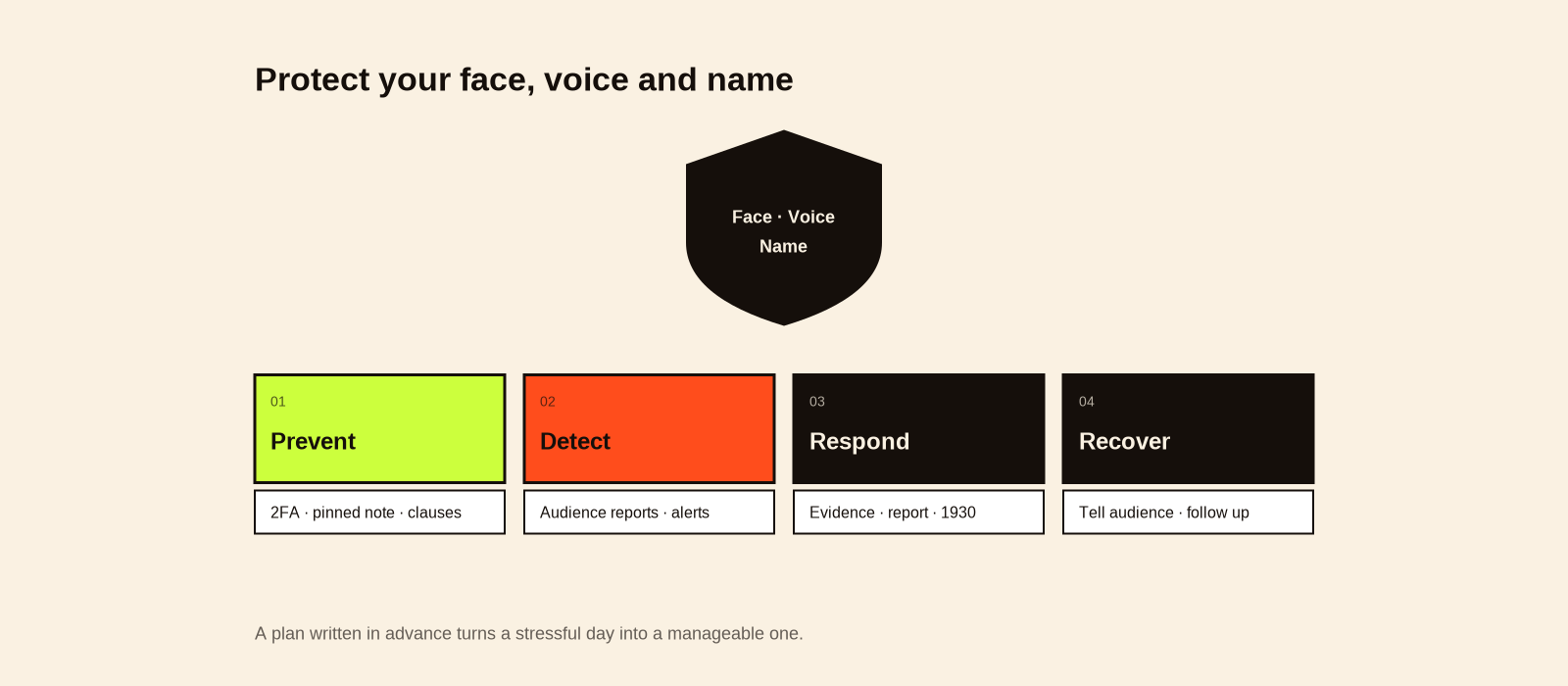
Once your face and voice are public, someone can feed them into an AI tool. Most creators will never face a serious deepfake, but face-swapped ads and cloned voices promoting scams do appear, and they tend to target people whose audiences trust them. You can't stop every misuse, but you can make it harder, spot it faster and respond with a plan instead of panic.
Quick answer
Secure your accounts, tell your audience publicly how you do deals and that you never ask them for money, keep your original files, and add AI-likeness clauses to brand contracts. Watch for misuse through audience reports, search alerts and, where available, YouTube's experimental likeness detection. If you find a deepfake, save evidence first, report it to the platform and its grievance officer, and report fraud at cybercrime.gov.in or the 1930 helpline. India's IT Rules, amended in February 2026, require faster action from platforms on impersonation complaints.
What can actually happen
It helps to know the shapes misuse takes, so you recognise it quickly. This guide covers AI-made content using your likeness. For fake profiles copying your name and photos, see our guide to creator impersonation and fake accounts.
| Type of misuse | What it looks like | Main harm |
|---|---|---|
| Face-swap ads | Your face edited onto an ad for a product, app or 'investment scheme' | Followers trust a scam because it seems to be you |
| Voice clones | Audio or voice notes in your voice asking for money or promoting something | Direct financial fraud against your audience |
| Fake endorsements | A brand or seller uses your clip or AI 'you' to claim you recommend them | Your credibility, and conflicts with real sponsors |
| Scam accounts using AI 'you' | New accounts post AI videos of you and DM followers with offers | Followers lose money; you get the angry messages |
| Morphed or harmful content | Edited images or videos that show you in false or degrading situations | Reputation and personal safety |
Prevention: make misuse harder and easier to spot
Lock down your accounts
A deepfake posted from your own hacked account is far more damaging than one posted by a stranger. Turn on two-factor authentication, use a separate business email, and review who has access to your channels. Our creator account security guide walks through each platform.
Tell your audience how you work, before anything happens
The best defence against a fake 'you' is followers who already know what the real you would never do. Put a short line in your bio or a pinned post, and repeat it occasionally in videos.
Quick safety note: I will never ask you for money, OTPs, UPI payments or investments in DMs or WhatsApp. I don't run giveaways that need a 'registration fee'. My only accounts are [list handles]. Brand promotions I do are always labelled and posted from these accounts. If you see 'me' saying otherwise, it's fake. Please report it and tell me at [email].
Keep your originals
Store raw footage, project files and exported originals with dates. If someone circulates a manipulated version, your original is the fastest proof of what you actually said. A simple backup routine is enough; see our creator backup strategy.
Use visible signals
A verified badge where you qualify, a consistent handle across platforms, and a small watermark or logo on your videos won't stop a determined faker, but they make copies easier for followers and platforms to tell apart from yours.
Put AI use of your likeness in your contracts
Brands increasingly have tools that can create new clips from your existing footage or voice. Unless your contract says otherwise, you may find it hard to object later. Add clauses that cover:
- No creating AI-generated or altered versions of your face, voice or name without separate written consent.
- No training AI models on your content or voice.
- Edits limited to normal cuts, captions and formatting of the content you delivered.
- Usage ends on a fixed date, after which the brand stops running your content in ads.
- If they want an AI version later, it's a new deal with its own fee and approval rights.
Our influencer contract guide for creators and the guide to creator usage rights explain how to word and negotiate these terms.
Detection: how you'll find out
Most creators hear about a deepfake from a follower, not a tool. Make that easy: tell people where to report suspicious content to you, and take those messages seriously. Beyond that:
- Search your name, handle and common misspellings on each platform every couple of weeks, including in ads libraries where platforms offer them.
- Set up web alerts for your name and channel name.
- Ask a trusted friend or team member to flag anything odd they see.
- Watch for sudden DMs from followers asking "is this really you?" That's often the first sign.
YouTube likeness detection
YouTube has a tool that scans for videos using your face. Its Help page on likeness detection describes it as "currently an experimental feature" that "isn't available in some countries", without listing which countries. YouTube first rolled it out to Partner Program creators in October 2025, and Tubefilter reported in May 2026 that any eligible creator over 18 would get access "in the coming weeks". Whether it's available to you in India isn't confirmed, so check YouTube Studio under Content detection.
- You must be over 18 and the Channel Owner or Manager.
- Setup needs a government ID and a selfie video, and verification "may take up to 5 days".
- It detects faces only for now. YouTube says it's working to extend detection to audio in 2026.
- For each match, you can request removal (as a privacy complaint), file a copyright request, or archive it.
- You can switch it off, and enrolled data is stored for up to three years from your last sign-in.
Response playbook: what to do when you find one
Move in this order. Reporting before you've saved evidence can leave you with nothing to show if the post disappears and resurfaces elsewhere.
1. Preserve evidence
- Screenshot the post, the account profile and any comments or DMs, with the date and time visible.
- Copy the exact URLs of the post and the account.
- Screen-record the video playing, if you can.
- Collect messages from followers who were contacted or lost money, with their permission.
- Note where your original content is stored, if the fake is based on a real clip.
2. Report to the platform
Use the platform's own reporting for impersonation, privacy or fake content. On YouTube, a privacy complaint is one of the routes for removal of content showing your likeness. If a report gets no response, escalate to the platform's Grievance Officer, which PIB names as the first stop for complaints.
According to a PIB release from MeitY dated 6 August 2026, the government amended the IT Rules on 10 February 2026 to address AI-generated content including deepfakes. Takedowns ordered by courts or the government must now happen within 3 hours instead of 36. Grievance redressal timelines were cut from 72 hours to 36 hours, and for sensitive categories such as impersonation and nudity from 24 hours to 2 hours. Legal analysis by Khaitan & Co notes the amendment came into force on 20 February 2026.
3. Appeal if the platform doesn't act
If the grievance officer doesn't resolve your complaint, the same PIB release says you can appeal to the Grievance Appellate Committee at gac.gov.in.
4. Report fraud and crime
If the deepfake is being used to cheat people, or harms you seriously, file a complaint on the National Cyber Crime Reporting Portal at cybercrime.gov.in or call the 1930 helpline. PIB says deepfakes, financial frauds and content misuse are all reportable there, and lists offences under the IT Act and the Bharatiya Nyaya Sanhita that can apply.
5. Talk to your audience
Post a short, calm warning so followers stop engaging with the fake. Don't repost the deepfake itself; a screenshot with a large 'FAKE' label is enough. Our guide to creator crisis communication covers tone and timing.
Heads up: a [video/ad/voice note] is going around that uses an AI-made version of my face/voice to promote [product/scheme]. That is not me, and I have no connection with it.

I will never ask you for money, OTPs or investments in DMs.
My only accounts are [handles].

If you've seen it, please report it on the platform. If you've lost money, call 1930 or file a complaint at cybercrime.gov.in. I've reported it and will update you here.
6. Know when to call a lawyer
Consider legal advice if the content keeps reappearing, a business is using your likeness to sell products, the content is sexual or defamatory, or you've lost brand deals because of it. Courts in India, notably the Delhi High Court, have granted interim orders protecting the personality rights of public figures, including against AI and deepfake misuse; LiveLaw reported one such order in September 2025. Those cases involved well-known celebrities, so a lawyer can tell you what applies to your situation.
Date found: ____  Found by: ____
Platform and URL(s): ____
[ ] Screenshots with date/time saved
[ ] Screen recording saved
[ ] Account profile captured
[ ] Original content located (if relevant)
[ ] Reported on platform (ticket/reference no.: ____)
[ ] Grievance officer contacted (date: ____)
[ ] GAC appeal filed, if unresolved (date: ____)
[ ] Cybercrime complaint / 1930 call (ack no.: ____)
[ ] Audience warning posted (link: ____)
[ ] Brands you currently work with informed
[ ] Lawyer consulted (if needed)
Status check dates: ____ / ____ / ____
Tell current sponsors early. A fake endorsement for a competitor can confuse them, and they'll appreciate hearing it from you first. Our creator reputation management guide covers the longer-term side.
ASCI's new AI rules for ads
ASCI published guidelines on labelling synthetically generated content in advertising in September 2026. They take effect three months after publication, so they are not yet in force as of November 2026. Once they apply, ads may not use "deepfakes or an individual's likeness without consent" or fabricated endorsements, even with a label. Ads that replicate a real person's likeness or voice with consent, or use AI-generated influencers, must be labelled. For creators, that gives you a clear industry rule to point to if a brand wants to put an AI version of you in an ad without asking.
Using AI versions of yourself responsibly
Some creators use AI avatars or voice clones of themselves to scale content. That's your choice, but it makes clear rules more important, because your audience needs to tell your real content from fakes.
- YouTube's altered-content rules say cloning your own voice for voiceovers doesn't on its own need the "AI use" disclosure, but realistic content showing a real person saying or doing something they didn't does.
- Meta says it may require an AI label for photorealistic video or realistic-sounding audio, such as a Reel with a realistic AI voiceover.
- In ads, ASCI's new guidelines will require a label when a real person's likeness or voice is replicated, even with consent.
- Only use voice-clone or avatar tools you trust, and read what they do with your recordings.
- Tell your audience how you use AI, for example in a pinned note, so a fake doesn't seem consistent with your normal output.
When unsure, label it. Our guide to AI disclosure for creators explains the platform settings step by step.
Conclusion
Deepfakes are a real risk, but not one that should keep you off camera. Secure your accounts, tell your audience how you work, keep your originals, and get AI-use clauses into your contracts. If misuse happens, save evidence, report to the platform and grievance officer, escalate to the GAC or cybercrime portal when needed, and warn your audience calmly. A plan you've written down in advance is what turns a stressful day into a manageable one.