Influencer Marketing Budget Planning for Seasonal Businesses
If most of your sales arrive in a few weeks or months, an evenly spread influencer budget wastes money. How seasonal brands should phase creator spend, book creators before rates and calendars fill up, build a content bank off-season and keep cash flow in check.
A woollens brand that sells most of its year in a few winter months, an air-conditioner maker that lives on the summer, a wedding-wear label, a coaching institute tied to exam dates: for these businesses, an influencer budget split evenly across twelve months is money spent when customers aren't buying and missing when they are. Seasonal brands need a budget shaped like their demand, and the planning has to start before the peak, not during it.
Quick answer
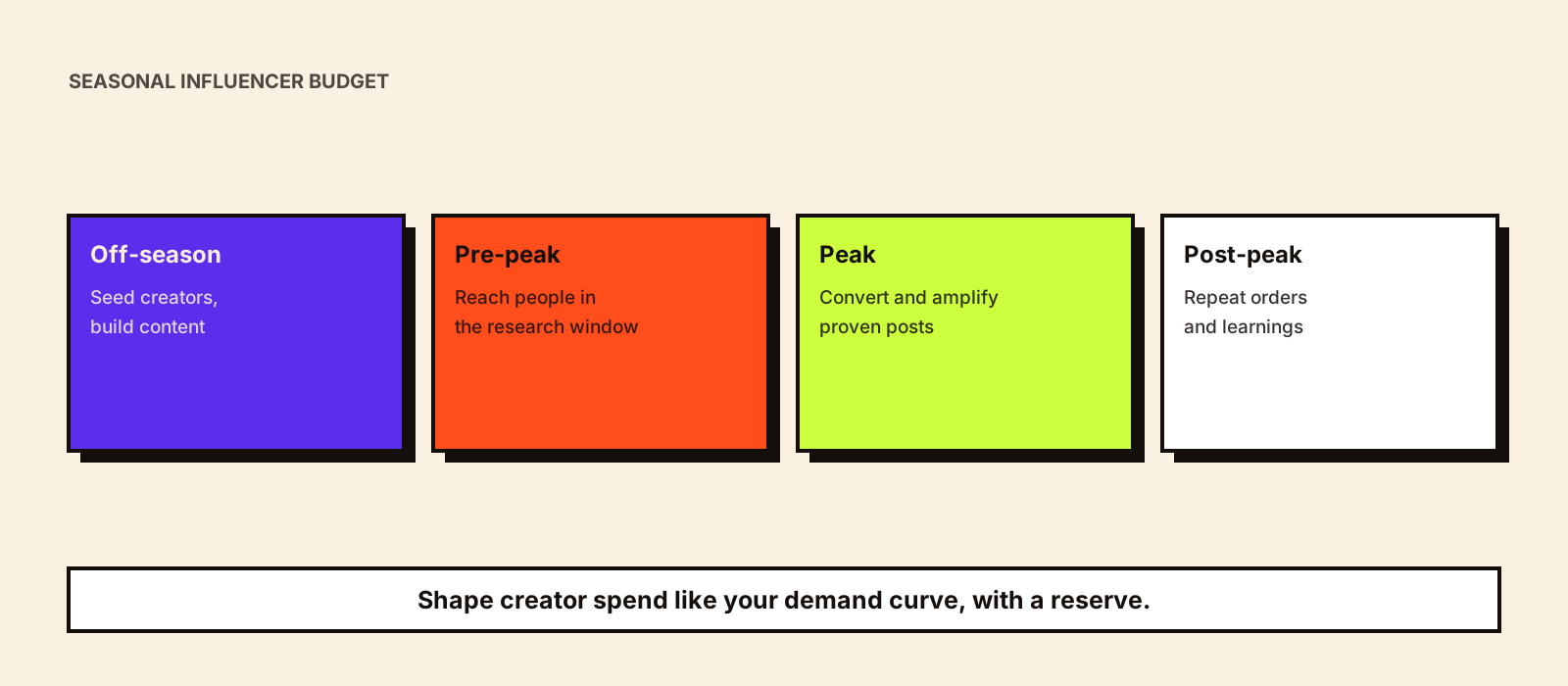
Map your sales by month, then phase creator spend in four parts: an off-season period for building content and relationships cheaply, a pre-peak period to build awareness and consideration, the peak itself for conversion-focused content and paid amplification of proven posts, and a short post-peak period for retention and learning. Book creators for the peak well in advance, because the best ones fill up and many raise rates in busy periods. Keep a reserve to scale what works mid-season, and check that the cash leaves the business at a time you can afford it.
Know which kind of seasonality you have
| Pattern | Examples | Budget implication |
|---|---|---|
| Weather-driven | Woollens, air conditioners, coolers, sunscreen, rainwear | Peak dates move with the weather; keep wave timing flexible by region |
| Festival and gifting | Gift hampers, jewellery, sweets, electronics during festive sales | Fixed dates, crowded feeds, higher creator demand; book early |
| Life-event | Wedding wear, wedding services, baby products | Long consideration; pre-peak content matters as much as the peak |
| Academic calendar | Coaching, test prep, school supplies, study-abroad services | Tied to exam and admission dates; parents and students decide at different times |
| Travel and holiday | Hotels, tour operators, travel gear | Booking happens well before travel; spend ahead of the season, not during it |
If your peaks are mainly festivals and cultural moments, seasonal influencer marketing in India covers the calendar and creative side. This page is about the money: how much to spend in each phase and when.
Step 1: Map demand, then map decisions
Start with your own sales by month (or week) for at least the last two years, by product and region if the pattern differs. Then mark when customers decide, which is often earlier than when they buy. Wedding outfits and holidays are researched weeks or months before purchase; an air conditioner might be bought on the first very hot weekend. Creator content has to arrive in the research window, not just the buying window.
Step 2: Phase the budget
| Phase | Typical share of annual creator budget (illustrative) | What the spend does | Measure |
|---|---|---|---|
| Off-season | 10–15% | Seeding, content shoots, testing hooks and creators at lower competition | Content produced, creator fit, early engagement quality |
| Pre-peak build | 25–35% | Awareness and consideration content in the research window | Reach in target audience, saves, branded search, waitlists |
| Peak | 40–50% | Conversion content, codes, paid amplification of proven posts | Orders, cost per new customer, stock sell-through |
| Post-peak | 5–10% | Usage, care and second-purchase content; review what worked | Repeat orders, returns, learnings for next season |
| Reserve | 10% (held back) | Scaling winners mid-season or covering a late, strong peak | Released only against agreed triggers |
These shares are illustrative, not a benchmark. A brand with a very short peak might put more into pre-peak; a brand whose customers decide on the day might put more into the peak itself. What matters is that the shape follows your demand curve. For building the overall budget figure and its line items, see influencer marketing budget planning.
Step 3: Book peak creators early
In busy periods, the best-fit creators are booked by several brands at once and many raise their rates. Approach them before the season, agree dates and fees, and consider a multi-post deal spanning pre-peak and peak, which gives the creator certainty and often costs less per post. Avoid booking creators whose feeds will be wall-to-wall sponsored content during the peak; your post will compete with five others in the same week.
- Shortlist and vet peak creators during the off-season.
- Lock dates with a clear go-live window, not a single day, so you can move with the weather or stock.
- Agree usage rights at booking if you plan to run their content as ads during the peak.
- Leave a few slots open for creators you discover in the pre-peak phase.
Step 4: Build a content bank off-season
Off-season is the cheapest time to produce creator content. A winter-wear brand can shoot styling content in autumn with creators who have time to do it properly. That content becomes the peak's paid ads, product page videos and email assets, already tested on a small audience. Store it with rights and expiry dates in an influencer content library so it can be found when the rush starts.
Step 5: Set triggers for the reserve
Decide in advance what would release the reserve, so it isn't spent in a panic or held back out of caution. For example: release half the reserve if peak-week cost per new customer is below target and stock is above a set level; hold it if the weather turns late or stock is tight. The same logic applies in reverse: if the season starts weakly, cut the later waves rather than pushing spend into a market that isn't buying yet.
Cash flow: when the money actually leaves
Seasonal businesses often have the least cash just before the peak, when stock has been bought but not sold. Creator payments add to that pressure. Plan payment timing as carefully as the budget split.
- Agree staggered payments (for example, part at booking, the rest after the content goes live) and put them in a cash calendar alongside stock purchases.
- Consider performance-linked elements for peak creators, such as a lower fixed fee plus commission, if your tracking supports it.
- Keep paid amplification flexible; it's the easiest line to scale up or down at short notice.
- Don't let an off-season budget underspend roll silently into the peak. Decide where it goes.
If you'd like help building a seasonal plan with the timing, creator bookings and budget phasing worked out, Kudozz's influencer campaign strategy service does this as part of annual planning.
An illustrative seasonal plan
| Month (hypothetical winter-wear brand, North India) | Phase | Creator activity | Indicative spend |
|---|---|---|---|
| July–August | Off-season | Seed 15 creators; shoot styling and fabric content with five | ₹1,20,000 |
| September | Pre-peak planning | Confirm peak creators, dates and usage rights | Booking deposits |
| October | Pre-peak build | Layering and fabric-care content as nights cool; wishlist and waitlist | ₹2,40,000 |
| November–December | Peak | Conversion content, codes, paid amplification of tested content | ₹3,80,000 + reserve if triggered |
| January | Late peak and post-peak | Care, styling repeats, clearance only if margins allow | ₹60,000 |
| February–June | Low | Review, creator relationship upkeep, no paid creator spend | Minimal |
Illustrative only. The numbers show shape, not a recommendation for any particular brand. For how this fits into a full-year plan with several products and regions, see influencer marketing annual plan.
Common mistakes
- Spreading the budget evenly across the year regardless of when customers buy.
- Starting creator outreach when the season has already begun.
- Spending the whole peak budget in the first week with nothing left to scale winners.
- Treating off-season as dead time instead of the cheapest time to make content.
- Ignoring regional differences; winter, monsoon and festival timing vary across India.
- Paying creators in full upfront just when stock purchases have drained cash.
Conclusion
A seasonal business doesn't need a bigger influencer budget, it needs a better-timed one. Map when customers decide and buy, phase spend from off-season content through pre-peak and peak, book creators early, hold a reserve with clear triggers, and plan payments around your cash position. Then each season's results feed a sharper plan for the next.