How Much Does an Influencer Marketing Agency Charge in India?
How influencer marketing agencies in India charge brands: retainers, campaign management fees, a percentage of creator spend, per-creator fees and performance elements, what the fee should include, the variables that move it, how to read a quote, and how to compare agency pricing fairly.
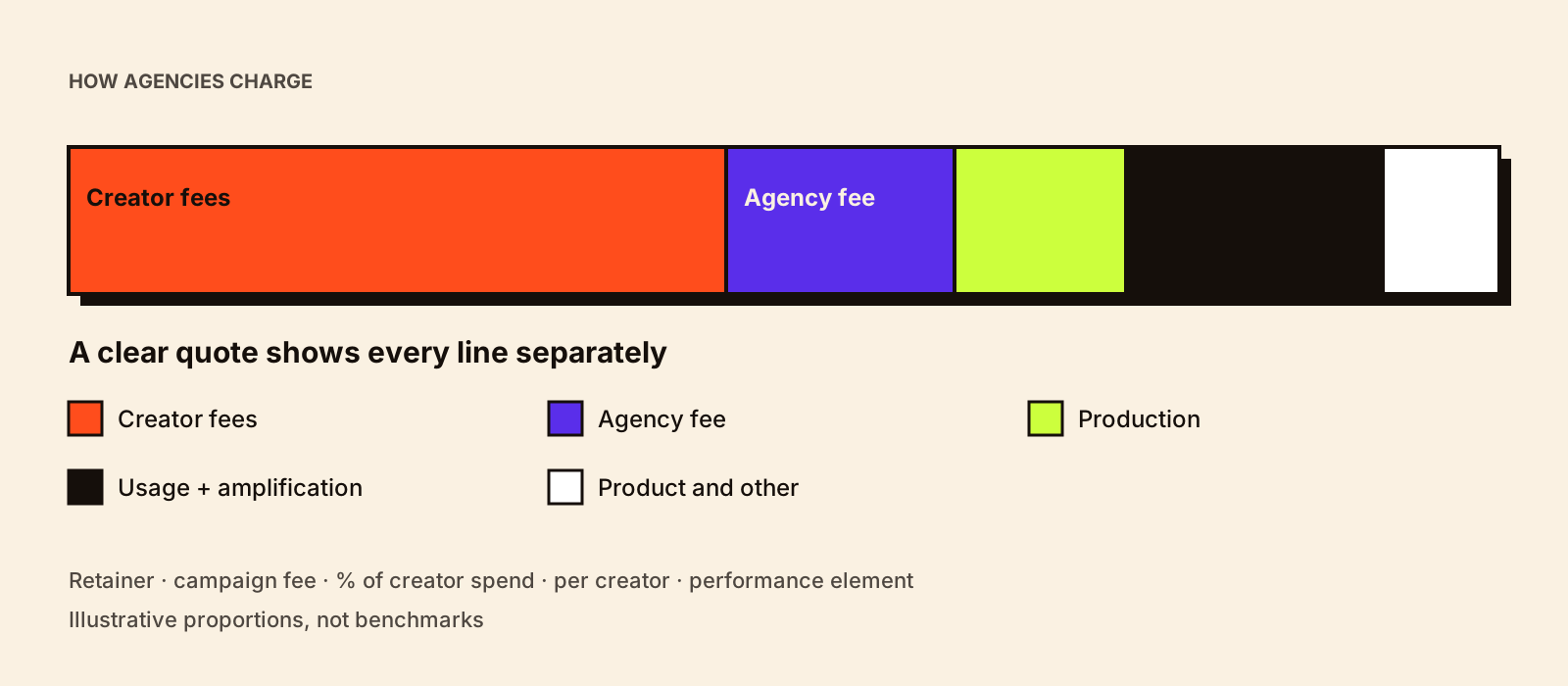
Ask three influencer marketing agencies for a quote on the same brief and you may get three numbers that can't be compared: one bundles creator fees, one shows a percentage on top, one quotes a monthly retainer with creators billed separately. Before judging which is expensive, you need to know what each number contains.
There is no reliable published rate card for Indian influencer agencies, and fees vary widely with scope, so this guide doesn't state standard percentages or amounts. It explains how agencies charge, what should be included, and how to compare quotes fairly. Creator rates themselves are covered in how much influencer marketing costs in India.
Quick answer
Influencer marketing agencies in India typically charge in one of five ways: a monthly retainer for ongoing work, a fixed campaign management fee per campaign, a percentage of the creator budget they manage, a per-creator or per-deliverable fee, or a performance element on top of a base fee. Creator fees, production, usage rights and paid amplification are usually separate costs. What an agency charges depends on scope (strategy, discovery, negotiation, management, reporting), the number of creators, platforms, regions and languages, timelines, category risk and how much reporting you need. Compare quotes by total campaign cost and by what the agency fee actually covers.
The five pricing models
| Model | How it works | Suits | Ask about |
|---|---|---|---|
| Monthly retainer | Fixed monthly fee for a defined scope over a minimum term | Always-on programs, ongoing creator partnerships | Exact monthly scope, overages, notice period, what happens to unused scope |
| Campaign management fee | Fixed fee per campaign | Launches and one-off campaigns with clear deliverables | Revision limits, replacement creators, reporting included |
| Percentage of creator spend | Fee calculated on the creator budget managed | Campaigns whose size varies a lot | The percentage, what it's calculated on, and whether it's shown separately |
| Per creator or per deliverable | Fee per creator managed or per piece of content | High-volume micro-creator or UGC work | How complex creators or extra rounds are handled |
| Performance element | Bonus or share linked to agreed results, on top of a base fee | Sales or lead campaigns with clean tracking | How results are measured and attributed |
Hybrids are common: a retainer for strategy and management with creator fees passed through at cost, or a campaign fee with a small performance bonus. None is automatically better. A percentage model can reward spending more rather than spending well; a retainer can leave you paying for scope you don't use; a pure performance model can push an agency towards discount-heavy content that hurts your brand.
What the agency fee should cover
| Service | Usually in the agency fee? | Notes |
|---|---|---|
| Campaign strategy and creator mix | Often | Deeper strategy work may be priced separately |
| Creator discovery, vetting and shortlist | Usually | Ask how many options you'll see and how they're vetted |
| Outreach and negotiation | Usually | Includes usage and exclusivity terms |
| Contracts with creators | Often | Check who signs and who holds the contracts |
| Briefing, content review and approvals | Usually | Agree revision limits |
| Go-live checks and disclosure | Should be | Missing disclosure is a shared liability |
| Reporting | Usually | Agree the format and depth before launch |
| Creator fees | Usually separate | Should be shown line by line |
| Production, shoots, editing | Usually separate | Unless the agency is producing content |
| Paid amplification (media spend) | Separate | Management of it may be in or out of the fee |
| Product, shipping and travel | Separate | Budget them explicitly |
A detailed breakdown of each service is in what an influencer marketing agency actually does.
What moves the agency fee
- Scope: strategy plus execution costs more than outreach alone.
- Number of creators and deliverables: coordination time scales with creators, not just budget.
- Platforms and formats: long-form YouTube integrations and multi-format packages take more management than single Reels.
- Regions and languages: multilingual, multi-city campaigns need more people and local knowledge.
- Timelines: compressed launch dates need more hands at once.
- Category risk: health, finance and education need claims review and more careful approvals.
- Usage rights and paid amplification: more negotiation and tracking.
- Reporting depth: dashboards, creator-level analysis and quarterly reviews take time.
- Contract length: retainers can price differently from one-off projects.
How to read an agency quote
A. Creator fees: per creator: platform, deliverables, usage period, exclusivity
B. Agency fee: model (retainer / campaign / % / per creator) and what it covers
C. Production: shoots, editing, UGC, if any
D. Usage rights and paid amplification: rights fees, media budget, management
E. Product, shipping, travel
F. Taxes: GST treatment of each line
Assumptions: revision rounds, timelines, approval turnaround, replacement policy
Payment terms: advance, milestones, who pays creators and when
- If creator fees and the agency fee are bundled into one number, ask for them separately.
- If the fee is a percentage, confirm what it's calculated on (creator fees only, or everything).
- Check what happens if a creator drops out: is a replacement included?
- Check whether the quote assumes your approvals come back within a set time.
- Ask whether creators are paid by the agency or by you, and on what timeline.
Illustrative comparison of two quotes
Illustrative example with hypothetical numbers. Two agencies respond to the same brief for 12 micro-creators on Instagram.
| Line | Agency A | Agency B |
|---|---|---|
| Creator fees | Bundled into total | ₹4,80,000 shown per creator |
| Agency fee | Bundled | ₹90,000 campaign fee |
| Usage rights for ads (60 days) | Not mentioned | ₹60,000 shown separately |
| Replacement if a creator drops out | Not mentioned | Included |
| Report | "Campaign summary" | Creator-level report and review call |
| Total shown | ₹5,90,000 | ₹6,30,000 |
Agency A looks cheaper, but you can't tell what you're paying the agency, whether ad usage is included, or what happens if a creator drops out. After clarification, the comparison may reverse. Structured comparison across several agencies is covered in the influencer marketing RFP guide.
Is an agency worth the fee?
An agency is worth its fee when it saves more than it costs: in your team's time, in creator fees negotiated sensibly, in avoided mistakes (wrong creators, missing disclosure, unusable rights), and in results you can measure. It's rarely worth it when you run a few creators a quarter and have someone in-house who enjoys doing it. The in-house comparison is in influencer marketing agency vs in-house, and the freelancer option in agency vs freelancer.
Common mistakes
- Comparing bundled quotes with itemized ones.
- Choosing the lowest agency fee and paying more in creator fees or rework.
- Retainers with no written scope or overage rule.
- Percentage fees without knowing what they're calculated on.
- Forgetting usage rights, product costs and GST when setting the budget.
Conclusion
Agency fees in India are shaped by scope, creator volume, regions, timelines, category risk and reporting, and they come as retainers, campaign fees, percentages, per-creator fees or hybrids. Ask for itemized quotes that separate creator fees from the agency fee, check assumptions and replacement terms, and compare total cost against what's included. The total campaign budget, including creator fees, is covered in influencer campaign costs in India.