What Does an Influencer Marketing Agency Do? The Services Explained
What an influencer marketing agency actually does, from strategy through reporting, the work you don't see during a live campaign, and how to choose the services your brand needs.
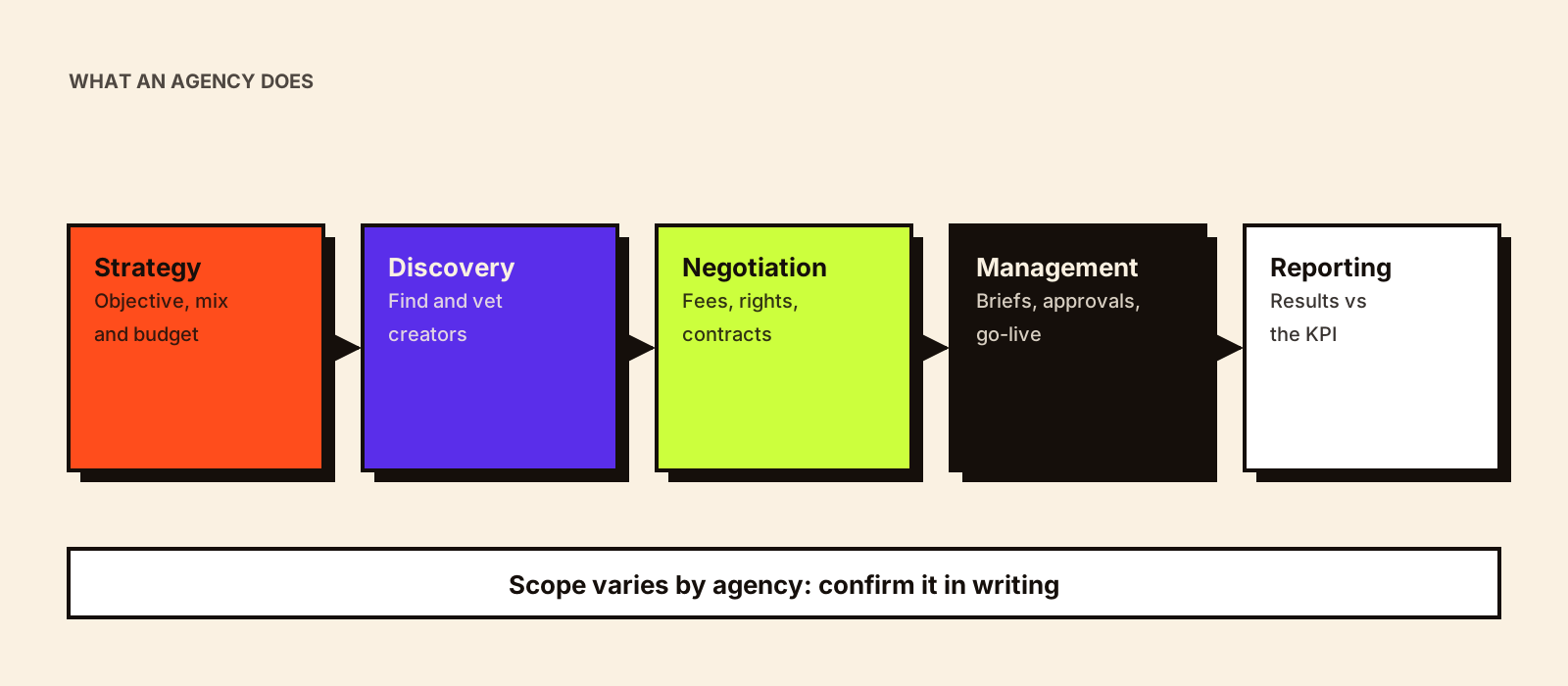
An influencer marketing agency's services can range from a single piece, just creator outreach, to a full end-to-end program covering strategy, discovery, negotiation, campaign coordination, and reporting. What's included varies significantly between agencies, which is why it's worth understanding each service individually before assuming a specific agency covers all of them.
Quick answer
An influencer marketing agency plans creator campaigns and runs them for brands: it sets the strategy and creator mix, finds and vets creators, negotiates fees, usage rights and deliverables, writes briefs, manages content approvals and publishing, checks disclosure, tracks performance and reports results against the objective agreed before launch. Some agencies also produce UGC, run ambassador programs and manage paid amplification of creator content. What's included varies, so confirm scope in writing.
The work you don't see during a live campaign
Most of an agency's time goes on coordination that never appears in a pitch deck. In a typical week of a multi-creator campaign, the team is:
- Chasing drafts and posting dates, and finding replacements when a creator drops out.
- Reviewing drafts against the brief, approved claims and disclosure rules before they reach you.
- Consolidating your team's feedback so creators get one clear set of changes.
- Checking live posts for the disclosure label, correct links and codes, and the agreed content.
- Collecting creators' insights screenshots and reconciling them with your analytics.
- Processing creator invoices and payments on the agreed dates.
- Flagging posts that are working so your paid team can amplify them while they're fresh.
This is the work that grows with every creator added, and it's usually the real reason brands hire an agency. The step-by-step process is in how influencer campaign management works.
1. Campaign strategy
Defining the business objective, target audience, platform, creator tier mix, and budget before any outreach begins. This is the foundation the rest of the services build on, and its absence is one of the most common reasons a campaign underperforms.
2. Influencer discovery
Sourcing candidate creators who match the target audience and category, using platform search, discovery tools, and existing network relationships rather than a generic follower-count leaderboard.
3. Creator evaluation
Reviewing audience overlap, engagement quality, authenticity, content style, and brand fit for each candidate, the vetting layer that turns a long list into a genuinely useful shortlist.
4. Creator outreach
Contacting shortlisted creators professionally and with genuine personalization, rather than a mass templated message, to gauge interest and fit before detailed negotiation begins.
5. Negotiation
Agreeing on compensation, deliverables, usage rights, and timeline with each creator, ideally grounded in realistic market context rather than a fixed internal rate card.
6. Campaign briefing
Writing and delivering a clear brief covering objective, key message, mandatory requirements, and disclosure, with enough guardrails to protect the brand without scripting the creator's natural voice.
7. Content coordination
Managing content review, revisions, and approvals across multiple creators at once, keeping timelines on track without letting any single creator's delay stall the whole campaign.
8. Campaign management
The overall day-to-day coordination of a live campaign, publishing schedules, creator communication, and adjusting course if something isn't working, covered in more depth in how influencer campaign management works.
9. Performance tracking
Monitoring reach, engagement, traffic, or conversion data throughout the campaign window, not only after it ends, so underperformance can be caught and addressed early.
10. Reporting
Compiling results into a structured report tied to the objective agreed before launch, rather than a generic metrics dump.
11. Content usage management
Tracking which content the brand has rights to reuse, where, and for how long, so strong creator content can be extended into paid ads or owned channels without a rights dispute later.
What a full-service agency handles end to end
| Stage | Agency handles | Brand still owns |
|---|---|---|
| Strategy | Objective, audience, creator and platform strategy, content direction, measurement plan | Business goals, budget approval, brand guidelines |
| Creator discovery | Sourcing, audience and authenticity checks, brand safety, shortlist with reasons | Shortlist approval |
| Outreach and negotiation | Creator communication, fees, deliverables, usage, exclusivity, timelines | Commercial sign-off |
| Campaign management | Briefs, product logistics, draft reviews, approvals, publishing, disclosure checks | Content approval within agreed turnaround |
| Amplification (if in scope) | Rights, permissions and coordination with the paid media team | Media budget |
| Reporting | Creator-level results, content performance, insights and recommendations | Sharing sales or lead data for measurement |
Each stage has its own guide: influencer marketing strategy, how to find the right influencers at scale, influencer outreach, how influencer campaign management works and influencer campaign reporting.
Full-service vs specialist agencies
| Choose | When |
|---|---|
| Full-service | You want one accountable partner from strategy to report, or have little in-house capacity |
| Specialist (discovery, UGC, reporting) | Your team runs campaigns but needs one capability done well |
| Hybrid | You own strategy and relationships; an agency runs execution |
To see how specific agencies package these services, compare Kudozz with four alternatives in the best influencer marketing agencies in India.
Services that genuinely vary between agencies
Not every agency offers every service above, and some specialize deliberately: some focus purely on creator discovery and matchmaking, others run full end-to-end campaign management, and others specialize in a single format like UGC production. Confirm exactly which services are included before assuming a broader scope than what's actually offered.
What an agency shouldn't do
- Guarantee sales, ROI or viral reach.
- Hide its fee inside creator payments.
- Promise named creators before checking their availability.
- Run campaigns without agreeing a KPI.
- Leave disclosure to chance.
- Keep creator contracts and content rights away from the brand.
How to choose the right services for your brand
| Your situation | Services that usually fit | What you can keep in-house |
|---|---|---|
| First campaign, no in-house experience | Strategy plus full campaign management and reporting | Product knowledge, approvals, sharing sales data |
| Team runs campaigns but struggles to find the right creators | Creator discovery and vetting | Outreach, briefs and relationships |
| Plenty of ideas, not enough hours | Outreach, negotiation and campaign management | Strategy and creator relationships |
| Need ad creative more than reach | UGC production with paid usage rights | Media buying and testing |
| A launch with a fixed date | Launch campaign coordination, seeding and embargo management | Launch messaging and PR |
| Results are hard to explain to leadership | Reporting and measurement setup | Campaign execution |
| Several creators you want to keep long term | Ambassador program management | Final say on creative and product input |
Then work through these steps:
- 1. Identify which parts of the process your team can already handle well internally
- 2. Identify which parts consistently take longer or produce weaker results than expected
- 3. Match those gaps to the specific services listed above, rather than buying a full package by default
- 4. Confirm with any prospective agency exactly which of these services they provide directly versus outsource
- 5. Start with the narrowest service that addresses your actual gap, and expand only if it proves valuable
The services Kudozz provides
As an influencer marketing agency working with brands in India and our other markets, we offer campaign strategy, creator discovery, outreach and management, social campaigns, product launch coordination, UGC production, ambassador program management, and reporting, each available as a standalone service or combined into a fuller engagement depending on what a brand actually needs.
The most useful question a brand can ask isn't 'what services do you offer.' It's 'which of these do we actually need right now.'— Kudozz Strategy Team
The full list, with what each service includes and who it suits, is on the Kudozz services page.
Deciding what your brand actually needs
Map these services against what your team already does well and where it gets stuck. If you're evaluating agencies, how to choose an influencer marketing agency in India covers the process, influencer marketing agency fees in India explains pricing, and how to write an influencer marketing agency brief helps you get comparable proposals.
If you're still deciding whether to bring in outside help at all, influencer marketing agency vs in-house compares the costs and trade-offs.