How to Choose an Influencer Marketing Agency in India
A structured way for Indian brands to choose an influencer marketing agency: the six-step selection process, how good agencies find and vet creators, pricing transparency, reporting, red flags, an evaluation checklist, and when managing creators in-house still makes more sense.
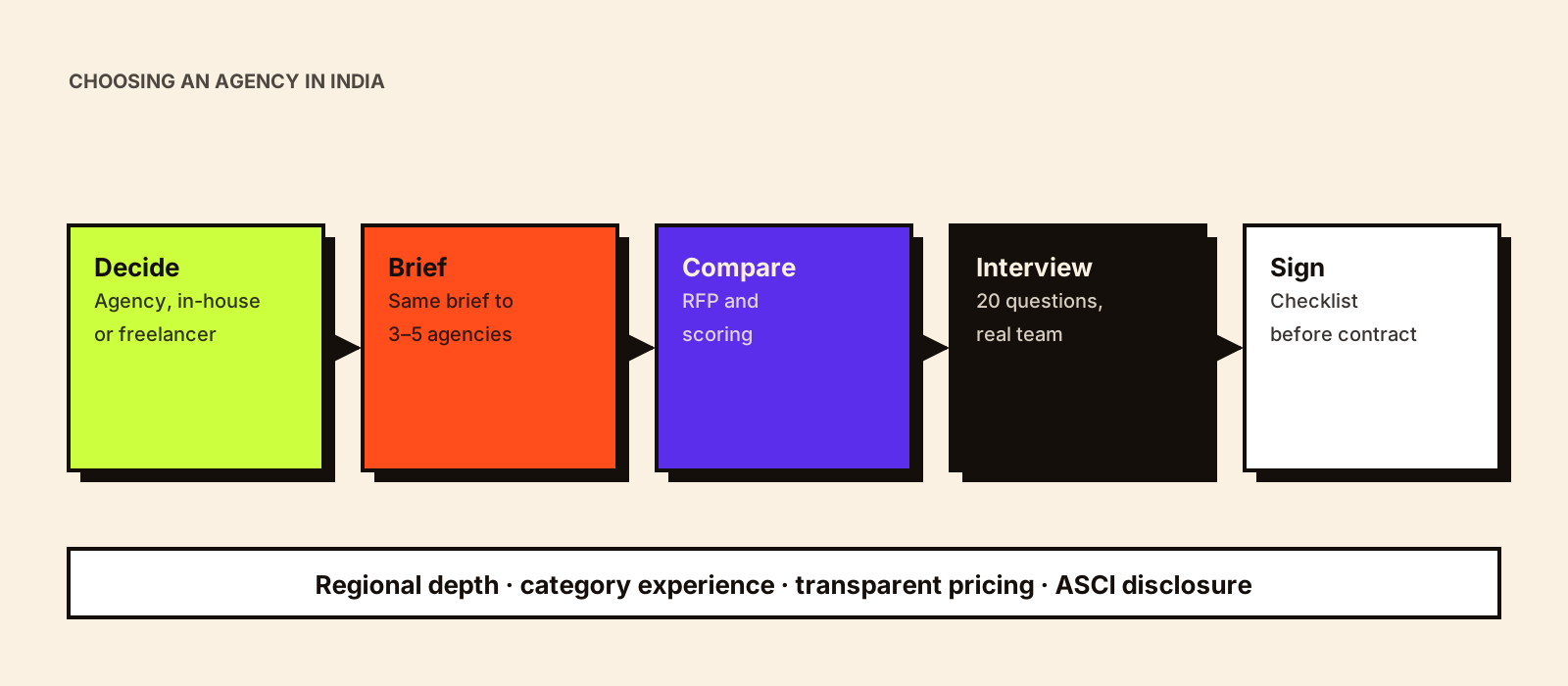
Choosing an influencer marketing agency in India means evaluating a vendor whose actual output, creator relationships, campaign judgment, reporting discipline, is hard to see until you're already working together. This guide gives a structured way to evaluate that before signing anything, with the considerations that matter for the Indian market: regional and language depth, category experience, transparent rupee pricing and familiarity with ASCI disclosure rules.
Quick answer
To choose an influencer marketing agency in India: be clear on your objective and budget range first, shortlist three to five agencies with relevant category, regional and platform experience, send them the same brief, and judge them on how they find and vet creators, how specifically they'd approach your campaign, how transparent their pricing is (creator fees separate from the agency fee), how they handle contracts, usage rights and disclosure, what their reports look like and who will actually run your account. Check references, consider a small paid pilot for big commitments, and confirm everything in the contract before signing.
If you want names to evaluate with this framework, our guide to the best influencer marketing agencies in India profiles Kudozz and four researched alternatives, with separate guides for Maharashtra, Gujarat, Karnataka, Delhi NCR, Mumbai and Ahmedabad.
What to look for, and the evidence to ask for
| Look for | Evidence to ask for | Weak sign |
|---|---|---|
| Understanding of your objective | A restated objective, one primary KPI and a measurement plan | A generic process deck |
| Creator judgment | A sample shortlist with dated audience data and a reason per creator | Follower counts and famous names |
| Fit with your category and markets | Recent work in your category, cities and languages, with live links | 'We work with every category' |
| Pricing transparency | Agency fee and creator fees as separate lines; what's excluded | One bundled total |
| Contracts, rights and disclosure | How creator agreements cover usage rights, exclusivity and ASCI disclosure | 'We'll sort rights later' |
| Reporting | An anonymized report tied to a KPI | Screenshots of reach and likes |
| The team | The named people who'll run your account and their time on it | Only senior pitch staff named |
| Honesty about limits | Clear statements of what results depend on | Guaranteed sales, ROI or virality |
Once proposals arrive, the influencer marketing RFP guide shows how to evaluate an agency proposal line by line, and before you sign, the influencer marketing agency checklist lists the questions to ask about the contract.
The agency selection process, step by step
| Step | What to do | Guide |
|---|---|---|
| 1. Decide whether you need an agency | Compare agency, in-house and freelance options for your volume | Agency vs in-house · Agency vs freelancer |
| 2. Understand pricing | Know the fee models before quotes arrive | Influencer marketing agency fees in India |
| 3. Brief the agencies | Same brief, budget range and deadline for everyone | How to write an agency brief |
| 4. Run a structured comparison | RFP, proposals and a weighted scoring matrix | Influencer marketing RFP |
| 5. Interview the finalists | Ask the same twenty-five questions and compare answers | Questions to ask an agency |
| 6. Check the contract | Scope, fees, rights, compliance, reporting and exit | Agency checklist before signing |
Guides for each step: influencer marketing agency vs in-house, influencer marketing agency vs freelancer, influencer marketing agency fees in India, how to write an influencer marketing agency brief, the influencer marketing RFP guide, questions to ask an influencer marketing agency and the influencer marketing agency checklist.
When a brand should consider working with an agency
An agency tends to earn its fee once a brand is running recurring campaigns, coordinating more creators than one internal team member can manage, or has tried sourcing and negotiating with creators directly and found it slower than expected. For a single, small test campaign, managing it in-house first is often the more efficient way to learn what you actually need from a partner later.
What an influencer marketing agency typically does
Services vary by agency, but typically include campaign strategy, creator discovery and vetting, outreach and negotiation, contracting, campaign coordination, and reporting. See influencer marketing services in India for a full breakdown of what each of these actually involves.
Understand your campaign objectives before hiring an agency
An agency conversation goes better when you already know what success needs to look like, awareness, engagement, or conversion, since this shapes which agency's strengths actually matter for your brand. See influencer marketing strategy for the Indian market for how to define this before any agency conversation starts.
Evaluating an agency's creator network
Ask specifically how deep an agency's network is in your category and, if relevant, in the regional or vernacular markets you care about, rather than accepting a general claim of network size. A network that's genuinely deep in beauty and fashion may be thin in B2B or regional-language creators.
Evaluating campaign strategy capabilities
A capable agency should be able to explain how they'd approach your specific objective and audience in the first conversation, not just present a generic process deck. Ask them to walk through a hypothetical version of your actual campaign.
How good agencies find and evaluate creators
Good agencies work from audience data, not a follower-count leaderboard. They compare a creator's audience location, age, language and interests against your customer profile, review real engagement (comments and saves, not just a percentage), look at recent content for tone and brand fit, and screen for purchased or bot followers before a name reaches your shortlist. Ask to see a sample shortlist with a one-line reason per creator; it shows more about an agency's judgment than any credentials slide. The checks themselves are covered in influencer audience quality and fit and how to vet influencers.
Understanding campaign management processes
Ask how the agency actually coordinates outreach, briefs, approvals, and deadlines across multiple creators at once, the operational discipline covered in how influencer campaign management works.
Transparency in pricing
Ask directly whether the agency's fee is separate from creator payments or a percentage of media spend, and whether quoted numbers are all-in or exclude categories like production or paid amplification. Given how fragmented Indian creator pricing is, a transparent agency should be able to explain their pricing logic clearly, not just hand over a number. The common pricing models, and how to compare quotes that are structured differently, are covered in influencer marketing agency fees in India.
Reporting and measurement
Ask what a sample report actually looks like and whether it's tied to a specific KPI agreed before launch, rather than a generic reach-and-engagement summary. Ask to see one from a past campaign with client details redacted.
Industry experience
Category experience matters, but shouldn't be the only filter, an agency with strong general creator-vetting judgment can often serve a new category well, provided they're honest about what they don't already know rather than overstating category expertise they don't have.
Communication and project management
Ask how the agency communicates during a live campaign, a single point of contact, response time expectations, and how they handle a missed deadline or underperforming creator, since this operational reliability matters as much as strategic thinking.
Questions brands should ask before hiring an agency
- How do you actually vet creators for audience fit and authenticity, beyond follower count?
- Is your fee separate from creator payments, and is your pricing all-in or itemized?
- What does a sample report look like, and is it tied to the KPI we agree on before launch?
- Who owns the contract and negotiation with the creator, you or us?
- How deep is your network in our specific category and any regional markets we care about?
- What happens if a creator misses a deadline or underperforms?
These six are the essentials. A fuller list of twenty-five, with what strong and weak answers sound like, is in questions to ask an influencer marketing agency.
Red flags
- Guaranteed sales, ROI, followers or virality.
- Reluctance to explain how they screen for fake followers or bought engagement.
- Pricing based only on reach, with no campaign KPI.
- No usage-rights discussion until after content is delivered.
- Case studies with big reach numbers but no engagement or conversion data.
- Pressure to sign a long retainer before running a single test campaign.
- The people in the pitch won't work on your account.
Influencer Marketing Agency Evaluation Checklist
- Objective and KPI defined clearly enough to brief a prospective agency
- Agency's creator network depth confirmed for your specific category and any regional markets
- Campaign strategy approach demonstrated, not just described in general terms
- Campaign management process explained end to end, not just at a high level
- Pricing structure and inclusions confirmed in writing
- Sample reporting reviewed and confirmed to be KPI-specific
- References or a redacted case study reviewed where possible
- Communication process and point of contact confirmed
How to evaluate results after the first campaign
The agency should deliver a report tied to the KPI agreed before launch, with creator-level results and recommendations, not a recap dominated by reach and impressions. If the only numbers are follower counts and total views, ask directly how the campaign performed against your objective. What a useful report contains is covered in how to create an influencer marketing report, and measurement in measuring influencer campaign ROI.
When Managing Influencers In-House May Make More Sense
In-house management can make sense when campaign volume is genuinely small, a handful of creators a quarter, when a team member already has real bandwidth and interest in owning outreach and vetting, or when the brand wants to build this capability internally over time rather than outsourcing it indefinitely. It's a less natural fit once creator count, campaign frequency, or regional complexity grows beyond what one person can realistically track. See influencer marketing agency vs managing influencers in-house for the full comparison.
The agencies worth hiring can explain, specifically, how they'd approach your campaign in the first conversation. A big media kit doesn't tell you that.— Kudozz Strategy Team
After signing, influencer marketing agency onboarding covers the onboarding pack, approval matrix, kickoff and first 30 days.
Before you sign
Once you've chosen, make sure the proposal becomes a contract that says what you agreed: scope, fees, creator payments, usage rights, disclosure responsibilities, reporting and exit terms. The influencer marketing agency checklist covers each point, and influencer marketing campaign costs in India helps you budget the campaign itself.
Choosing an agency for a campaign in the UAE instead? A few checks change, including permits for resident and visiting creators and Arabic-language capability; see how to choose an influencer marketing agency for a UAE campaign.
After you've chosen, what to expect in the first 30, 60 and 90 days of an influencer campaign sets out the checkpoints to hold the agency to.