How to Write an Influencer Marketing Agency Brief for Your Campaign
How to brief an influencer marketing agency so proposals come back comparable and campaigns start fast: the twelve sections of an agency brief, a copy-ready template, what to share about budget, audience and past campaigns, and how an agency brief differs from a creator brief.
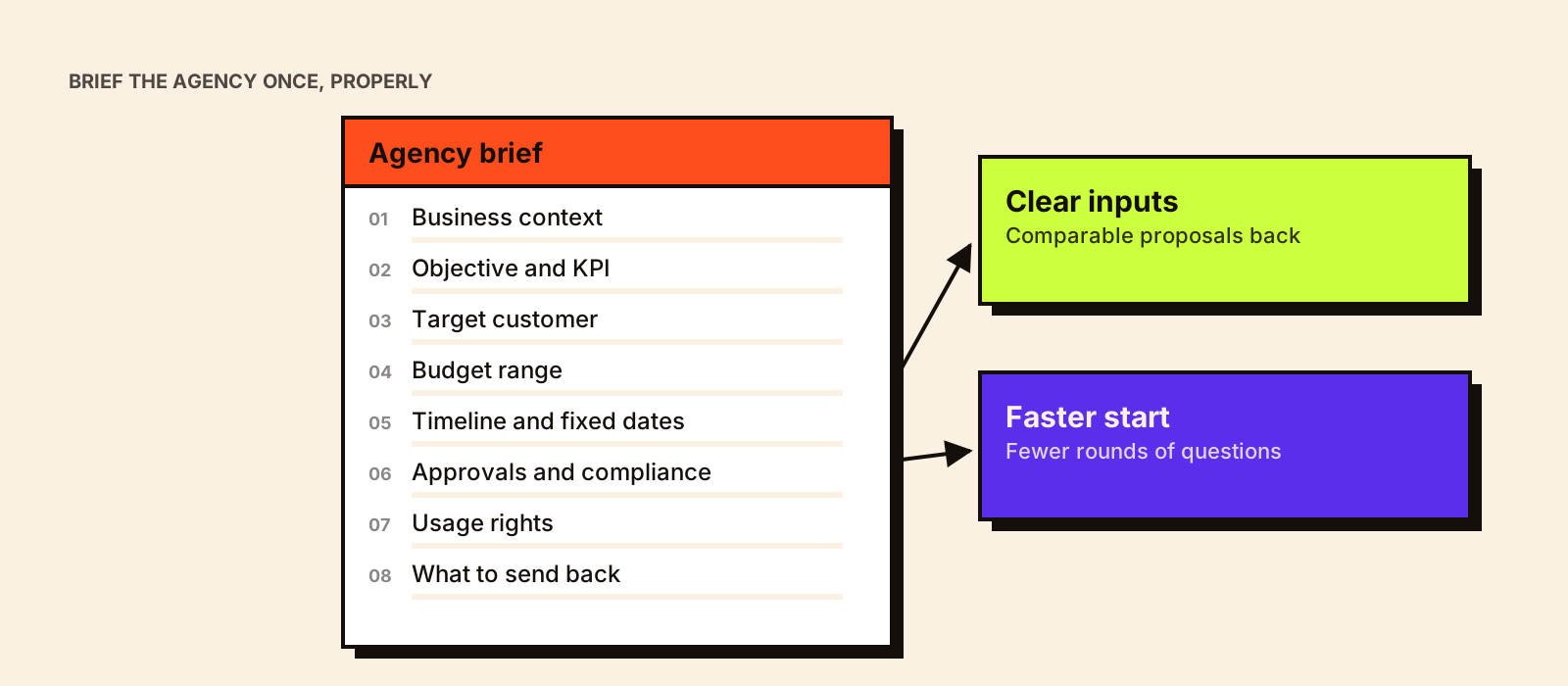
The quality of an agency's proposal is capped by the quality of the brief it receives. A one-line email asking for "an influencer plan for our launch" gets back generic shortlists and numbers nobody can compare. A clear brief gets back thinking you can judge, and it cuts days off the start of the campaign.
This is the brief a brand sends an agency. It's different from the creative brief creators receive, which is covered in how to create an influencer campaign brief.
Quick answer
An influencer marketing agency brief should cover: the business context, the campaign objective and primary KPI, the target customer, the product and key messages, markets, regions and languages, platforms and formats if decided, the budget range and what it includes, timelines and fixed dates, approvals and compliance rules, usage rights needs, what worked or didn't in past creator campaigns, and what you want the agency to send back. Share a budget range, even a wide one; without it, proposals can't be compared.
Agency brief vs creator brief
| Agency brief | Creator brief | |
|---|---|---|
| Audience | The agency's strategy and account team | Each creator |
| Purpose | Plan the campaign and propose creators, budget and approach | Make specific content |
| Contains | Business context, objective, budget, audience, timelines, constraints | Key message, deliverables, dos and don'ts, disclosure, dates |
| Written by | The brand | Usually the agency, approved by the brand |
The twelve sections
| Section | What to include | Why the agency needs it |
|---|---|---|
| 1. Business context | Brand, stage, category, competitors, current marketing mix | Creators should fit where the brand is today |
| 2. Objective and KPI | One primary objective and how success will be measured | Changes creator mix, formats and budget split |
| 3. Target customer | Who buys, where they live, languages, what they care about | Drives creator selection by audience, not follower count |
| 4. Product and messages | What's being promoted, proof points, claims you can substantiate | Shapes briefs and review |
| 5. Markets and languages | Pan-India, specific cities or states, language priorities | Determines regional creator sourcing |
| 6. Platforms and formats | If already decided; otherwise ask for a recommendation | Avoids proposals for the wrong channels |
| 7. Budget | Range, and whether it includes creator fees, agency fee, production and media | Makes proposals comparable |
| 8. Timeline | Fixed dates (launch, sale event), approval windows, go-live window | Tests feasibility |
| 9. Approvals and compliance | Who approves, turnaround, legal review, category rules | Sets realistic schedules |
| 10. Usage rights | Whether content will be used in ads, on site, for how long | Changes creator fees and negotiation |
| 11. What you've learned | Past creators and results, what failed and why | Avoids repeating mistakes |
| 12. What to send back | Format of response, deadline, questions contact | Gets comparable proposals |
Agency brief template
BRAND: [ ]   CONTACT: [name, role, email]   DATE: [ ]

1. BUSINESS CONTEXT
What we sell, to whom, our stage, main competitors, current marketing channels.

2. OBJECTIVE AND PRIMARY KPI
Objective: [awareness / launch / leads / sales / content for ads]
Primary KPI: [ ]   Secondary KPIs: [ ]

3. TARGET CUSTOMER
Age, gender mix, cities/states, languages, income band, interests, what they worry about.

4. PRODUCT AND KEY MESSAGES
Product(s): [ ]   Proof points: [ ]   Claims we can substantiate: [ ]   Claims to avoid: [ ]

5. MARKETS AND LANGUAGES
[Pan-India / priority cities / states]   Languages: [ ]

6. PLATFORMS AND FORMATS
[Decided: ___ ]  or  [Please recommend]

7. BUDGET
Range: ₹[ ] to ₹[ ]   Includes: [creator fees / agency fee / production / paid media / product]

8. TIMELINE
Fixed dates: [launch, sale, event]   Content live window: [ ]   Report needed by: [ ]

9. APPROVALS AND COMPLIANCE
Approvers: [ ]   Turnaround: [ ] working days   Category rules: [ ]

10. USAGE RIGHTS
Organic only / paid ads / website / duration: [ ]

11. WHAT WE'VE LEARNED
Past creators or agencies, what worked, what didn't.

12. WHAT WE'D LIKE BACK
Approach, sample creator profiles (not a final list), budget split, timeline, team, reporting.
Response by: [date]   Questions to: [contact]
Budget: share a range
Brands often withhold budget to see what agencies propose. The result is proposals sized to guesses, which can't be compared. A range, with what it's meant to cover, lets agencies propose the best plan for your money. If you genuinely don't know, say so and ask for options at two or three budget levels. Budget planning is covered in how to calculate an influencer marketing budget.
Target customer: be specific
"Women 18–35 in India" describes several hundred million people. "Working women 25–34 in Pune, Bengaluru and Hyderabad who buy skincare online and read ingredient lists" lets an agency find creators whose audiences actually overlap with your customers. Share customer data if you have it: order locations, age bands, languages from support tickets. Audience matching is covered in influencer audience quality and fit.
After the brief: the briefing call
- Walk the agency through the brief and answer questions; write down the answers and share them with every agency if you're comparing several.
- Share product samples or a demo so the agency understands what creators will be showing.
- Confirm the response deadline and format.
- Tell them how you'll choose, so proposals address what matters to you.
If you're sending the brief to several agencies, the formal process is covered in the influencer marketing RFP guide, and the questions to ask in the pitch meeting in questions to ask an influencer marketing agency.
Common mistakes
- Several objectives with no priority.
- No budget range.
- Describing the audience by age and gender only.
- Leaving out fixed dates and approval times, then discovering the plan is impossible.
- Not mentioning that content will be used in ads, which changes creator fees.
- Asking for a final creator list before the agency understands the brand.
Conclusion
A good agency brief gives the context, objective, audience, budget, dates, constraints and history an agency needs to think well, and says what you want back. It takes an hour to write and saves weeks of back-and-forth. Keep it to a few pages, share a budget range, and use the same brief with every agency you're comparing.