Influencer Marketing Agency Questions: 25 Questions Brands Should Ask Before Hiring
Twenty-five questions to ask an influencer marketing agency before hiring, grouped by strategy, creators, process, compliance, measurement, team, commercials and due diligence, with what a strong answer and a weak answer sound like, and the red flags to listen for.
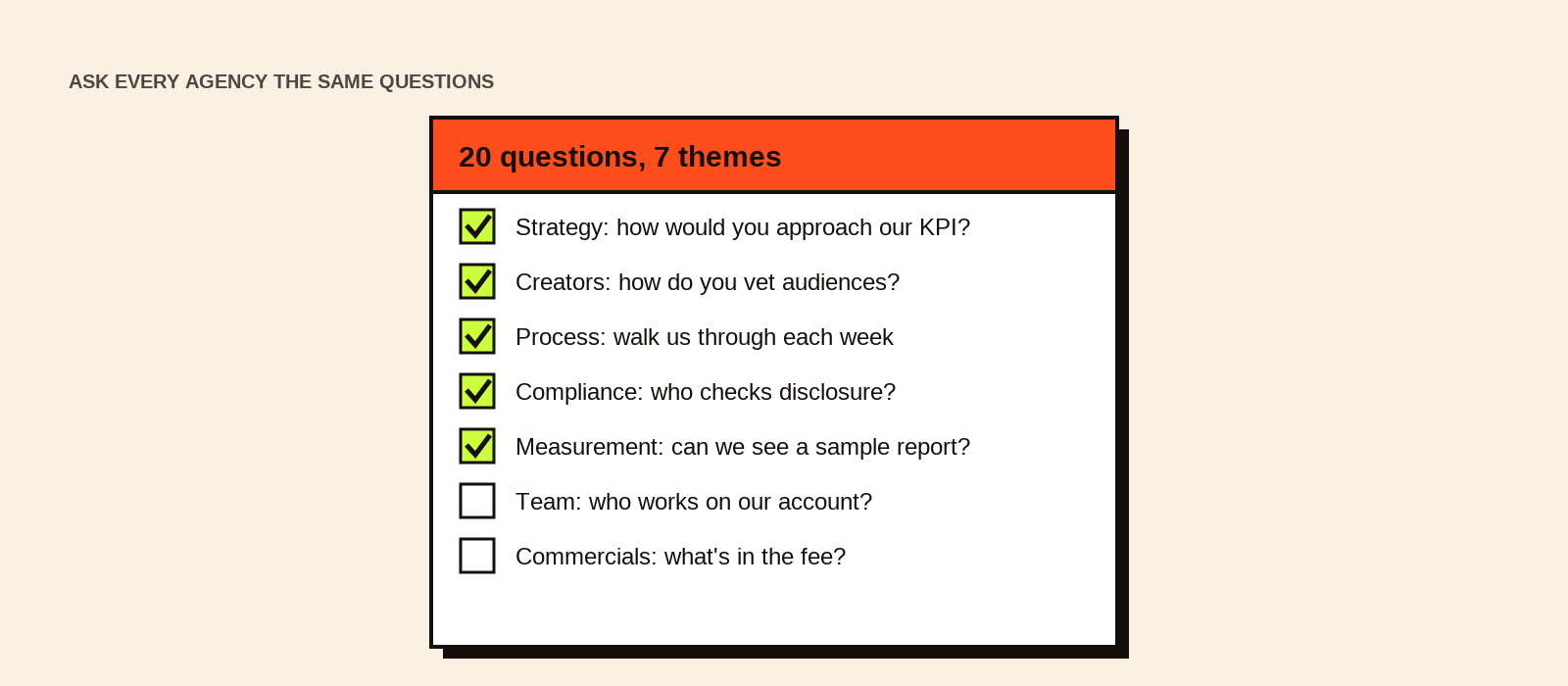
Agency pitches are designed to impress. The useful part of the meeting is the conversation after the deck, when you ask how things actually work. These twenty-five questions are the ones that separate agencies with a real process from agencies with a good presentation.
Quick answer
Before hiring an influencer marketing agency, ask how it would approach your objective, how it finds and vets creators, what a shortlist looks like, how it handles contracts, usage rights, disclosure and claims, how it measures and reports, who exactly works on your account, how it charges and what's included, and what happens when things go wrong. Strong answers are specific, show a documented process and admit trade-offs. Weak answers are generic, promise guaranteed results or avoid the question.
Strategy (questions 1–4)
| Question | Strong answer sounds like | Weak answer sounds like |
|---|---|---|
| 1. How would you approach our objective? | Specific creator mix, formats and phasing tied to your KPI | "We'll use top influencers to go viral" |
| 2. What would you not recommend for us, and why? | Clear trade-offs (e.g. "celebrities won't suit a consideration-led product") | Everything is recommended |
| 3. How would you split this budget? | Split by tier, formats, usage and testing, with reasoning | One total, no logic |
| 4. What would you test first? | A small test with a decision point before scaling | "Launch big from day one" |
Creators (questions 5–8)
| Question | Strong answer | Weak answer |
|---|---|---|
| 5. How do you find creators for a brief like ours? | Search methods, regional sourcing, tools plus manual review | "We have a huge database" |
| 6. How do you vet audience quality and fraud? | Audience data from creators, authenticity checks, content review | "We check engagement rate" |
| 7. Can we see a sample shortlist with reasons? | Profiles with dated audience data and one-line rationale | Handles and follower counts only |
| 8. Do you have exclusive creators or represent creators too? | Clear answer, with how conflicts are managed | Vague, or pushing their own roster without saying so |
What good vetting involves is covered in how to vet influencers before a brand collaboration.
Follow-up questions on how the agency vets creators
- Which audience data do you get directly from creators (insights screenshots or exports), and how recent must it be?
- What share of a creator's audience must be in our target market before you'd recommend them?
- Which signs of bought followers or engagement make you reject a creator, and how many did you reject for the last brief like ours?
- How do you check past content and sponsorships for brand-safety and competitor conflicts?
- Who makes the final shortlist decision, and can we see the creators you considered and dropped, with reasons?
Process and compliance (questions 9–12)
| Question | Strong answer | Weak answer |
|---|---|---|
| 9. Walk us through a campaign week by week. | Stages, approval windows, who does what | "Four to six weeks, end to end" |
| 10. How do you handle contracts and usage rights? | Templates, rights defined by platform and duration, stored records | "Creators are fine with it" |
| 11. How do you make sure disclosure and claims are correct? | Pre-live and post-live checks, ASCI rules, category claims review | "Creators handle that" |
| 12. What happens if a creator misses a deadline or drops out? | Buffers, backup shortlist, escalation process | "That never happens" |
Disclosure rules for Indian campaigns are summarized in influencer marketing compliance.
Measurement (questions 13–15)
| Question | Strong answer | Weak answer |
|---|---|---|
| 13. How will you measure success against our KPI? | Tracking plan: links, codes, landing pages, lift signals | Reach and likes only |
| 14. Can we see a sample report? | Creator-level results, learnings, recommendations | A screenshot collage |
| 15. What results can you promise? | Honest ranges and what they depend on; no guarantees | Guaranteed ROI, sales or viral reach |
Reporting expectations are set out in how to create an influencer marketing report.
Team (questions 16–17)
| Question | Strong answer | Weak answer |
|---|---|---|
| 16. Who will work on our account, and how much of their time do we get? | Named people, roles, rough share of time | "Our whole team" |
| 17. Have you worked in our category and regions? | Relevant examples, and honesty about gaps | "We've done everything" |
Commercials (questions 18–20)
| Question | Strong answer | Weak answer |
|---|---|---|
| 18. How do you charge, and what's included? | Model explained, creator fees shown separately | One bundled number |
| 19. Who pays creators, and when? | Clear money flow and timelines | Unclear, or creators paid only after long delays |
| 20. What are the contract term and exit terms? | Reasonable notice, handover of files and contacts | Long lock-in, no handover |
Pricing models are compared in influencer marketing agency fees in India.
Due diligence and fit (questions 21–25)
| Question | Strong answer | Weak answer |
|---|---|---|
| 21. Can we speak to two current clients in a similar category? | Names offered, with permission, without hesitation | "Our clients are confidential" with no alternative |
| 22. If we part ways, what do we keep? | Contracts, content files, creator contacts and reports handed over | Creator relationships and data stay with the agency |
| 23. Do you work with our competitors? | Clear policy on category conflicts and separate teams | Avoids the question |
| 24. What happens in the first 30 days? | Onboarding steps, access needed, first deliverables | "We'll start sourcing straight away" |
| 25. Would you run a paid pilot before a retainer? | A scoped pilot with success criteria | Retainer only, minimum long term |
What to verify before signing is in the influencer marketing agency checklist, and what the first month should look like is in influencer marketing agency onboarding.
If you're evaluating a platform instead of an agency
Self-serve influencer platforms and marketplaces sell software or access to creators, not a managed service, so the questions change. Ask these before signing a platform contract:
| Question | Why it matters |
|---|---|
| Where does creator audience data come from: connected accounts, estimates or scraped data? | Estimated data can differ a lot from the creator's own insights |
| How many active creators match our markets, languages and categories, not the whole database? | Database size says little about relevant supply |
| What does the plan include: seats, searches, campaigns, payments, reporting? | Overage and add-on costs change the real price |
| Who handles contracts, disclosure checks and creator payments? | On most platforms that work stays with your team |
| Can we export our creator lists, content and results if we leave? | Avoids losing your data with the subscription |
| What's the minimum term and notice period? | Annual commitments are common; test before committing |
The differences between the models are covered in influencer marketing agency vs platform, and what features matter in influencer marketing software.
Red flags
- Guaranteed sales, ROI, followers or virality.
- Promising specific named creators before checking availability.
- Follower count as the main selection criterion.
- No sample report, or reports that only show reach.
- Reluctance to separate creator fees from the agency fee.
- Dismissive answers about disclosure or claims.
- The people in the pitch won't be on your account.
Using the answers
Ask every agency the same questions and note answers in the same sheet, so you're comparing like with like. For formal selection, fold these questions into the scoring matrix in the influencer marketing RFP guide; before signing, confirm the answers made it into the contract with the influencer marketing agency checklist. If you run a D2C brand, what D2C founders should look for in an influencer agency adds the questions about margins, ad rights and tracking.
Conclusion
The right agency answers these questions specifically, shows its process, and is honest about trade-offs and risks. The wrong one answers with enthusiasm and guarantees. Ask all twenty, compare answers side by side, and weigh process and transparency as heavily as creative ideas. The wider selection criteria are in how to choose an influencer marketing agency in India.