Influencer Marketing Agency for D2C Brands: What Founders Should Look For
A D2C brand isn't buying reach from an agency. It's buying customers at a cost the business can carry, and a steady supply of creative for ads. What to check before you hire one, the questions to ask, the red flags, and how to run a pilot that tells you something.
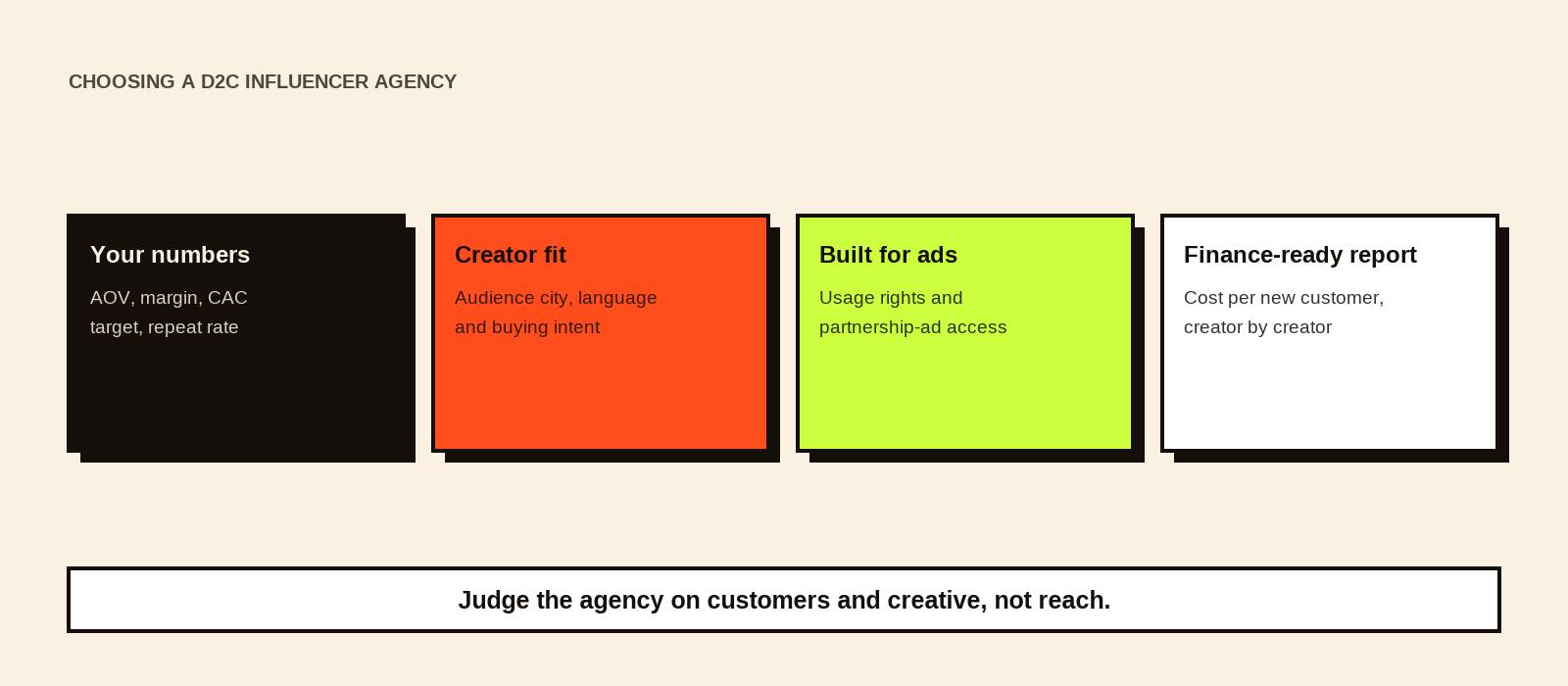
Most agency credentials decks look the same: a wall of logos, a reach number in the crores and a creator network 'across every category'. For a D2C founder, almost none of that answers the real question, which is whether this team can bring in customers at a cost your margins can carry and keep your ads supplied with content that sells. This guide is about evaluating an agency against that question.
Quick answer
A good influencer marketing agency for a D2C brand starts from your unit economics (order value, contribution margin, target cost per customer and repeat rate), chooses creators on audience fit rather than follower count, writes ad usage and partnership-ad permissions into every creator contract, sets up tracking before anyone posts, and reports cost per new customer rather than reach. Ask for a 6–8 week pilot on one product with success criteria agreed in writing, insist that creator fees are shown separately from the agency fee, and walk away from anyone who guarantees ROAS.
Do you need an agency yet?
Not every D2C brand does. If you're working with three or four creators a month and someone on the team enjoys the outreach, you'll learn more doing it yourself. The case for outside help gets stronger when the work stops fitting in the gaps of someone's week.
| Signal | What it usually means | Agency worth considering? |
|---|---|---|
| Fewer than 5 creators a month, one product, one city | Manageable in-house with a simple tracker | Not yet; build your own process first |
| Your Meta ads fatigue faster than you can replace the creative | Creative supply is the bottleneck, not media buying | Yes, if the agency produces ad-ready creator content |
| A launch or sale date you can't move | Coordination risk: seeding, embargoes, posting windows, stock | Yes, at least for the launch |
| You need creators in Tamil, Telugu, Bengali or Marathi markets | Sourcing and vetting outside your own network and language | Usually yes |
| You run 15+ creators a month and contracts or payments slip | Operations, not strategy, is breaking | Yes, or hire a dedicated manager |
| You can't tell which creators bring repeat customers | Measurement problem | Only if the agency can show how it would fix it |
If you're still deciding between building the function and buying it, influencer marketing agency vs managing influencers in-house compares the two, and influencer marketing agency vs freelancer covers the narrower option of hiring one person for outreach.
What a D2C-ready agency does differently
Plenty of agencies are good at awareness campaigns for large brands. That work is judged on reach, sentiment and share of voice, and it's run on quarterly or annual budgets. A D2C brand lives on a shorter loop: spend this month, see orders this month, decide next month. The differences show up in small operational details.
| Area | Awareness-led agency | D2C-ready agency |
|---|---|---|
| First meeting | Asks about brand values and campaign theme | Also asks for AOV, margin, current CAC, repeat rate and bestsellers |
| Creator selection | Category fit and follower size | Audience location, language, age and buying intent, checked against your customer data |
| Deliverables | Posts on the creator's profile | Posts plus raw footage, hook variations and ad usage rights for 30–90 days |
| Paid amplification | Optional boost at the end | Planned from the brief: which posts become partnership ads, and on what budget |
| Tracking | Reach and engagement screenshots | A code and UTM link per creator, tested before posting, with an agreed rule for counting orders |
| Report | Total reach, total engagement | Orders, new vs returning customers, cost per new customer, and which creators to rebook |
| After the campaign | Case study deck | Top content moved into ads, product pages and email; next month's roster adjusted |
Eight things to check before you sign
1. They start from your numbers
An agency that proposes creators before asking about your margins is guessing. The useful ones ask for order value, gross margin, what you currently pay per new customer on Meta and Google, and how many customers reorder within 90 days. With those numbers they can tell you what a creator is worth paying, and they can tell you when influencer marketing probably won't pay back for a low-margin product. The calculation is set out in how to calculate the break-even point of an influencer campaign.
2. They can show how they vet creators
'We have 50,000 creators in our network' tells you nothing about whether any of them suit you. Ask to see the shortlist format: does it show audience city and language split, engagement quality (comments that mention the product, saves, shares) and a note on why each creator fits? Ask what happens when a creator's audience turns out to be 40% outside India. You want a process, not a database.
3. Content is planned for ads, not just for the feed
For most D2C brands the biggest return from creators comes after the post: running the best videos as ads, on product pages and in retargeting. That only works if the contract covers it. Check that standard contracts include paid usage for a stated period, partnership-ad permission, raw files or a clean version without text, and the right to cut shorter edits. Negotiating these after a video has done well usually costs more and wastes the moment. Instagram partnership ads explains how the permission works on Meta.
4. Tracking is set up before anyone posts
Ask who creates the discount codes and UTM links, whether they're tested on your Shopify or WooCommerce checkout before go-live, and how sales on Amazon, Flipkart or quick-commerce apps will be estimated, since codes rarely follow customers there. Also ask which orders will count. Codes undercount and 'everything that sold that month' overcounts, so the rule should be agreed before launch, not after the numbers are in.
5. The report would satisfy your finance person
Request a sample report from a past performance campaign, with the client's name removed if needed. Look for cost per new customer, first-order revenue, the share of orders from new customers, a creator-by-creator breakdown and a clear label on anything estimated. A report that leads with impressions and 'estimated media value' is built for awareness clients.
6. Fees are transparent
You should be able to see what each creator is paid and what the agency earns, separately. Bundled pricing ('₹5 lakh for the campaign') makes it impossible to judge whether creator fees are fair or to compare agencies. Also confirm who holds the creator contracts and whether usage rights pass to you. The common fee structures are explained in how much an influencer marketing agency charges in India.
7. They handle disclosure and claims properly
In India, paid, gifted and affiliate content needs a clear disclosure label under ASCI's guidelines for influencer advertising, and the Department of Consumer Affairs has published its own endorsement guidance for influencers. D2C categories such as skincare, supplements and food also carry claims risk. A careful agency reviews drafts for disclosure and for claims the product can't support before anything goes live. Influencer campaign compliance in India lists what to check.
8. Operations are boringly reliable
Ask how products reach creators, who chases late drafts, how many approval rounds are standard and how creators are paid. These sound minor until a launch slips because twelve parcels are stuck or a creator posts the wrong offer code. A good answer is specific: a dispatch tracker, a two-round approval limit, payment on publishing against an invoice.
Questions to ask in the first call
About our numbers
- What would you need from us to set a target cost per new customer?
- At our margin, what is the most we should pay per order from creators?

About creators
- Show us a sample shortlist. How do you check audience location and language?
- How do you decide between nano, micro and mid-tier creators for a product like ours?

About content
- What usage rights and partnership-ad permissions are in your standard creator contract?
- Do we get raw footage? Who edits ad versions?

About tracking
- Who creates codes and links, and how are they tested before posting?
- How will you estimate sales on marketplaces where codes don't work?
- What rule will we use to count orders, and will you put it in writing?

About money
- Which part of the fee goes to creators and which to you?
- What happens if a creator doesn't deliver?

About the pilot
- What would a 6–8 week pilot look like, and what result would make you recommend we stop?
The last question matters most. An agency that can describe what failure would look like is one that's thinking about your business. For a longer, general-purpose list, see the influencer marketing agency questions guide.
Red flags for a D2C brand
- A guaranteed ROAS or a guaranteed number of sales. No one controls what an audience buys, and a guarantee usually means the risk is hidden somewhere else, such as creators paid only on commission who never post.
- Reports that lead with reach, impressions or 'earned media value' when your brief was sales.
- No access to creator-level data. You should see which creator drove what, not just a campaign total.
- Usage rights that stay with the agency, or content you can only run while you remain a client.
- A creator list that arrives before anyone has asked who your customer is.
- Reluctance to run a small pilot before a long retainer.
- No mention of disclosure, or creators who post without an 'Ad' or 'Collaboration' label.
How to structure a pilot that tells you something
A pilot should answer one question cleanly, not try to prove the whole channel. Pick one product with healthy margin and good reviews, one primary goal (usually new customers at or below a target cost) and a fixed window. Here is an illustrative structure for a skincare brand selling mostly on its own website. The numbers are hypothetical, not a benchmark.
| Element | Illustrative pilot |
|---|---|
| Product | One bestselling serum, ₹899 AOV, strong reviews |
| Creators | 10–12 micro-creators in two languages, chosen for skin concern match |
| Deliverables | One Reel and one Story set each, plus 60 days of paid usage and partnership-ad permission |
| Paid support | A fixed partnership-ad budget for the best three posts from week 3 |
| Tracking | A unique code and UTM link per creator; post-purchase 'where did you hear about us?' question |
| Success criteria (agreed in writing) | Cost per new customer at or below target on tracked orders; at least three posts good enough to keep running as ads |
| Duration | 6–8 weeks, with a 60-day repeat-purchase check afterwards |
Before committing your full budget to any partner, how to run a pilot influencer campaign covers sample sizes and how to read mixed results.
Fee models and what they mean for a D2C brand
| Model | How it works | Suits | Watch for |
|---|---|---|---|
| Monthly retainer | Fixed fee for strategy, management and reporting; creator fees passed through | Always-on programmes with steady volume | Clarity on how many creators and assets the retainer covers |
| Per campaign | One fee for a defined launch or sale campaign | Launches, festive sales, pilots | Scope creep: extra creators or revisions billed later |
| Percentage of spend | Agency fee is a share of creator and media spend | Larger budgets | An incentive to spend more rather than spend better |
| Hybrid or performance | Lower fixed fee plus a bonus tied to tracked orders or new customers | Brands with clean tracking and enough volume | Agree in advance how orders are counted and capped |
Performance-linked deals sound safest, but they only work when tracking is reliable and both sides agree what counts. Performance-based influencer marketing explains how to set them up without perverse incentives.
What to expect in the first 90 days
- Weeks 1–2: numbers shared, tracking agreed, creator shortlist with reasons, contracts and briefs signed.
- Weeks 3–6: products dispatched, drafts approved, posts live, first partnership ads running behind the strongest posts.
- Weeks 7–8: a pilot report covering cost per new customer, creator ranking and the content worth keeping in ads.
- Weeks 9–12: a second round that drops the weakest creators, rebooks the best and tests one new variable (a new tier, language or product).
If the second round isn't sharper than the first, that's the clearest sign the partnership isn't learning. The wider D2C strategy that an agency should plug into is in influencer marketing for D2C brands in India.
Conclusion
Choosing an agency as a D2C brand comes down to whether they think in your numbers. Look for a team that asks about margin before creators, builds every contract for ad use, sets up tracking before posts go live and reports what finance would accept. Then test them on a small, well-defined pilot and judge the second round as much as the first.