How to Calculate the Break-Even Point of an Influencer Campaign
How many orders or customers does an influencer campaign need before it pays for itself? A step-by-step method in rupees: full campaign cost, contribution margin per order, break-even orders, break-even cost per customer, and payback when customers buy again.
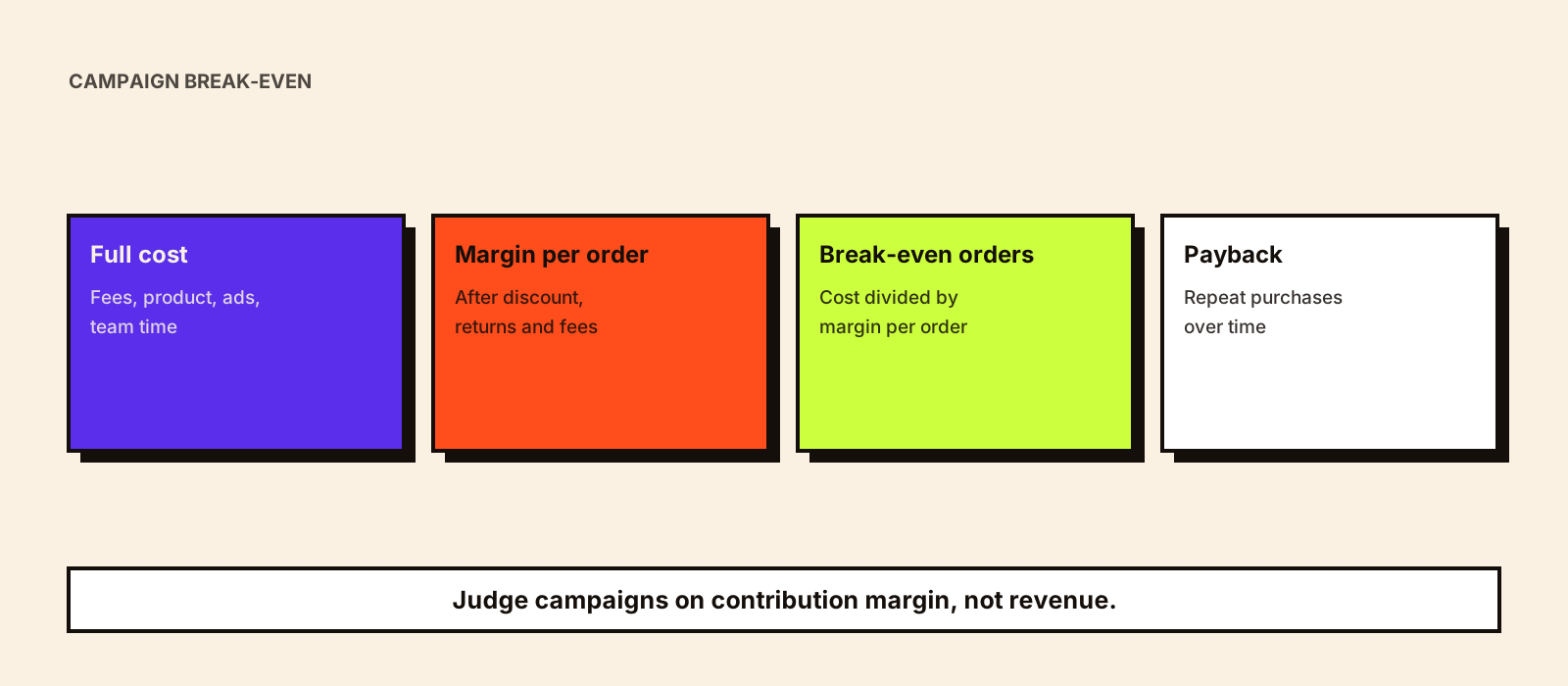
'Did the campaign make money?' is the question finance asks, and 'it generated 4x ROAS' doesn't answer it. Revenue isn't profit, and a campaign can produce plenty of revenue while losing money on every order. A break-even calculation tells you the number of orders or customers you need before the campaign has paid for itself, so you can judge it before launch as well as after.
Quick answer
Break-even orders = full campaign cost ÷ contribution margin per order. Full campaign cost includes creator fees, product and shipping for creators, paid amplification, agency or team time and tools. Contribution margin per order is the selling price after the creator discount, minus product cost, shipping, payment fees, GST you don't keep and an allowance for returns. If you expect customers to reorder, calculate a second number: how many first-time customers you need when each one's expected margin over, say, 6 or 12 months is counted. Your maximum affordable cost per new customer is that margin figure.
This page focuses on orders, customers and payback in rupees. For a ROAS-based version with worked examples in AED and SAR, see how to calculate break-even ROAS for influencer campaigns in the GCC.
Step 1: Add up the full campaign cost
| Cost line | Include? | Note |
|---|---|---|
| Creator fees | Yes | Including usage-rights fees if you'll run the content as ads |
| Product sent to creators | Yes | At cost, plus packaging and shipping |
| Paid amplification | Yes | Partnership ads, boosts or whitelisting spend |
| Agency fee or team time | Yes | Estimate internal hours at a realistic cost; leaving it out flatters the result |
| Tools and tracking | Share | The campaign's fair share of software and production |
| Discounts on creator-coded orders | No, handle in margin | Counting it here and in the margin double-counts it |
Step 2: Work out contribution margin per order
Contribution margin is what each order contributes after the costs that only exist because the order happened. Use realistic averages from your own data, not the list price.
Average order value, after creator discount (excluding GST)   ₹[  ]
– Product cost (landed cost of goods)                          ₹[  ]
– Shipping and packaging                                       ₹[  ]
– Payment gateway or COD charges                               ₹[  ]
– Marketplace commission (if the order is on a marketplace)    ₹[  ]
– Returns allowance (return rate × cost of a return)            ₹[  ]
= Contribution margin per order                                ₹[  ]
Work in prices excluding GST if you're GST-registered, since the tax isn't yours to keep. Cash-on-delivery brands should include failed deliveries (return to origin) in the returns allowance; they can be a large hidden cost.
Step 3: Calculate break-even orders and break-even CPA
| Line (hypothetical home-care brand) | Value |
|---|---|
| Creator fees (10 micro-creators) | ₹2,50,000 |
| Product, packaging and shipping to creators | ₹15,000 |
| Paid amplification | ₹60,000 |
| Team time (estimated) | ₹45,000 |
| Full campaign cost | ₹3,70,000 |
| Average order value after 15% creator discount, ex-GST | ₹1,190 |
| Product, shipping, payment and returns allowance | ₹690 |
| Contribution margin per order | ₹500 |
| Break-even orders (₹3,70,000 ÷ ₹500) | 740 |
| Break-even cost per order | ₹500 |
Illustrative figures. The campaign needs 740 orders to recover its cost on first orders alone, which means it can afford to pay up to ₹500 per order. That ₹500 is your break-even CPA. For how CPA, CPM and CPE are calculated and compared across creators, see influencer marketing CPM, CPE, CPC and CPA.
Step 4: Add repeat purchases and calculate payback
Many influencer campaigns don't break even on the first order and shouldn't be expected to. If new customers come back, what matters is how long it takes for their combined margin to cover the cost of acquiring them. That's the payback period.
| Period after first order (hypothetical) | Share of customers who reorder | Margin per reorder | Cumulative margin per customer |
|---|---|---|---|
| First order | 100% | ₹500 | ₹500 |
| Months 1–3 | 30% | ₹520 | ₹656 |
| Months 4–6 | 20% | ₹520 | ₹760 |
| Months 7–12 | 25% | ₹520 | ₹890 |
Illustrative figures. If the campaign above brings in 600 new customers, cost per new customer is about ₹617. It misses break-even on the first order (₹500) but passes it within the first three months if this repeat pattern holds. Use repeat rates from your own customer data, ideally for customers acquired through creators, because they can behave differently from customers acquired through search or ads. How to measure customer quality from influencer campaigns explains how to compare cohorts.
Step 5: Decide what counts as a campaign order
Break-even depends on which orders you credit to the campaign. Codes and links undercount (people see a post and buy later on a different device or a marketplace), while counting every order in the campaign period overcounts. Agree the rule before launch and state it in the report.
- Conservative: tracked codes and links only. Useful as a floor.
- Middle: tracked orders plus a clearly stated uplift from a post-purchase survey or comparison period.
- Fullest: incremental orders estimated from a holdout region or a before-and-after baseline.
If the campaign breaks even on the conservative count, the decision is easy. If it only breaks even on the fullest count, be open about that and run a cleaner test next time. Influencer marketing incrementality explains how to estimate the orders creators actually added.
Using break-even before launch
Break-even is most useful as a planning check. Before you approve a creator list, compare break-even orders with what's plausible. If ten micro-creators would need to sell 740 orders between them and your past campaigns averaged 30 orders per creator, the plan is unlikely to break even on first orders, and you either need cheaper creators, a higher-margin product, a longer payback window or a different objective. Influencer marketing ROI forecasting shows how to build that range of likely outcomes.
For campaigns where finance needs this analysis set up and reported consistently, Kudozz's campaign reporting service builds the cost, margin and attribution rules in before launch.
Is influencer marketing a good acquisition channel for you?
Break-even also lets you compare creators fairly with other channels. Use the same cost definition and the same order rule for each channel, then compare cost per new customer and payback, not ROAS. A creator campaign with a slightly higher cost per customer can still be the better channel if those customers reorder more or return less. Equally, if creator customers are mostly discount hunters who never come back, a low first-order CPA can hide a poor investment.
Common mistakes
- Using revenue or ROAS as if it were profit.
- Leaving out team time, product seeding and paid amplification from the campaign cost.
- Including GST in order value when it isn't money the business keeps.
- Ignoring returns and cash-on-delivery failures in the margin.
- Assuming repeat purchase rates from the whole customer base apply to creator-acquired customers.
- Changing the attribution rule after seeing the results.
Conclusion
Break-even is a simple calculation that forces the right questions: what did the campaign really cost, what is each order really worth, and how long until new customers pay back? Work out the full cost, the contribution margin per order and the break-even number before launch, decide how you'll count orders, and add a payback view if customers reorder. Then the conversation with finance is about evidence, not ROAS.