Influencer Marketing Software: What Features Should Brands Actually Need?
A needs-first buying guide: which software features matter at each stage of maturity, must-have vs nice-to-have, questions to ask vendors, total cost, and when an agency or a lighter setup is the better choice.
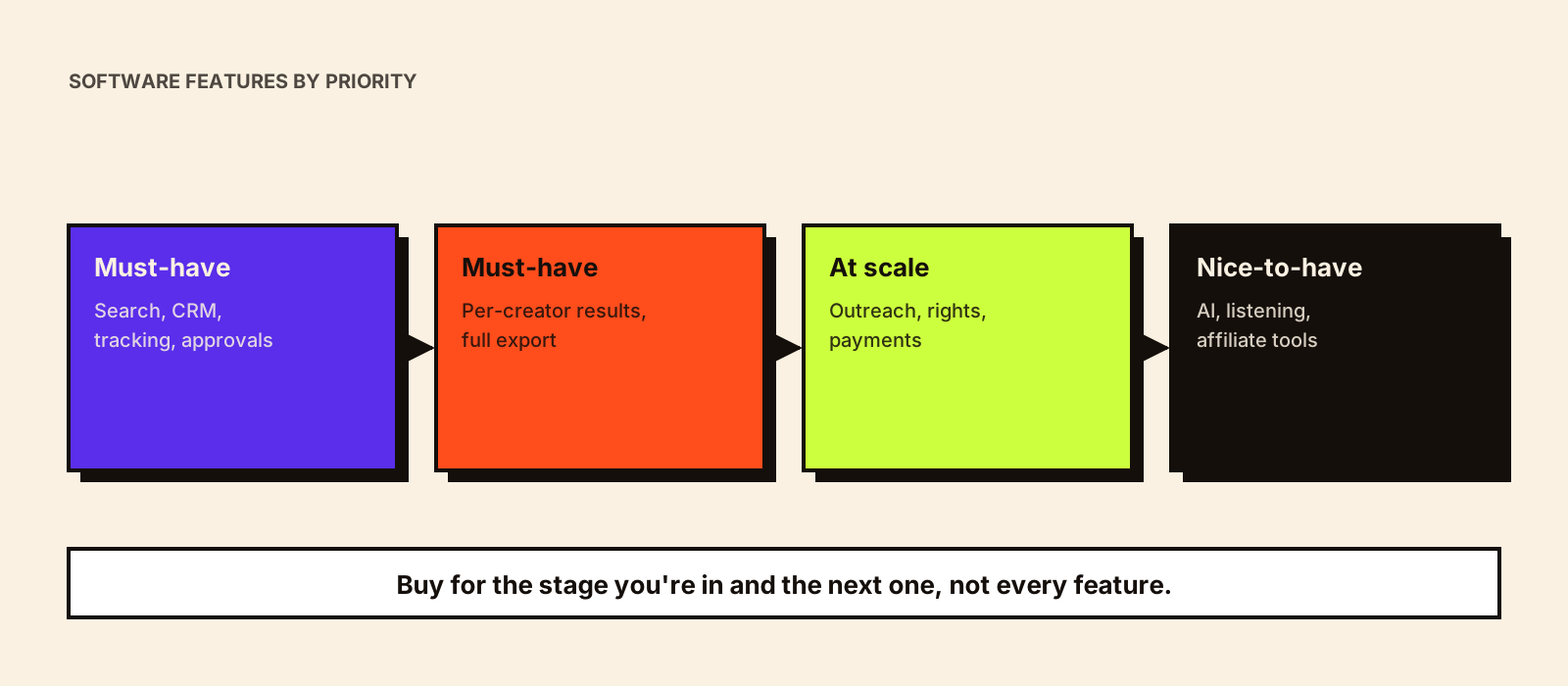
Influencer marketing software is usually sold as an all-in-one platform: discovery, outreach, CRM, campaigns, payments, analytics. Most brands use a fraction of it. The question worth answering before a demo is not 'what can this do?' but 'which features would we use every week, and which problem would they solve?'
Quick answer
Most brands need five core capabilities: creator search with trustworthy data, a creator record that keeps history (CRM), campaign tracking with statuses and approvals, consistent performance tracking per creator, and exportable reporting. Content rights tracking, payments, AI features, social listening and affiliate tools become valuable as volume grows. Choose based on your current bottleneck and campaign volume, insist on a trial with your own creators and languages, check export and total cost, and compare against a lighter setup or an agency if you run only a few campaigns a year.
If you're deciding between software and an agency in the first place, influencer marketing agency vs platform compares SaaS tools, marketplaces and managed services.
Features that matter, by priority
| Feature | Priority | Why | What good looks like |
|---|---|---|---|
| Creator search and filters | Must-have (if you source in-house) | Finding relevant creators faster | Content search, language and region filters, labelled data sources |
| Creator profiles with history (CRM) | Must-have | Knowledge survives team changes | Campaigns, rates, results, notes and rights on one record |
| Campaign tracking and statuses | Must-have | Seeing what's happening across creators | Custom statuses, deadlines, owner per creator |
| Content approvals | Must-have | Nothing goes live unchecked | Draft upload, comments, approval record with date and approver |
| Performance tracking per creator | Must-have | Comparing creators fairly | Same metrics for every creator, capture dates, tracking links/codes |
| Reporting and export | Must-have | Showing results; not being locked in | Exports to CSV/Sheets; shareable reports |
| Outreach and email integration | Useful at scale | Less copy-paste | Templates, sequences with stop rules, conversation logging |
| Usage rights and content library | Useful at scale | Reusing content safely | Rights type, platforms, expiry alerts |
| Payments and invoicing | Useful at scale | Fewer payment delays | Approval-linked payments; fits Indian GST/TDS handling or exports to finance |
| Authenticity and fraud signals | Useful | Avoiding bad bookings | Evidence behind flags, not just a score |
| AI search, drafting and summaries | Nice-to-have | Speed | Explainable, testable, regional-language capable |
| Social listening | Nice-to-have | Finding creators and topics from conversations | Useful only if you'll act on it |
| Affiliate and commerce integration | Depends on model | Commission-based programmes | Works with your store and attribution |
Match features to your maturity
| Stage | Typical situation | What you need | What you probably don't |
|---|---|---|---|
| Starting out | 1–2 campaigns a quarter, one person | A structured tracker, native platform tools, templates | An all-in-one platform |
| Growing | Monthly campaigns, small team | CRM, campaign tracking, approvals, tracking links, reporting | Social listening, advanced AI |
| Scaling | Always-on programme, many creators, several markets | Search at scale, outreach automation, rights, payments, dashboards | Features duplicating tools you already have |
| Integrated | Creator marketing tied to paid, commerce and CRM | APIs and integrations, governance, analytics connections | Lock-in without export |
Influencer marketing automation explains the maturity stages in more detail.
Questions to ask before buying
- Which three problems will this solve for us, and how will we measure that in 90 days?
- How many creators do you cover in our languages, regions and categories? Can we test it?
- Which data is first-party, public or estimated, and is it labelled in the interface?
- How does performance tracking work for Instagram, YouTube and any other platforms we use? Which metrics need creators to connect their accounts?
- Can creators submit drafts and insights without creating an account?
- How are content approvals recorded, and can we see who approved what?
- Does it handle usage rights and expiry dates?
- How do payments work with Indian invoicing, GST and TDS, or do we export to our finance system?
- What integrations exist (email, analytics, store, ads), and what's the API?
- What does it cost at our expected volume next year, including seats, creators tracked and add-ons?
- How do we export all our data, and in what format?
Understand the total cost
Licence fees are only part of the cost. Add setup and migration time, training, the hours someone spends keeping data clean and any add-ons you'll need within a year. Then compare it to what you spend now: team hours on manual work, missed deadlines, duplicate bookings, lapsed rights. Software is worth it when it saves more than it costs and the team actually uses it. An unused platform is the most expensive option.
When software alone isn't enough
Software organises work; it doesn't do it. Someone still needs to search, vet, negotiate, brief, review and interpret results. If your team doesn't have that capacity, or lacks experience with creators in particular regions or categories, software can make a thin team look busier without improving results. That's where an agency, or a hybrid model with strategy in-house and execution outsourced, often makes more sense. Influencer marketing agency vs in-house covers the trade-offs.
Kudozz is an agency, not a software vendor. We use technology to support discovery, tracking and reporting, and our team handles the strategy, creator selection and management work around it.
A simple scoring matrix
Criterion                          Weight   Tool A   Tool B   Current setup
Solves our top bottleneck           25%
Creator coverage (our languages)    20%
Data transparency                   10%
Campaign tracking and approvals     15%
Reporting and export                10%
Ease of use (team trial feedback)   10%
Total annual cost at our volume     10%
WEIGHTED TOTAL
Always score your current setup too. Sometimes the best decision is improving the spreadsheet and processes you already have.
Software, agency or hybrid: by situation
| Situation | Usually the better fit | Why |
|---|---|---|
| First campaigns, small team | Agency or light setup | Learning what works matters more than tooling |
| Experienced in-house team, growing volume | Software | The team has judgment; software removes admin |
| Entering new regions or languages | Agency or hybrid | Regional creator access and vetting experience |
| Always-on programme, many creators | Software + agency support for peaks | Steady work in-house; launches and festivals outsourced |
| Regulated category (health, finance) | Hybrid with strong review process | Approval workflow and expertise both matter |
Implementation risks to plan for
- Data migration: creator history scattered across sheets and inboxes rarely imports cleanly. Budget time to clean it.
- Adoption: if one key person keeps using their own spreadsheet, the software never becomes the source of truth.
- Creator friction: creators who won't log in to submit drafts push work back into WhatsApp.
- Platform access: features that rely on platform APIs can change if access changes; ask how the vendor has handled this before.
- Lock-in: confirm export of creators, notes, campaigns and content before signing.
Common mistakes
- Buying the most complete platform when you need two features.
- Choosing on discovery database size rather than coverage of your creators.
- Skipping a trial with real campaigns.
- Ignoring export until you want to leave.
- Assuming software replaces the need for experienced people.
Vendors increasingly sell an intelligence layer on top of these features; creator intelligence platform explains what that should contain.
Conclusion
The right influencer marketing software is the one that fixes your current bottleneck, covers your creators and languages, keeps history on the creator record, tracks performance consistently and lets you leave with your data. Buy for the stage you're in and the next one, not for every feature. For a closer look at the campaign side, see influencer campaign management software, and for measurement, influencer analytics tools.