Influencer Marketing RFP: How Brands Should Evaluate Agencies
How brands run an influencer marketing RFP: when a formal process is worth it, the RFP structure, how many agencies to invite, what a strong proposal contains, a weighted scoring matrix for comparing agencies, pitch meetings, paid pilots and making the final decision.
A request for proposal (RFP) turns agency selection from a series of impressive presentations into a comparison you can defend to your CFO. It asks every agency the same questions, gets answers in the same format, and scores them on criteria you set before anyone pitches.
Quick answer
An influencer marketing RFP is a document sent to a shortlist of agencies asking for a proposal against a defined brief, in a set format and by a set date. Invite three to five agencies, include the brief, budget range, evaluation criteria and timeline, and ask for an approach, sample creators with rationale, budget split, team, process, reporting and commercial terms. Score proposals on weighted criteria agreed in advance, meet the top two or three, check references, and consider a small paid pilot before a long commitment.
When a formal RFP is worth it
| Worth a formal RFP | A lighter process is fine |
|---|---|
| Annual or always-on program | One small test campaign |
| Large budget or leadership scrutiny | Budget within a manager's own approval |
| Procurement requires it | Founder-led startup choosing quickly |
| Several stakeholders must agree | One decision-maker |
For a lighter process, send the same brief to two or three agencies and use the questions in questions to ask an influencer marketing agency.
What to put in the RFP
- Company overview and the campaign or program brief; see how to write an influencer marketing agency brief.
- Budget range and what it covers.
- Scope of services you want (strategy, discovery, negotiation, management, UGC, reporting).
- Evaluation criteria and their weights.
- Required response format and page limit.
- Timeline: questions deadline, submission date, pitch dates, decision date, start date.
- Commercial requirements: pricing model, payment terms, contract basics.
- Confidentiality, and whether you'll pay for strategic work in the pitch.
Brief structure: how to write an influencer marketing agency brief.
How many agencies to invite
Three to five is usually enough. More than that and you can't evaluate properly, and good agencies may decline an RFP that looks like a lottery. Build the shortlist from agencies with relevant category, regional and platform experience; the criteria are in how to choose an influencer marketing agency in India.
What a strong proposal contains
| Section | Strong | Weak |
|---|---|---|
| Understanding | Restates your objective and customer in its own words, with sharp questions | Repeats the brief back |
| Approach | Clear creator strategy, formats and phasing tied to the objective | A generic influencer marketing overview |
| Creators | Sample profiles with a one-line reason each, audience data dated | A long list of big names without reasoning |
| Budget | Split by creator fees, agency fee, production, usage, media | One total |
| Timeline | Week-by-week plan with approval windows | "4–6 weeks" |
| Team | Named people and their time on your account | Leadership bios only |
| Process | Vetting, contracts, QA, disclosure, escalation | "End-to-end management" |
| Measurement | KPIs, tracking method, report format and review cadence | "Detailed reporting" |
| Risks | What could go wrong and how they'll handle it | No risks mentioned |
Treat sample creators as evidence of thinking, not a final roster: availability and fees change, and a proposal promising named creators before contacting them is a warning sign.
A weighted scoring matrix
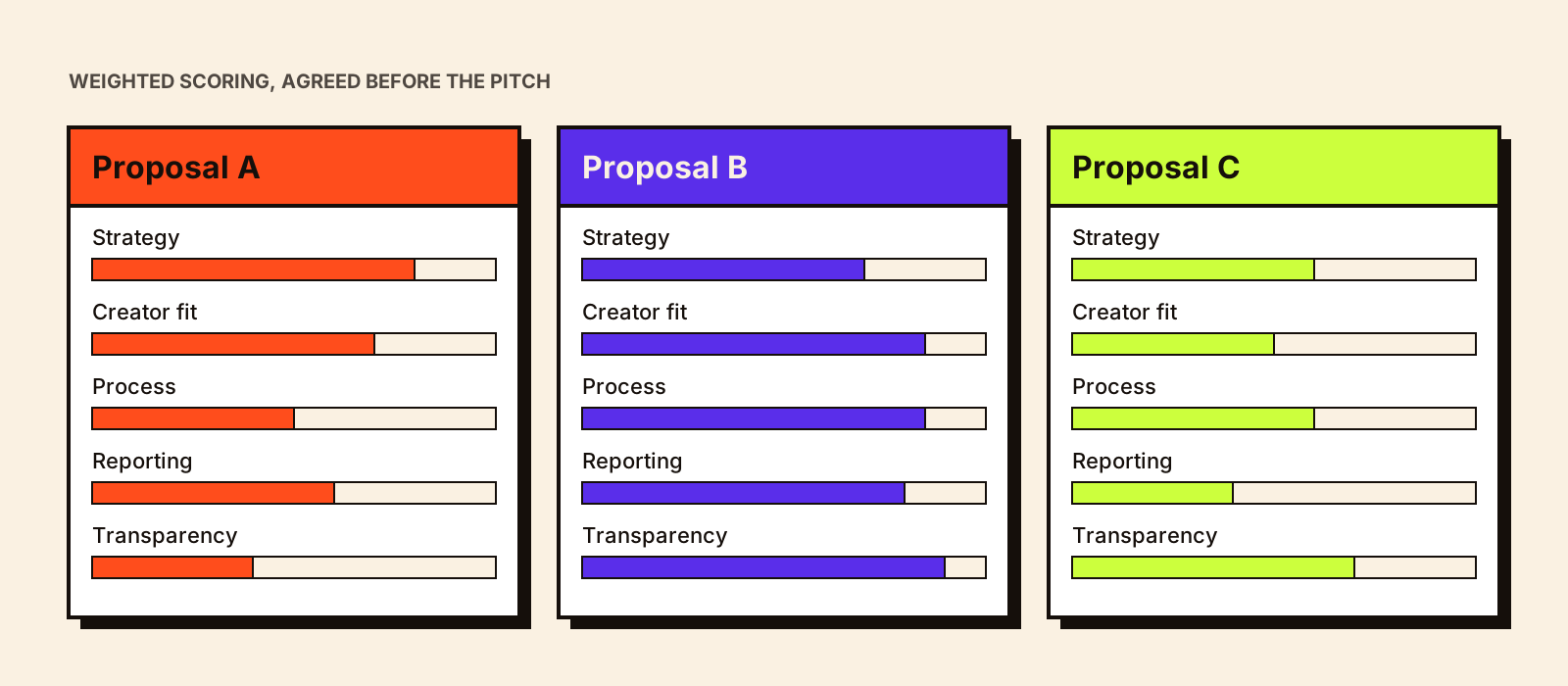
Agree criteria and weights with your stakeholders before reading any proposal. The weights below are an illustrative starting point; adjust them to what matters for your campaign.
| Criterion | Illustrative weight | What a 5 looks like |
|---|---|---|
| Understanding of brand and customer | 15% | Insight you hadn't articulated yourself |
| Strategy and creator approach | 20% | Creator mix and formats clearly tied to the objective |
| Creator fit (samples) | 15% | Audience-matched, varied, well reasoned |
| Process and compliance | 15% | Documented vetting, QA, disclosure, escalation |
| Measurement and reporting | 15% | Tracking plan and report format agreed upfront |
| Team and capacity | 10% | Named people with relevant experience and real time |
| Commercials and transparency | 10% | Itemized, clear on creator vs agency fees |
Agency: [ ]   Evaluator: [ ]
Criterion                     Weight   Score (1–5)   Weighted
Understanding                 15%      [ ]           [ ]
Strategy and creator approach 20%      [ ]           [ ]
Creator fit                   15%      [ ]           [ ]
Process and compliance        15%      [ ]           [ ]
Measurement and reporting     15%      [ ]           [ ]
Team and capacity             10%      [ ]           [ ]
Commercials and transparency  10%      [ ]           [ ]
Total                                                 [ ]
Notes / questions for the pitch:
- Score independently, then compare; discuss big disagreements.
- Keep price as one criterion, not a tie-breaker applied after everything else.
- Normalize quotes first: agencies may have priced different scope; see influencer marketing agency fees in India.
Fee structures: influencer marketing agency fees in India.
Pitch meetings and references
- Meet the top two or three; insist the people who'll run your account attend.
- Ask them to walk through one past campaign end to end, including what went wrong.
- Ask for two references from clients with similar scope, and call them.
- Check how they handle disclosure and claims in your category.
Consider a paid pilot
For large or long commitments, a small paid pilot (one campaign, a defined number of creators, a clear KPI) shows how an agency actually works: responsiveness, creator quality, approvals, reporting. Pay for it; asking agencies to run free trials skews the process towards agencies that can afford to give work away.
After the decision
Tell unsuccessful agencies promptly, with brief, useful feedback. Before signing with the winner, run through the influencer marketing agency checklist so the contract reflects what was proposed.
Common mistakes
- Inviting too many agencies.
- No budget range, so proposals can't be compared.
- Setting criteria after seeing the pitches.
- Choosing the best presentation rather than the best process.
- Not meeting the actual account team.
- Asking for free strategy work you'd otherwise pay for.
Conclusion
A good RFP gives a small group of relevant agencies the same brief, budget range and criteria, asks for proposals in a comparable format, and scores them on what matters before anyone pitches. Meet the real team, check references, and use a paid pilot where the commitment is large. The result is a decision you can explain, and an agency that knows exactly what it was chosen to deliver.