Influencer Marketing for Brands Sold Through Distributors and Retailers
How brands that sell through distributors, modern trade and local stores can run creator campaigns: stock first, 'where to buy', regional creators, trade partners and region-level sales measurement.
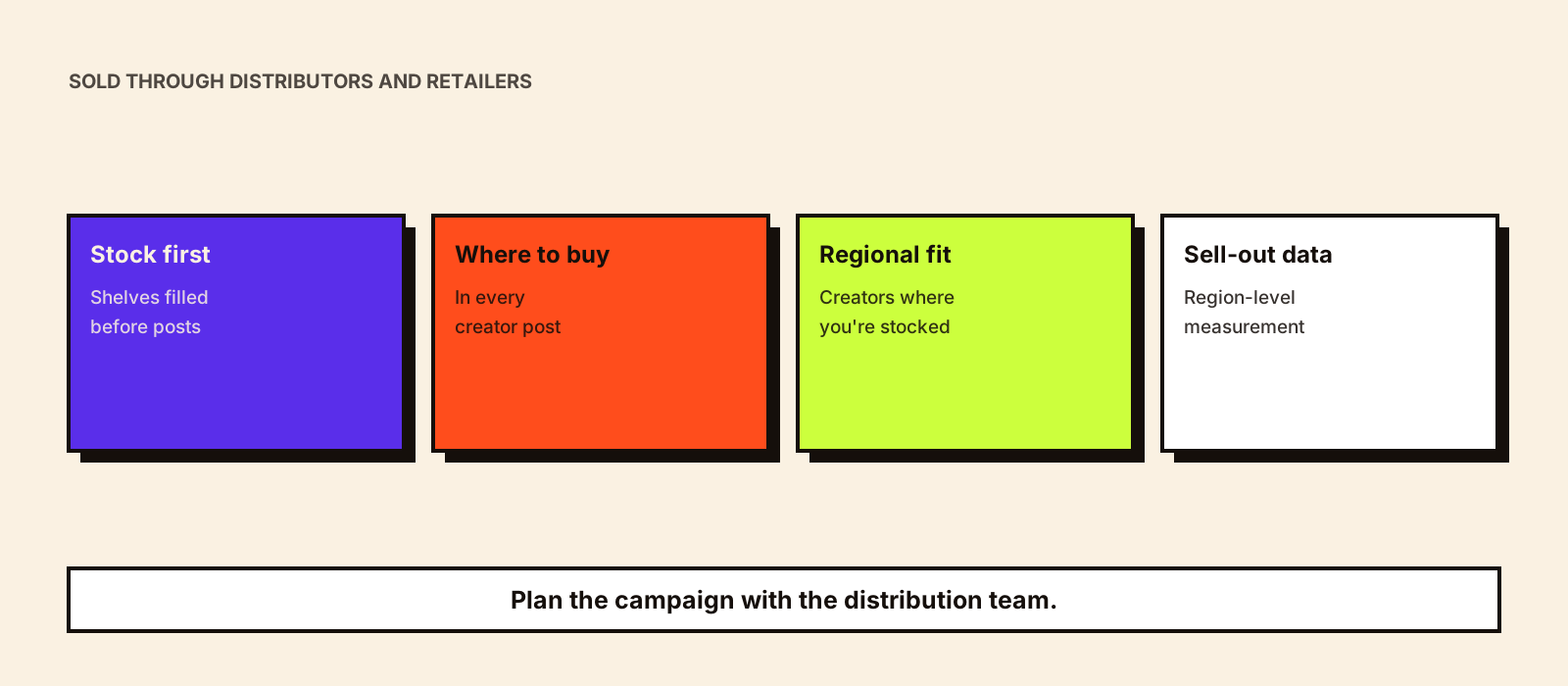
Many Indian brands sell most of their volume through distributors, wholesalers, modern trade chains and neighbourhood stores, not through their own website. Influencer marketing for these brands has a problem that D2C brands don't: the viewer can't click to buy. They have to find the product on a shelf, often in a store the brand doesn't control, and the sale shows up weeks later in distributor or retailer data. Creator campaigns can still work, but only if they're planned with the sales and distribution side.
Quick answer
Brands sold through distributors and retailers should make sure stock is on shelves in the campaign areas before creators post, tell viewers exactly where to buy, involve trade partners early, and measure with secondary sales or retailer sell-out data by region rather than clicks. Target creators by the regions where distribution is strong, use retailer-specific offers only where retailers have agreed, and compare campaign regions with similar regions without the campaign.
What's different when you don't sell directly
| Issue | D2C brand | Brand selling through distributors and retailers |
|---|---|---|
| Where viewers buy | A link | A store, a chain or a marketplace the brand doesn't run |
| Stock | Brand controls it | Depends on distributor and retailer orders |
| Tracking | Codes and links | Sales data by region, often with a lag |
| Partners | None | Distributors, retailers and sales teams need to know |
| Timing | Post when ready | Post after stock reaches shelves |
10 ideas for creator campaigns through retail and distribution
1. Launch only where stock has landed
Ask sales for the regions and outlets where the product is on shelf, and brief creators in those regions first.
- Creator content that sends people to empty shelves wastes the campaign and annoys retailers.
2. 'Where to buy' in every post
Every creator post should say where to find the product: the chains, the types of store and any marketplaces or quick-commerce apps that stock it.
- Keep a store-locator or 'where to buy' page current, and link it where the platform allows.
3. Shelf-finding content
Creators show the product in a real store: which aisle, what the pack looks like, the price on the shelf.
- Get permission from the store before filming inside it.
4. Regional creators matched to distribution
Pick creators by the cities and states where distribution is strong, not by national reach.
- Check audience location screenshots against your distribution map.
5. Brief the trade before the public
Share the campaign plan, creator content and dates with distributors and key retailers in advance, so they order stock and display the product.
- A creator campaign can be a selling point in the trade conversation.
6. Retailer-specific offers, with agreement
An offer or code redeemable at one chain can be tracked, but only if the retailer has agreed and its billing can record it.
- Don't promise an offer in creator content that stores don't know about.
7. Creator visits to partner stores
Creators visit a partner store or a chain's flagship for a demo or tasting, with the store promoting the visit too.
- Coordinate staff, stock and timing with the store.
8. Content for retail partners to use
Clear creator clips with retailers and distributors for their own social pages, WhatsApp catalogues or in-store screens.
- Usage rights must cover partner use, and partners must keep disclosure.
9. Retail sales staff and counter content
For categories sold at counters (electronics, paint, appliances, cosmetics), short creator demos can help store staff explain the product.
- Keep claims identical to the approved list.
10. Marketplace and quick commerce alongside stores
Many buyers will search online after seeing a post. Make sure the product is listed and in stock on the marketplaces and quick-commerce apps you use.
- Sales may move between channels; read them together.
Regional planning is covered in regional influencer marketing in India, and online channels in influencer marketing for quick-commerce brands.
How to measure it
| Method | What it shows | Watch for |
|---|---|---|
| Campaign regions versus similar regions without it | Change in secondary sales or retailer sell-out | Regions must be genuinely comparable |
| Before versus after in the same outlets | Change in outlet sales | Seasonality, other promotions |
| Retailer-specific codes | Redemptions at agreed chains | Only where billing records them |
| Brand search and 'where to buy' visits | Interest after posts | Interest isn't a sale |
| Distributor reorders | Trade confidence | Can lag by weeks |
Comparing regions with and without a campaign is a form of incrementality testing; see how to measure influencer marketing incrementality.
Common mistakes
- Going live before stock reaches shelves.
- No 'where to buy' information in the content.
- Choosing national creators for a brand with regional distribution.
- Leaving distributors and sales teams out until the campaign is live.
- Judging the campaign on link clicks when most sales happen in stores.
Conclusion
When customers buy in stores you don't control, creator campaigns need the distribution side as much as the creative side: stock first, clear 'where to buy', regional creators and region-level sales measurement. Kudozz plans regional creator campaigns around distribution footprints through its regional influencer marketing service.