Dark Social and Influencer Marketing: How to Measure What You Can't Track
When creator content is forwarded on WhatsApp and in DMs, sales show up as direct traffic or branded search. What dark social is, what you can observe versus assume, and how to estimate and report it honestly.
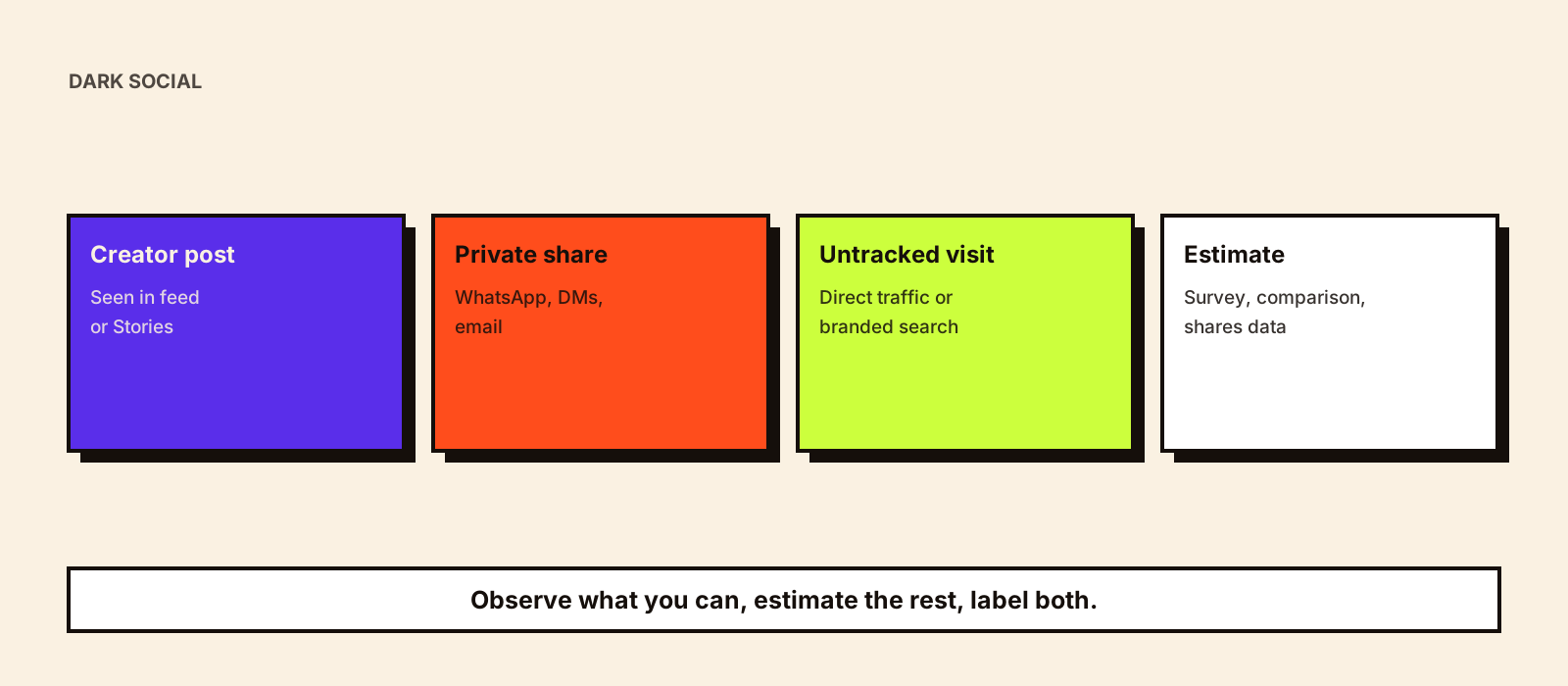
A creator posts about your product. A viewer screenshots it and sends it to a family WhatsApp group, and a cousin buys it two days later by typing your brand into a search bar. Your analytics records a direct visit or a branded search, not a creator sale. That private sharing is usually called dark social, and in India, where so much recommendation happens on messaging apps, it can be a large part of what a creator campaign does.
Quick answer
Dark social is sharing that happens in private channels, such as WhatsApp, DMs, Telegram, email and text messages, where links travel without referral data, so the resulting visits show up as direct traffic or branded search instead of being credited to the source. For influencer marketing, it means codes and links undercount creator impact. You can't track private sharing directly, but you can estimate it: ask customers how they heard about you, watch direct and branded-search traffic around creator posts, make content easy to forward with your own trackable links, and test with comparison groups. Treat these as estimates, not measurements.
Where the term comes from
The term is widely attributed to journalist Alexis Madrigal, who wrote in The Atlantic in 2012 that a large share of the site's traffic arrived with no referrer, and argued it came from people sharing links privately rather than typing addresses. The idea has since been applied to messaging apps, which now carry much of that sharing.
What you can observe vs what you're assuming
| Signal | What it actually shows | What it doesn't prove |
|---|---|---|
| Direct traffic rising after creator posts | More visits with no referrer in that period | That the visits came from shared creator content |
| Branded search rising | More people searching your name | Which creator, post or share caused it |
| 'How did you hear about us' answers naming a creator or WhatsApp | What customers remember | Exact counts; memory is imperfect and skewed |
| Shares and sends counts in creator insights | How often the post was sent onward in-app | What happened after it was sent |
| Tagged links you put in shareable formats | Visits from links that carried your tags | Shares that didn't use those links |
Keep these labels in your report. Calling an estimate 'dark social revenue' as if it were measured overstates what you know.
How to estimate dark social impact
- Ask at the point of purchase or sign-up: a short 'How did you hear about us?' question with options including specific creators, 'a friend sent it to me' and 'WhatsApp or a group'.
- Compare periods and places: direct and branded-search traffic in campaign weeks against previous weeks, and campaign cities against similar cities without creator activity.
- Use creator insights: ask creators for shares and sends counts, not just likes, and compare them across posts.
- Run a comparison test: hold back creator activity in one region or segment and compare total sales, not only tracked ones; see influencer marketing incrementality.
- Add self-reported and observed signals together in one view rather than picking the one that looks best.
Test-and-control methods are explained in influencer marketing incrementality, and how different attribution models credit the same sale in influencer marketing attribution models.
Make shareable content easier to follow
- Give creators short, memorable links and codes that survive being copied into a message.
- Use a landing page that works well on mobile when opened from WhatsApp, with the creator's offer visible immediately.
- Brief creators on formats people forward: useful explainers, price comparisons, recipes, checklists.
- Add 'share with someone who needs this' prompts only where they fit the creator's style.
If your brand sells in WhatsApp chats, see influencer marketing for brands selling through WhatsApp for traceable click-to-chat links.
Reporting it honestly
Tracked results (codes and links): [orders / leads]
Self-reported: [x]% of new customers in the period named a creator or 'a friend or group'
Direct traffic: [+x]% vs the previous [n] weeks  |  Branded search: [+x]% (Search Console)
Comparison: campaign cities vs comparison cities: [result]
Estimate of untracked impact: [range], method: [ ]
Confidence: [low / medium / high] and why
Common mistakes
- Judging a creator only on code redemptions in a market where people share through WhatsApp.
- Treating every rise in direct traffic as creator impact.
- Reporting a dark social estimate as a measured number.
- Asking 'how did you hear about us' with no creator or 'friend sent it' options.
Conclusion
Dark social is why creator campaigns often do more than their tracked numbers show, and also why it's easy to overclaim. Observe what you can, estimate the rest with clear methods, and label each number for what it is. Kudozz builds this kind of measurement into its campaign reporting service.