How to Politely Decline an Influencer Collaboration Request (With Templates)
Brands get far more creator requests than they can accept: free product asks, paid pitches, event invitations and agency rosters. How to decide quickly, reply kindly, keep good creators for later and avoid the replies that turn into public complaints, with copy-ready templates.
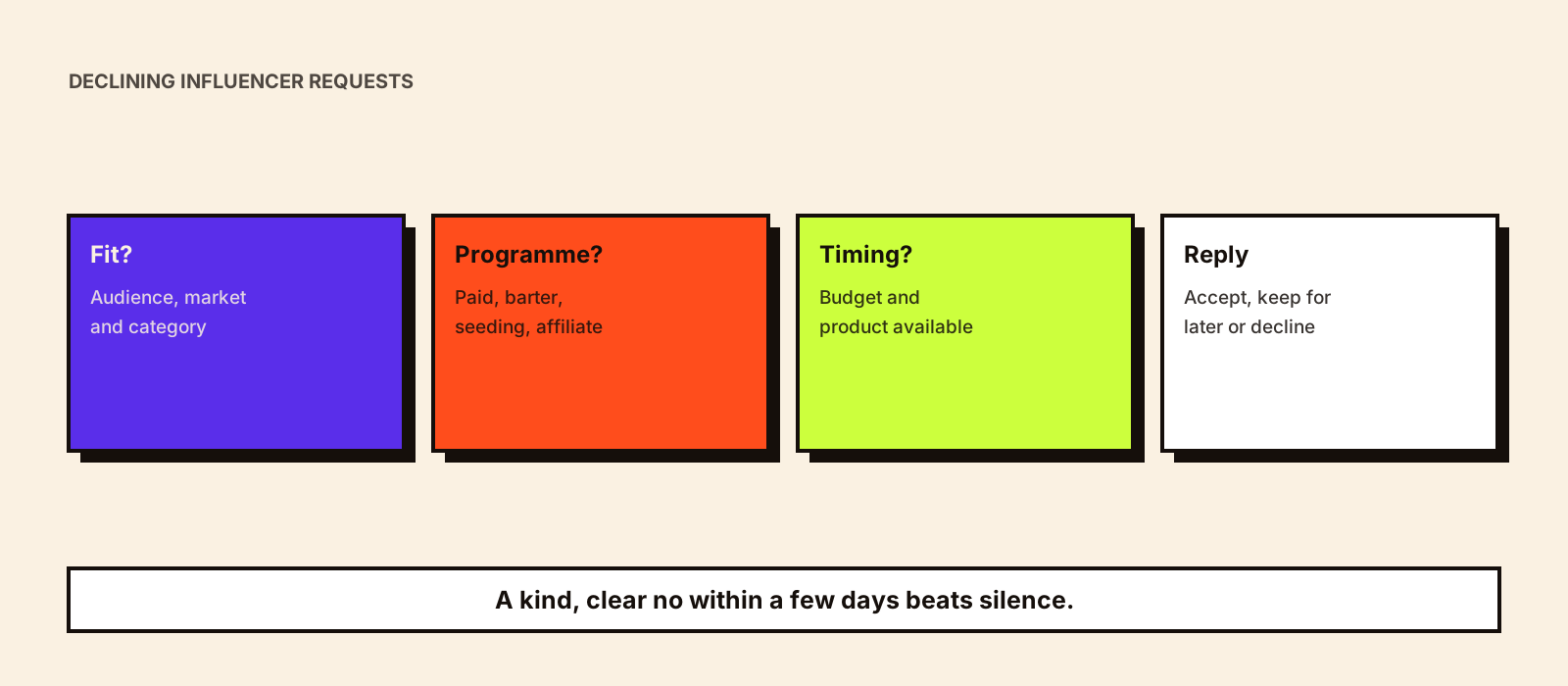
Once a brand has any visibility, the inbox fills with creator requests: 'Can you send me your product?', rate cards from people you've never heard of, agency rosters and event invitations. Most will be a no. How you say it matters, because creators talk to each other, screenshots travel, and some of today's small creators are next year's partners.
Quick answer
To decline an influencer collaboration politely, reply within a few days, thank them by name, say clearly that you won't be going ahead this time, give a short honest reason if you can (budget, timing, audience or category fit), and say whether you'd like to hear from them in future. Don't ghost, don't promise 'maybe later' if you mean no, and don't ask for free content as a consolation. Keep a short list of creators worth contacting again, and use templates so the team replies consistently.
A quick triage for every request
| Question | If yes | If no |
|---|---|---|
| Does their audience match who you sell to, and where you deliver? | Keep going | Decline: audience fit |
| Is the request something you run (paid, barter, seeding, affiliate)? | Keep going | Decline, or point them to the programme you do run |
| Do you have budget or product available in that period? | Keep going | Decline for now, keep on the list if the fit is good |
| Does their content meet your brand-safety bar? | Consider it, then check audience quality before agreeing | Decline without detail |
Anyone who passes the triage still needs normal checks before you agree anything; see how to vet influencers. If you often say yes to product-for-content requests, set them up properly as barter influencer collaborations or a seeding programme rather than one-off favours.
What a good decline includes
- Their name and something specific, so it doesn't read as automated.
- A clear no. 'Not right now' is fine if it's true; vague replies invite follow-ups.
- A short reason where it helps: budget, timing, audience location or category.
- What happens next: whether you'll keep their details, or whether there's a programme they can apply to.
- A reply within a few working days. Silence is the most common complaint creators have about brands.
Templates
Hi [name],

Thanks for getting in touch and for your interest in [brand]. We aren't able to send product for this request, as our gifting for [month/quarter] is already allocated to [a set programme / specific campaigns].

[If true:] We do run a creator programme a few times a year; you can share your details here: [link], and we'll reach out if a campaign fits.

Wishing you the best with your content,
[name], [brand]
Hi [name],

Thank you for sending your rates and ideas. We won't be able to go ahead this time; our creator budget for [period] is already committed.

We liked [specific thing about their content] and would like to keep your details for future campaigns, if that's all right with you.

Best,
[name]
Hi [name],

Thanks for reaching out. We've had a look, and we're focusing on creators whose audiences are mainly in [markets / segments] for now, so this isn't the right match for us.

Thanks again for thinking of [brand], and good luck with your channel.

[name]
Hi [name],

Thanks for sharing your roster. We aren't adding new creator partners at the moment. If it's useful, our current focus is [categories / markets], so creators in that space would be the most relevant for future briefs.

Kind regards,
[name]
Hi [name],

Thank you for your time and for the ideas you shared on [date]. We've decided not to proceed with this collaboration, mainly because [budget / format / timing]. We appreciate the work you put into the proposal and would be glad to stay in touch.

Best regards,
[name]
What to avoid
- Ignoring the request, then contacting the same creator months later as if nothing happened.
- Offering 'exposure' or a repost instead of payment when they asked for a paid collaboration.
- Asking for content, ideas or audience data and then declining without credit or payment.
- Criticising their content, numbers or rates in the reply.
- Replying from a personal account or in a public comment.
- Promising future work you don't plan to offer.
Managing a busy creator inbox
- Give requests one route in, such as a short form linked from your bio or website, so they don't scatter across DMs, email and comments.
- Say on that page what you do and don't run (for example, 'We don't send products on request; we run seeding twice a year').
- Tag requests as decline, keep for later or follow up, and review the 'keep' list when you plan the next campaign.
- Agree who replies, how fast, and which templates to use, so the tone is consistent.
If creators are the ones turning your brand down, the guide to influencer collaboration rejection covers how to respond and what to learn from it.
Conclusion
Declining well is part of running a creator programme. Triage quickly, reply kindly and clearly, keep good creators on a list, and give requests one route in so nobody is ignored. If your team spends more time sorting the inbox than running campaigns, Kudozz can manage creator outreach and requests through its influencer outreach and management service.