How to Become a UGC Creator in India (Even With a Small Following)
A practical guide to becoming a UGC creator in India: how it differs from influencing, the skills brands look for, building sample videos, pitching, pricing components, usage rights and a 30-day starter plan.
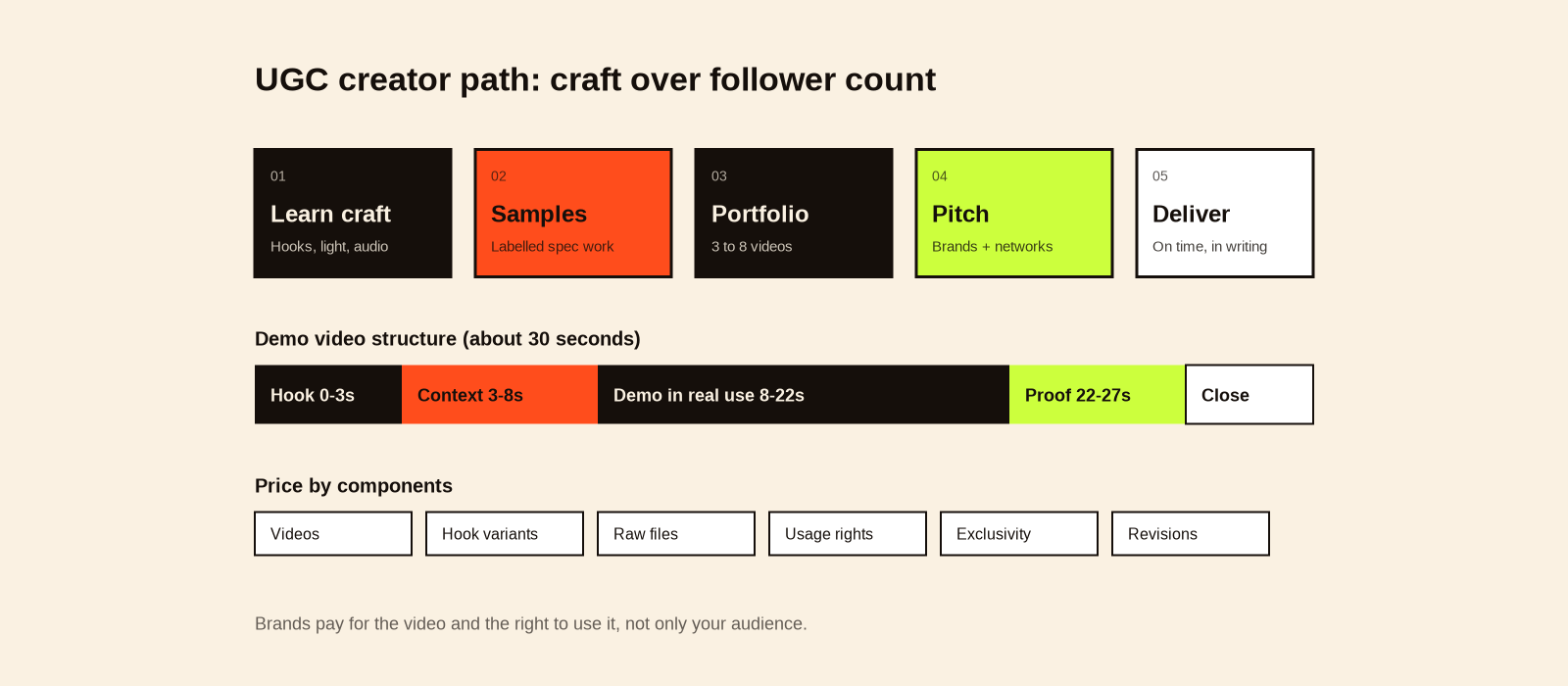
You can make a clean product video on your phone, but your follower count looks small next to the creators getting brand deals. UGC (user-generated content) work is one of the few creator paths where that matters less, because brands are paying for the video itself rather than for your audience. This guide covers what the work actually involves, the skills brands check for, how to build samples and pitch, and how to price and protect your work without guessing.
Quick answer
To become a UGC creator in India, learn to make short product videos that hook quickly, show the product in real use and make only honest claims. Build three to five clearly labelled sample videos with products you already own, put them in a simple portfolio, then pitch brands directly and apply to agencies and creator networks. Price by components: number of videos, hook variants, raw files, usage rights, exclusivity and revisions. You don't need a large following, though some briefs do ask for one.
UGC creator vs influencer: what the brand is buying
An influencer is mostly paid to post to their own audience. A UGC creator is mostly paid to make content the brand will use: on its own Instagram page, on product listing pages, in emails, or as paid ads. The video may never appear on your profile at all. If you want the brand-side view of the same split, read this explainer on UGC vs influencer content, which is written for marketers but shows you how they think about budgets.
| UGC creator | Influencer | |
|---|---|---|
| What the brand pays for | The video and the right to use it | Reach and trust with your audience |
| Where it appears | Brand pages, ads, listings, website | Your own profile |
| Follower count | Often not required | Usually central to the deal |
| Key deliverable | Edited videos, hook variants, raw files | Posts, stories, links |
| Biggest pricing lever | Usage rights and duration | Audience size and fit |
Do you really not need followers?
Many UGC briefs don't care about your audience because the brand controls distribution. That's why people with a few hundred followers can do this work. Be realistic, though: some briefs are hybrid and ask you to post the video too, and those usually do look at your audience and engagement. Some brands also prefer creators who match a customer profile, such as a new parent, a college student in Pune or a home cook who speaks Tamil. Your profile still matters as a shop window, even when the numbers don't.
Skills brands look for in UGC creators
Brands rarely hire on talent alone. They hire someone whose videos are usable with minimal fixes and who delivers on time. Here's what that means in practice.
| Skill | What good looks like | How to practise |
|---|---|---|
| Hooks | The first 1 to 3 seconds name a problem or show a result | Write 5 openings for each product; study short-form video hooks |
| Clear demonstration | Viewer understands what the product does without sound | Film close-ups of hands using it; test with the sound off |
| Real use | Product shown in a believable setting: kitchen, desk, bathroom shelf, bike | Film where you actually use it, not on a bare table |
| Phone lighting | Face and product evenly lit, no harsh shadows | Film facing a window in daylight; avoid overhead tube light alone |
| Audio | Clear voice, no fan or traffic hum | Use a basic clip mic or record in a soft-furnished room |
| Scripting | Short, natural lines that sound like you | Write, read aloud, cut every line you'd never say to a friend |
| Editing | Tight cuts, readable captions, correct aspect ratio | Edit the same clip three ways and compare |
| Hook variants | Same body, 2 to 4 different openings for ad testing | Always film extra openings at the shoot |
| Brief-following | Every must-say and must-avoid point respected | Make a checklist from each brief before filming |
| Reliability | Drafts on the agreed date, quick replies | Track deadlines in one place |
| Honest claims | Only what you've experienced or the brand has substantiated | Ask the brand for approved claims in writing |
For openings, our guide to short-form video hooks has formats you can practise on any product, and the guide to writing video scripts helps you keep a 30-second script natural. On claims, especially for skincare, supplements and health products, read creator advertising rules in India before you say anything like 'cures', 'clinically proven' or 'results in 7 days'.
Build sample videos with products you already own
You don't need a brand to say yes before you can show what you can do. Pick three to five products you genuinely use: a pressure cooker, a sunscreen, a phone stand, a pair of running shoes, a local namkeen brand. Make one sample video for each, in different styles so a brand can see your range.
- Label every sample as spec work, for example 'Sample video, not sponsored' in the caption and portfolio. Never imply a brand hired you when it didn't.
- Don't add fake brand logos, end cards or 'in partnership with' text. Showing the real product packaging as you use it is fine; designing ads that look official is not.
- Keep claims to your own experience: 'I've used this for a month and my cooker hasn't leaked' is fine; 'kills 99% of germs' needs the brand's evidence.
- Make a mix: one unboxing, one problem-and-solution demo, one talking-head review, one 'three ways I use it' video.
- Shoot vertical 9:16, keep each video 20 to 45 seconds, and export a version without music so a brand could add its own.
A product demo video structure you can reuse
Most product demos follow the same five beats. Use this as a starting point and adapt the wording to the product and your language.
0-3s HOOK: Show the problem or the result. 'My dosa batter used to stick every single time.'
3-8s CONTEXT: Who you are and why you care. 'I make breakfast for four people before 8 am.'
8-22s DEMO: Show the product in real use, close-up, step by step. Point at the one feature that matters.
22-27s PROOF: What changed for you, in honest words. 'Two weeks in, nothing sticks and cleaning takes a minute.'
27-30s CLOSE: Simple next step the brand approves. 'It's the one in the link if you want to try it.'

FILM EXTRA: 3 alternative hooks, 2 B-roll clips of the product alone, 1 close-up of the label or packaging.
Regional-language UGC is a genuine opportunity here. Brands selling in Gujarat, Tamil Nadu, West Bengal or Maharashtra often want a script that sounds native rather than translated, and a creator who can deliver the same demo in Marathi and Hindi, or Telugu and English, gives them more to test. Demand varies a lot by category and language, so don't assume every language gets the same volume of briefs. Put your languages at the top of your portfolio so brands notice this skill.
Portfolio basics
Your portfolio is the single page or folder you send with every pitch. Keep it simple: a short intro line, your languages and niches, 3 to 8 videos that play without downloading, what you offer (videos, hook variants, raw files, photos), and your contact email. For layout, platforms and examples, read our full guide to building a UGC creator portfolio rather than reinventing it.
Where to find UGC work
| Route | How it works | Watch out for |
|---|---|---|
| Agencies and creator networks | They match creators to brand briefs and handle coordination | Read the terms; never pay a fee to 'get listed' |
| Direct outreach to brands | Email or DM D2C brands whose products you use | Find the marketing or partnerships contact, not customer support |
| UGC marketplaces and platforms | Brands post briefs; creators apply | Platform fees, payment timelines and who owns usage rights |
| Freelance job boards | General video or content gigs | Vague briefs and unrealistic revision demands |
| Local businesses | Cafes, salons, boutiques and coaching centres need short videos too | Agree scope and usage in writing even when the client is small |
If you're considering agencies, it helps to know what agencies ask for when you apply to a creator network: usually a portfolio link, niches, languages, city and contact details, rather than just follower numbers.
How to pitch a brand for UGC
Keep the pitch short and specific to the brand. Mention a product you've actually used, link to one relevant sample and offer a small, clear first project. For more variations, see our guide on how to pitch brands as a creator.
Subject: UGC demo videos for [product name]

Hi [name],

I'm [your name], a UGC creator based in [city]. I make short product demo videos in [languages] for [niche, e.g. kitchen and home] brands.

I've been using your [product] for [time]. Here's a sample demo I made on my own, not sponsored: [link]. My full portfolio is here: [link].

For a first project I could deliver [2] edited videos of 20 to 30 seconds with [3] hook variants each, in [Hindi and English]. Happy to share pricing based on how and where you plan to use them.

Thanks,
[Name] | [phone] | [email]
Pricing basics: what you're actually charging for
We won't give you rupee figures here, because UGC rates vary widely by category, complexity, language and how the brand uses the video, and invented averages would mislead you. What you can do is price each component separately so your quote makes sense and grows when the brand asks for more.
| Component | Question to ask the brand | Why it changes the price |
|---|---|---|
| Number of videos | How many finished videos? | Each needs scripting, filming and editing time |
| Hook variants | How many alternative openings per video? | Extra filming and editing, and more value for ad testing |
| Raw files | Do you need unedited footage? | The brand can cut many more assets from them |
| Usage rights | Organic only, or paid ads too? For how long? | Paid ads and longer durations are worth more |
| Exclusivity | Can I work with competing brands? For how long? | You give up other income during that period |
| Revisions | How many rounds are included? | Unlimited revisions eat your time |
| Product and logistics | Is the product sent, kept or returned? | Costs and time you'd otherwise absorb |
To set your base numbers, work through how much creators should charge for brand deals in India, then turn it into a simple rate card that lists these components as add-ons. The two levers people underprice most are usage rights and exclusivity; read our guides to creator usage rights and creator exclusivity before you agree to 'perpetual' or 'all channels' terms.
Usage rights, contracts, GST and TDS
Get every UGC job in writing, even a short email confirmation. The agreement should list deliverables, hook variants, raw files, deadline, revision rounds, payment amount and date, where the brand can use the content, for how long, whether paid ads are included, and any exclusivity. Our influencer contract guide for creators walks through the clauses one by one.
On tax, don't rely on social media summaries. Read our guides on GST for influencers and on TDS for creators in India, which explain when registration may apply and why a brand may deduct tax before paying you. Keep every invoice and payment record from your first job.
Red flags and scams
- You're asked to pay a registration, training or 'verification' fee before getting work.
- A 'brand' asks you to buy the product first and promises a refund plus payment later.
- Unlimited revisions, or 'we'll pay only if the ad performs'.
- Contracts that grant perpetual use in all media for a one-time small fee without saying so clearly.
- Requests for your OTP, bank login or ID documents over WhatsApp before any agreement.
- Pressure to promise results you can't verify, such as weight loss or skin changes.
If an offer feels off, check it against our guide to spotting fake brand collaboration offers and scams before you reply.
A 30-day UGC starter plan
| Week | Focus | Output by the end of the week |
|---|---|---|
| Week 1 | Craft basics | Lighting and audio test clips; 10 hooks written for 3 products you own |
| Week 2 | Samples | 3 sample videos, each with 2 hook variants, labelled as spec work |
| Week 3 | Portfolio and pricing | Portfolio page live; component-based price list; contract checklist ready |
| Week 4 | Outreach | 10 personalised pitches sent; applications to 2 or 3 agencies or networks; follow-ups scheduled |
After 30 days, review honestly: which samples got replies, which pitches got opened, and what you'd film differently. Then make two more samples in the niche that got the most interest.
Conclusion
UGC work rewards craft and reliability more than audience size. If you can hook quickly, demonstrate a product clearly, follow a brief, deliver on time and keep your claims honest, you have something brands need. Start with labelled samples from products you already own, price by components rather than guesswork, and get usage rights and payment terms in writing before you film.