How to Connect Influencer Campaigns to Your CRM and Follow-Up Process
Creator campaigns can bring in enquiries, but many are lost between the click and the first reply. How to capture the creator source on every lead, route WhatsApp, form and call enquiries into your CRM, follow up quickly and report which creators brought customers.
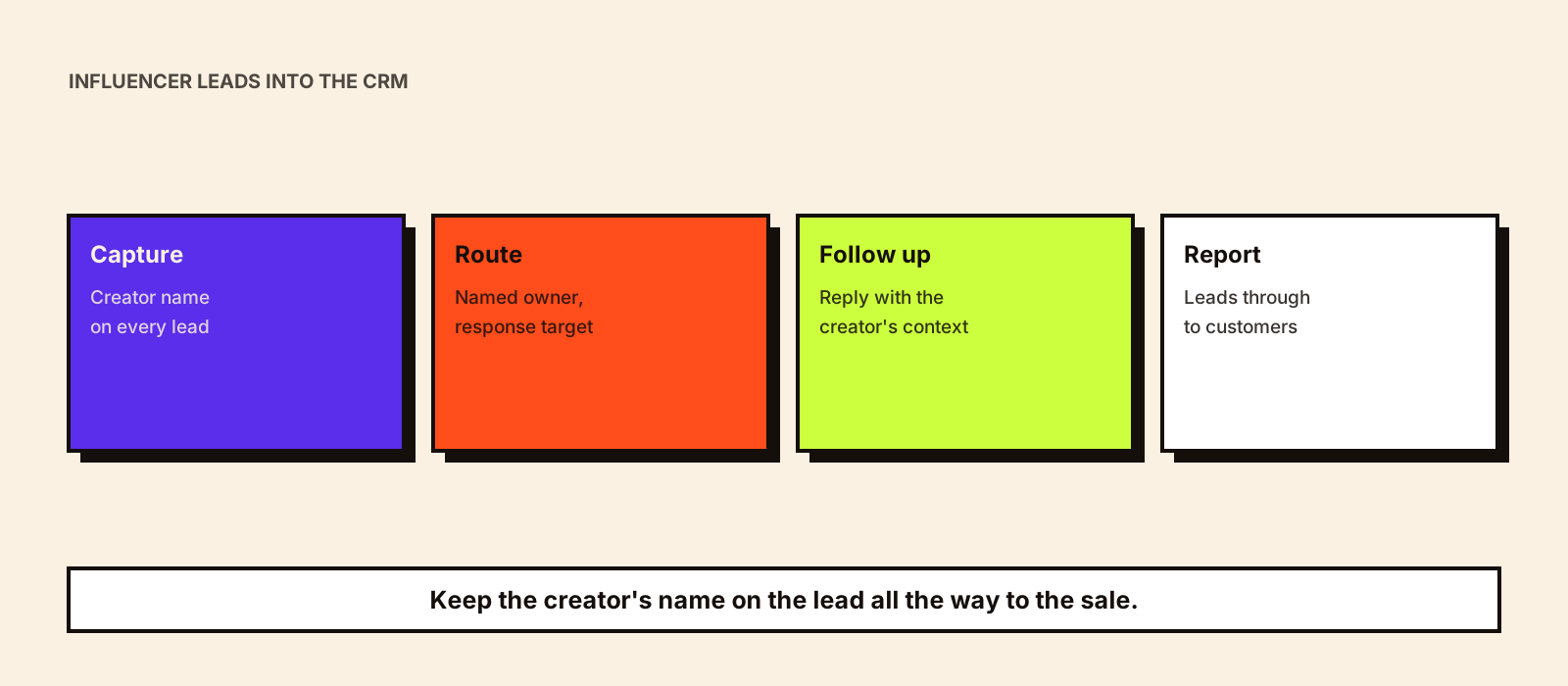
Service businesses, education brands, real estate developers, clinics and B2B companies often run creator campaigns to generate enquiries rather than direct sales. The campaign does its job, people message or fill in a form, and then the trail goes cold. The lead sits in a shared WhatsApp inbox, nobody records which creator sent it, and three weeks later no one can say whether the campaign brought a single customer.
Quick answer
Decide where every creator-driven enquiry will land (a form, WhatsApp, a phone number) and make sure each one carries the creator's name into your CRM, using UTM parameters and hidden form fields, creator-specific WhatsApp pre-filled messages or tracked numbers. Route leads to a named owner with a response-time target, follow up with a script that acknowledges where the lead came from, collect consent properly, and report by creator all the way from lead to customer. Set this up before the first post goes live.
How this differs from related guides
If you're still deciding whether creators suit lead generation, and which lead action to ask for, start with influencer marketing for lead generation. If you're looking for a system to manage your relationships with creators themselves, that's an influencer marketing CRM, a different tool. This guide covers the plumbing between a creator's post and your sales team's customer CRM.
Step 1: Choose where leads will land
| Lead path | Best for | How the creator source is captured |
|---|---|---|
| Web form | Considered purchases, B2B, education, finance | UTM parameters on the creator link, copied into hidden form fields |
| WhatsApp chat | Local services, retail, quick questions, mobile-first audiences | A creator-specific link with a pre-filled first message, e.g. 'Hi, I saw [creator]'s video' |
| Phone call | High-value services, older audiences, urgent needs | A tracked number per creator or per campaign |
| Booking or demo calendar | Clinics, consultations, software demos | UTM parameters passed into the booking form |
| Promo or referral code | Any path, as a backup | Code asked for or entered at the enquiry stage |
Pick one primary path per campaign. Offering form, WhatsApp and phone in the same post splits the audience and makes tracking harder. If your customers expect WhatsApp, use it; see influencer marketing for brands selling through WhatsApp for how the WhatsApp side should be set up.
Step 2: Capture the creator on every lead
The single most important field is 'which creator sent this lead'. Without it, you can count leads but you can't decide which creators to rebook.
Forms
Give each creator their own link with UTM parameters, using a consistent naming scheme (influencer UTM tracking explains one). Ask your developer or form tool to copy the UTM values into hidden fields, so they arrive in the CRM with the lead. Test it yourself from a phone, inside the Instagram and YouTube in-app browsers, because that's where most creator clicks open.
A wa.me link can carry a pre-filled message. Give each creator a link whose message names them, such as 'Hi, I'm interested after watching Priya's video'. Most people send it unchanged, and your team can tag the chat with the creator's name. If you also put paid budget behind creator content, Meta's ads that click to WhatsApp open a chat directly from Facebook and Instagram ads, and the ad itself tells you which creative started the conversation.
Calls
For phone-led businesses, a tracked number per creator (or per campaign, if you have many small creators) is the cleanest option. Make sure whoever answers the call records the source in the CRM, and ask 'where did you hear about us?' as a check.
Step 3: Set up the CRM fields
You don't need special software. Most CRMs, and even a well-run spreadsheet for a small team, can hold these fields. What matters is that they're filled in the same way every time.
| Field | Example value | Why it matters |
|---|---|---|
| Lead source | Influencer | Separates creator leads from ads, search and referrals |
| Campaign | diwali-2026-home-loans | Groups leads by campaign |
| Creator | creator-handle | Lets you compare creators |
| Entry path | WhatsApp / form / call | Shows which path converts best |
| First response time | Minutes or hours | Speed is often the biggest driver of lead-to-customer rate |
| Lead status | New / contacted / qualified / won / lost | Tracks the lead through to an outcome |
| Lost reason | Price / timing / not eligible / no response | Tells you whether the creator brought the wrong audience |
| Consent recorded | Yes, with date and wording | Needed before marketing follow-up |
Step 4: Route leads and set response times
Creator posts produce bursts, not a steady flow. A single post can bring most of its enquiries within the first day or two, then tail off. Plan staffing around go-live dates and agree who owns creator leads during the burst.
- Share the go-live calendar with the sales or support team a week ahead, with expected timing per creator.
- Name an owner for each lead path (WhatsApp inbox, form leads, calls) and a backup.
- Set a first-response target your team can actually meet, for example within business hours on the same day, and track it.
- Use a quick auto-reply for out-of-hours messages that says when a person will respond.
- Agree what counts as a qualified lead before launch, so marketing and sales report the same thing.
Step 5: Follow up in a way that fits the creator's audience
Someone who arrives from a creator's video already knows a little about you, and they came with that creator's framing in mind. Acknowledge it. A follow-up that references the video feels like a continuation; a generic sales script feels like a cold call.
Hi [name], thanks for getting in touch after [creator]'s video. I'm [your name] from [brand].

To point you in the right direction, could you tell me [one qualifying question, e.g. which city you're in / what you're looking to solve]?

If it's easier to talk, I can call you at a time that suits you.
- Answer the question the creator's video raised first, before pitching anything else.
- Use the same offer or terms the creator mentioned. A mismatch kills trust quickly.
- Plan two or three follow-ups over a week for leads that go quiet, then stop.
- Move leads to email or a call only when they're ready; don't force channel changes.
- Brief your team on what each creator said, so nobody contradicts the content.
Consent and data handling
Leads are personal data. Under India's Digital Personal Data Protection Act, 2023 and the DPDP Rules notified in November 2025 (which are being brought into force in phases), you should be clear about why you're collecting details, use them for that purpose, and get consent where it's needed before sending marketing messages. Answering an enquiry is different from adding someone to a promotional broadcast list; ask before you do the second. Creators and agencies should not collect and pass on your leads' details through their own channels unless your agreement covers how that data is handled. Influencer marketing data privacy covers the wider obligations; this is general information, not legal advice.
Step 6: Report by creator, from lead to customer
Report the whole chain, not just lead volume. A creator who brings fewer leads that convert well can be worth more than one who brings many that never answer.
| Creator | Leads | Qualified | Customers | Cost per customer | Main lost reason |
|---|---|---|---|---|---|
| Creator A (illustrative) | 120 | 40 | 9 | ₹6,700 | Outside service area |
| Creator B (illustrative) | 45 | 30 | 8 | ₹5,000 | Timing |
| Creator C (illustrative) | 60 | 12 | 1 | ₹40,000 | Not eligible |
In this hypothetical table, Creator A looks best on leads but Creator B brings customers more cheaply, and Creator C's audience mostly isn't eligible. That's the kind of decision you can only make when the creator field survives all the way to 'won'. If you want help designing the tracking and the campaign around it, Kudozz's campaign strategy service plans lead paths and reporting before creators are briefed.
Common mistakes
- Sending every creator to the same untagged link or WhatsApp number.
- Losing UTM data because the form doesn't store it in hidden fields.
- Not warning the sales team about go-live dates, so the burst of enquiries waits days for a reply.
- Reporting leads instead of customers, which rewards creators with large but poorly matched audiences.
- Adding enquiries to promotional broadcasts without consent.
- Follow-up scripts that ignore what the creator said, or quote a different offer.
Conclusion
Influencer campaigns that generate enquiries are only as good as what happens after the click. Capture the creator on every lead, route enquiries to a named owner, reply quickly with context, handle consent properly and report through to customers. With that in place, you can tell which creators actually grow the business and put next quarter's budget behind them.