How to Build an Influencer Marketing Business Case Finance Leaders Will Accept
How to build a business case for influencer marketing that a CFO can approve: the problem it solves, full costs, outcome ranges instead of single numbers, how results will be measured, risks, a staged pilot with go and stop rules, and a one-page template.
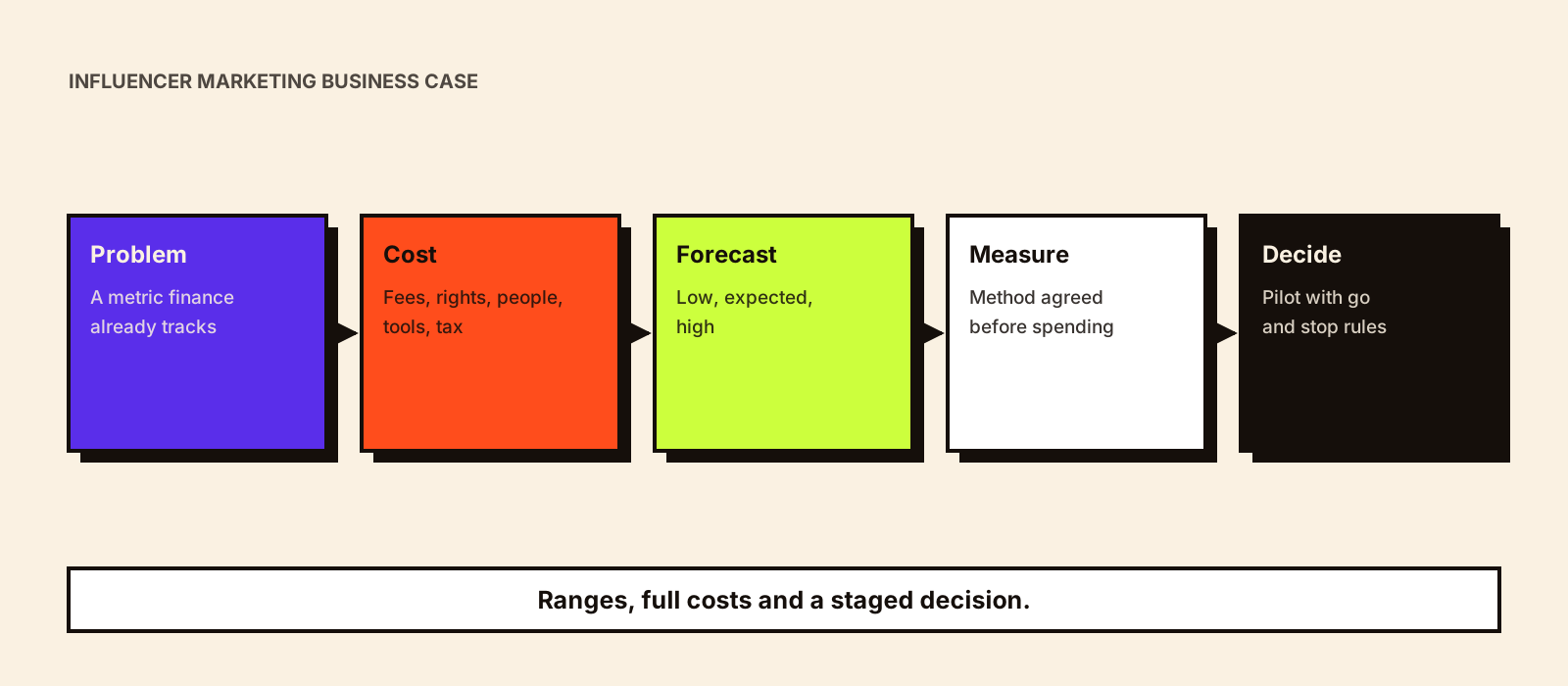
Marketing teams often ask finance for creator budget with a deck of reach figures and a single ROI number. Finance leaders tend to reject both: reach isn't a financial outcome, and a single number hides how uncertain it is. A business case that gets approved looks more like any other investment proposal: a problem, the full cost, a range of outcomes, how you'll know, what could go wrong and when you'll decide to stop or continue.
Quick answer
State the business problem creators address, cost everything (creator fees, usage rights, product, agency or team time, tools, paid amplification and tax), forecast outcomes as low, expected and high scenarios with stated assumptions, agree the measurement method before spending, list the main risks, and ask for a staged budget: a pilot with pre-agreed go and stop rules, followed by a larger commitment only if the pilot clears them.
What finance leaders look for
| Finance question | Weak answer | Strong answer |
|---|---|---|
| What problem does this solve? | 'Creators are where the audience is' | 'Our cost per new customer from paid social has risen; we want a second source of demand and ad creative' |
| What does it really cost? | Creator fees only | Fees, rights, product, shipping, tools, people, amplification, GST |
| What will we get? | '5x ROI' | Low, expected and high scenarios with the assumptions behind each |
| How will we know? | Platform reports | A method agreed now: codes and links, a holdout region or a lift study |
| What if it doesn't work? | Not addressed | A pilot with stop rules and a cap on the first commitment |
Step 1: Start with the business problem
Tie the proposal to a number finance already tracks: customer acquisition cost, repeat purchase rate, the cost of producing ad creative, sales in a new region, or qualified leads. Explain why creators address it better than, or alongside, the alternatives. If you can't name the problem, you're not ready to ask for a budget.
Step 2: Cost everything
Underestimated costs are the fastest way to lose finance's trust after approval. Include creator fees, usage rights and exclusivity, product and shipping, agency or freelance fees, internal team time, tools, paid amplification of creator content, and GST and TDS handling. The full list is in influencer campaign hidden costs.
Step 3: Forecast ranges, not a single number
| Scenario | What it assumes | Use |
|---|---|---|
| Low | Below-average views and conversion, some creators underdeliver | The case still has to be survivable at this level |
| Expected | Your own past campaign results, or cautious benchmarks | The basis for planning |
| High | Strong performance and reuse of content in ads | Upside, not the promise |
Show the assumptions behind each step (views, click rate, conversion, order value, margin) so finance can challenge them. The forecast chain and a calculator are in influencer marketing ROI forecasting. Include the value of content reused in ads only if you'll actually reuse it.
Step 4: Agree how results will be measured
Agree the method before spending, so results aren't argued over afterwards. Tracked links and codes give a floor; holdout regions or lift studies estimate what the campaign added; marketing mix models suit brands with several years of data. Say which you'll use and what it can't capture. See influencer marketing incrementality and influencer marketing and marketing mix modeling.
Step 5: Name the risks
- Performance risk: creators underdeliver or content doesn't convert. Mitigation: pilot first, diversify creators.
- Brand risk: a creator controversy. Mitigation: vetting and contract terms.
- Compliance risk: missing disclosure or unsupported claims. Mitigation: approval checks.
- Measurement risk: results can't be separated from other activity. Mitigation: a holdout or lift design.
- Operational risk: delays, stock problems. Mitigation: buffers and a contingency list of creators.
Step 6: Ask for a staged decision
Finance approves uncertain spending more readily when the first commitment is small and the next step depends on evidence. Propose a pilot budget, a review date, and rules agreed in advance: for example, continue if cost per acquired customer is within a set range of paid social, or if a lift study shows a detectable effect; stop or redesign if not. How to design the pilot is in creator campaign testing.
A one-page template
1. Problem: [metric finance tracks], current value, target
2. Proposal: what creators will do, platforms, markets, duration
3. Alternatives considered and why this is better or complementary
4. Full cost: fees, rights, product, agency/team, tools, amplification, tax
5. Outcomes: low / expected / high, with assumptions
6. Measurement: method, what it captures, what it misses
7. Risks and mitigations
8. Decision requested: pilot budget, review date, go/stop rules
9. Next stage if successful: budget and timing
Hypothetical example
Hypothetical, for illustration only. A personal-care brand's cost per new customer from paid social has risen for three quarters. The marketing team proposes a three-month creator pilot in two states, with the full cost laid out, a low-expected-high forecast of new customers, and a holdout state for comparison. Finance approves the pilot with a rule: expand to six states if cost per incremental customer is within 20% of paid social and repeat rates are no worse.
Common mistakes
- Leading with reach and engagement instead of a business metric.
- A single ROI number with no assumptions.
- Costs that leave out rights, tools and people.
- Deciding how to measure after the campaign.
- Asking for the full annual budget without a pilot.
Conclusion
A business case wins approval by being honest about cost and uncertainty. Name the problem, cost everything, show ranges with assumptions, agree measurement upfront and ask for a staged decision. Once approved, the budget split is covered in the influencer marketing budget guide.