Live Shopping in India: Where Brands Can Sell Live in 2026 and How to Plan a Creator Live Demo
Live shopping in India has had more launches than successes. A dated guide to where brands can actually sell live today, when a creator-hosted live demo is worth doing, a run-of-show template, and how to measure a live session and reuse the recording.
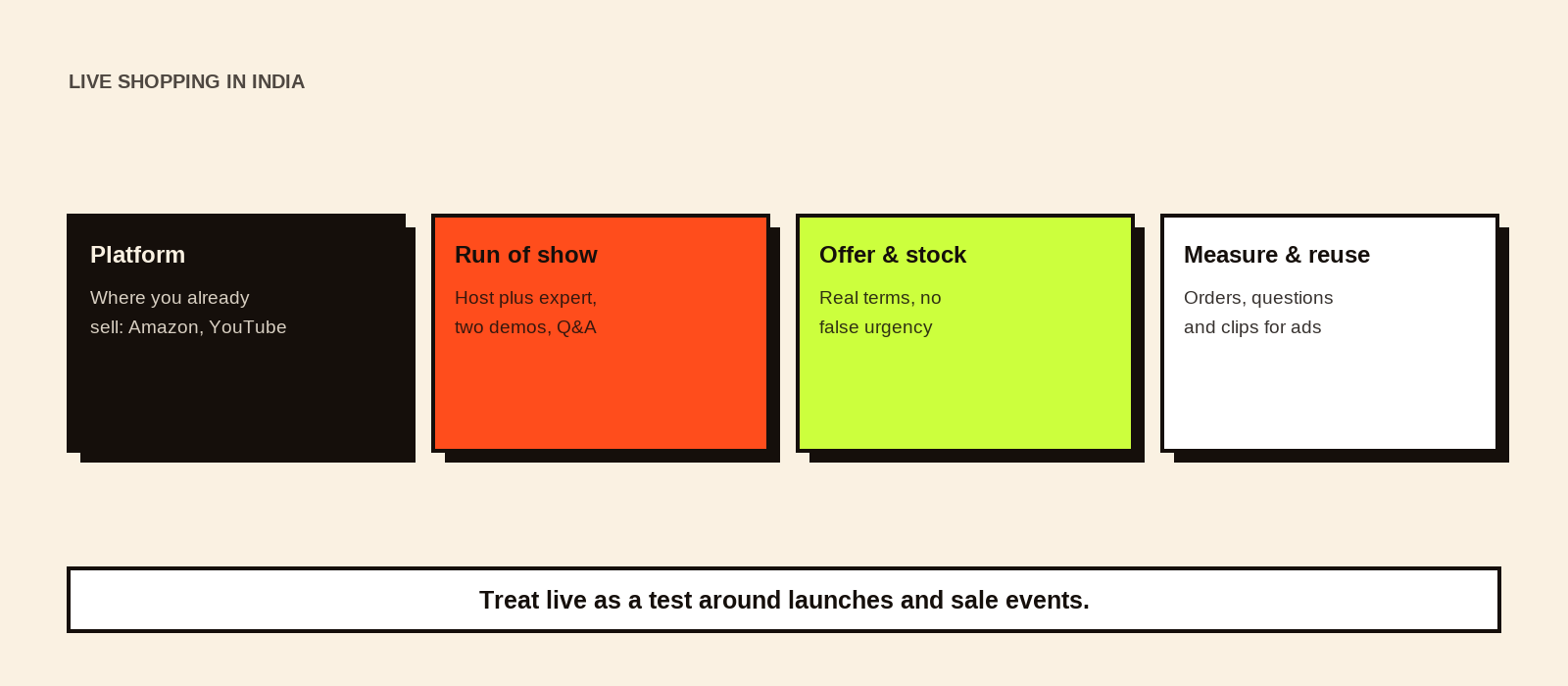
Live shopping arrives in Indian marketing plans every year or two, usually after a story about how big it is in China. The reality here has been patchier. Several dedicated live-commerce apps have closed, Instagram dropped its live shopping feature, and the activity that remains sits mostly inside marketplaces during sale events. That doesn't make live useless for D2C brands. It means you should pick the platform carefully, use live for the products it genuinely helps sell, and plan for the recording to do as much work as the broadcast.
Quick answer
In India, brands can currently sell live mainly through Amazon Live, YouTube livestreams with product tags from partner retailers, and live features inside Flipkart, Myntra and Nykaa. Instagram Live has no shopping checkout, though it still works for demos with a link or code. Live shopping suits products that need demonstration or questions answered, launches and sale-event moments, and works best with a creator host paired with a product expert. Judge it on orders, questions answered and the reusable clips it produces, not on viewers alone.
Where you can sell live in India (status as of November 2026)
Live features change often, so check the current status with the platform or your account manager before planning a session around any of these.
| Platform | Status | How purchase works | Notes |
|---|---|---|---|
| Amazon Live | Active | Shoppers buy on amazon.in from the stream | Amazon reported 43 million minutes viewed in 30 days (March 2026). Suits brands selling mainly on Amazon |
| YouTube livestreams with product tags | Active | Creators tag products from partner retailers (Flipkart, Myntra, Amazon, Nykaa and others); purchase on the retailer | Part of the YouTube Shopping affiliate programme; open-platform option |
| Flipkart live and video features | Active | Inside the Flipkart app | Flipkart reported 12.7 million users on its video and live-commerce features and 1,000+ hours of live commerce in the opening phase of Big Billion Days 2026 |
| Myntra live (Glamstream, M-Live) | Active | Inside the Myntra app | Myntra reported 3,000 hours of Glamstream live in late 2025; fashion and beauty |
| Nykaa in-app live | Active | Inside the Nykaa app | Beauty-focused |
| Instagram Live | No shopping checkout | Link sticker, code or DM after the live | Instagram ended live shopping in 2023. From 29 September 2026 Meta made live video ads generally available, so a creator's live content can run as a partnership ad |
| Bulbul, Simsim | Closed | Not applicable | Dedicated live and video-commerce apps that shut down |
| TikTok | Not available | Not applicable | Banned in India since 2020 |
Platform figures are company-reported. Sources: About Amazon India (March 2026), Flipkart's Big Billion Days update as reported by MediaNews4U (October 2026), Myntra's CMO in Social Samosa (November 2025), Meta for Business (September 2026), and Storyboard18's review of live commerce in India (February 2026) for which apps are active and which have closed.
An honest read on scale
Storyboard18's February 2026 analysis was titled, in effect, that live commerce hasn't cracked India despite creators' wider influence on purchases. The experts it quoted said live selling struggles above impulse price points. Forecasts are more optimistic: Google and Deloitte projected in April 2026 that live commerce could become an $8 billion sector by 2030, though that's a projection from a Google-commissioned report, not current scale.
For a D2C brand, the practical reading is that live is a format to test around specific moments, mostly inside the marketplace where your product already sells, rather than a channel to build your growth plan on. If you're not on Amazon, Flipkart, Myntra or Nykaa, YouTube live with product tags or an Instagram Live demo with a code is the realistic route.
When a creator live demo is worth doing
| Good fit | Weak fit |
|---|---|
| Products that need demonstrating: skincare textures, kitchen appliances, gadgets, makeup shades | Simple products a 20-second Reel explains fully |
| Categories where buyers have many questions before paying | High-ticket items most people won't buy in one sitting |
| A launch or a sale event with a genuine offer and deadline | An ordinary week with nothing new to say |
| A creator whose audience already watches their lives | A creator whose audience only watches short clips |
| Stock and the offer confirmed on the platform you're selling through | Uncertain stock or a listing still awaiting approval |
Pairing a creator host with a product expert (a formulator, chef or engineer) tends to work better than either alone. The creator keeps it watchable and asks the questions viewers are typing; the expert answers the technical ones credibly. Hindi, Hinglish or a regional language often suits the format better than formal English, because live is conversational. Expert creator marketing covers working with specialists on camera.
A run-of-show template
Before going live
- Confirm stock, price and offer on the selling platform; test product tags or links
- Brief host and expert; agree claims that are allowed and not allowed
- Assign a moderator to pin answers, post links and flag questions

0–5 min   Welcome; who the host and expert are; what viewers will see; disclosure ('this is a paid partnership with ...')
5–15 min  First demonstration: the main use, shown slowly and close up
15–20 min Read and answer the top questions so far
20–30 min Second demonstration: a variant, shade or common problem it solves
30–35 min The offer: what it is, how to use it, when it ends (state real terms only)
35–42 min Rapid-fire questions; comparisons; who the product isn't for
42–45 min Recap, where to buy, repeat the disclosure

After the live
- Save the recording; mark timestamps of the best answers and demos
- Reply to unanswered questions in comments or DMs within 24 hours
Offers, stock and claims
- Offer: only promise what the checkout will apply. If the marketplace runs the discount, confirm the dates and price with your account manager before announcing it live.
- Urgency: don't invent countdowns or fake 'only five left' claims. False urgency is one of the dark patterns listed in the Central Consumer Protection Authority's 2023 guidelines.
- Stock: hold enough for a spike in the hour after the live, and have a plan for what the host says if it sells out.
- Claims: agree the claims list in advance. Live is unscripted, which is where unsupported health, skincare or performance claims slip out.
- Disclosure: the host should state the partnership at the start and the end, and the stream title or description should carry it too, in line with ASCI's influencer guidelines.
Influencer campaign compliance in India lists the disclosure and claims checks in more detail. If you want help planning the session, choosing a host and running moderation, Kudozz's social campaign service covers timed creator moments like this.
Measuring a live session
| Measure | Where it comes from | Why it matters |
|---|---|---|
| Orders during and 48 hours after the live | Platform dashboard, affiliate report or creator code | The direct commercial result |
| Peak and average concurrent viewers | Platform analytics | Whether the creator's audience actually shows up live |
| Questions asked and answered | Moderator log | Shows purchase intent and the objections to address in ads |
| Average watch time | Platform analytics | Tells you whether the demo held attention |
| Usable clips produced | Your edit after the session | Live content's long-term value for ads and product pages |
Compare the cost of the session (creator fee, expert time, offer cost, production) against direct orders, and then against what the reusable clips would have cost to produce separately. On many sessions, the second comparison is what makes live worth repeating.
Reusing the recording
A 45-minute live usually contains five to ten moments worth keeping: a clear demo, an honest answer to a common objection, a comparison, a reaction to a texture or result. Cut them into short clips for Reels and Shorts, product pages and FAQs, and, with the creator's agreement and the right usage terms, partnership ads. The questions viewers asked are a ready-made list of objections for your next brief. How to repurpose influencer content and Instagram partnership ads explain the rights and the ad set-up.
Live is one of several routes from creator content to purchase. Social commerce in India for D2C brands compares the others, and Instagram Live influencer marketing covers non-shopping lives on Instagram in more depth.
Conclusion
Live shopping in India works best inside the marketplaces and on YouTube, around launches and sale events, for products that need showing and explaining. Treat it as a test rather than a channel: choose the platform where you already sell, pair a creator host with an expert, confirm stock, offer and claims beforehand, and measure orders alongside the clips and customer questions the session produces. If the recording earns its keep in ads and product pages, the live has done its job even when the viewer count is modest.