Social Commerce in India: How D2C Brands Turn Creator Content Into Sales
In India, people discover products on Instagram and YouTube but rarely pay there. Social commerce works through the routes in between: creator codes, affiliate tags on Amazon, Flipkart and Myntra, WhatsApp chats and marketplace search. Which route fits your product, what each one costs and how to measure it.
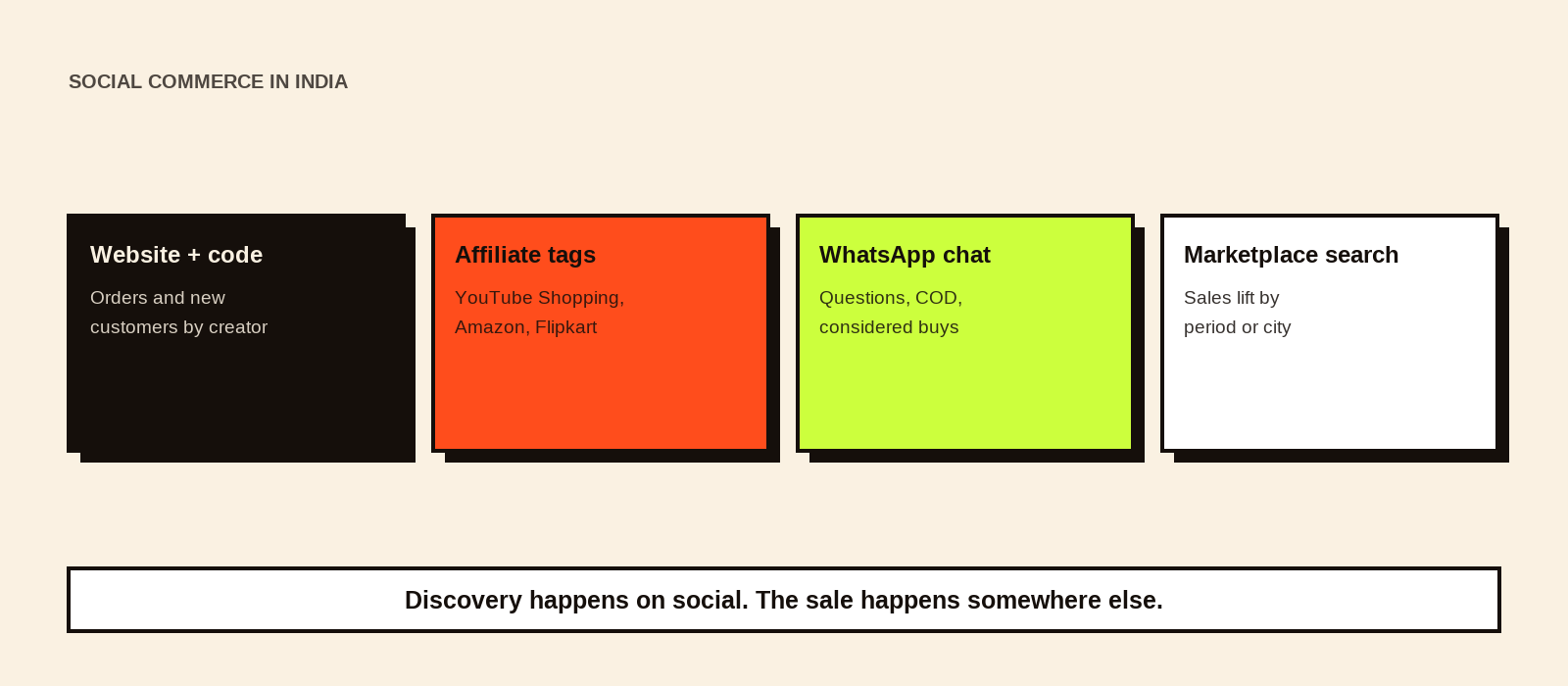
Ask a D2C founder where their last hundred customers discovered the brand and many will say Instagram or YouTube. Ask where those customers paid and the answer is almost never 'inside the app'. That gap is the defining feature of social commerce in India. Discovery happens on social platforms; the sale happens on your website, a marketplace, a quick-commerce app or in a WhatsApp chat. Building a social commerce strategy means designing the route between the two, not waiting for a buy button.
Quick answer
Social commerce in India means using creator and social content to drive purchases that are completed somewhere else: on your website through a creator code or link, on Amazon, Flipkart or Myntra through affiliate tags, in a WhatsApp conversation, or through marketplace search. Choose the route by price, product complexity and where your customers already trust the checkout. Low-ticket, impulse products suit marketplace affiliate tags and quick commerce; considered or bundled products suit your website or WhatsApp. Measure each route separately, and require disclosure on every paid, gifted or affiliate post.
Why India's social commerce looks different
Much of what's written about social commerce assumes people can tap a product in a video and pay without leaving the app. That model never took hold for most Indian D2C brands. Instagram removed its Shop tab from the main navigation in February 2023, with a Meta spokesperson telling Retail Dive there would 'no longer be a dedicated shopping destination', and Instagram's live shopping feature ended later that year. Product tags still exist, but the checkout happens off the platform.
What has grown instead are bridges between social content and existing checkouts, mostly built by the marketplaces and YouTube. For a D2C brand, that's good news: you can use checkouts customers already trust, with cash on delivery and returns, while creators do the discovery. The trade-off is data and margin, which is why the route you choose matters.
Six routes from creator post to sale
| Route | How it works | Suits | Data you get | Main cost |
|---|---|---|---|---|
| Website link plus creator code | Link in bio or Story link to your site; code for a discount or gift | Bundles, subscriptions, new launches, products needing explanation | Orders, new customers and repeat by creator | Creator fee, discount, payment and shipping |
| YouTube Shopping affiliate tag | Creator tags your product sold on a partner retailer in a video, Short or livestream | Brands selling on Flipkart, Myntra, Amazon, Nykaa and other partners | Limited for brands; creator sees affiliate data | Marketplace commission and fees; optional paid boost |
| Marketplace creator programmes | Amazon's influencer storefronts; Flipkart and Myntra affiliate tags on Facebook | Brands whose main sales channel is a marketplace | Affiliate orders where the programme reports them | Commission you or the marketplace sets |
| WhatsApp chat | Creator post or Click-to-WhatsApp ad opens a chat; sale closed by a person or chatbot | Higher-ticket, customised or regional products; COD confirmation | Conversations and orders by source if you tag entry points | Team time and per-message charges |
| Marketplace or quick-commerce search | Creator says 'search [brand] on Amazon' or 'on Blinkit' | Mature listings with reviews; impulse products in stocked cities | Only sales lift by period or city | Platform fees; retail media to stay visible |
| Marketplace content commerce | Creators and resellers share catalogue products on Meesho and similar platforms | Value-priced products for Tier 3+ shoppers | Platform reporting | Platform commission; thin margins |
Most brands end up using two or three of these at once. The skill is giving each creator one clear route, so viewers aren't asked to choose between four places to buy. Where to send influencer traffic when you sell on your website, marketplaces and quick-commerce apps covers that decision in detail.
Where the platforms stand in November 2026
These programmes change quickly, so treat this as a dated snapshot and check the current terms before planning. The figures below are reported by the companies themselves.
YouTube Shopping
YouTube's shopping affiliate programme launched in India in October 2024 with Flipkart and Myntra, letting eligible creators tag products in videos, Shorts and livestreams. Google's India blog later reported Amazon joining as a partner, with AJIO, Meesho, Snapdeal and Tata CLiQ described as rolling out soon, alongside existing partners including Nykaa, Purplle, Shopsy and Tira. Google says average affiliate payouts to creators rose 160% between the first quarter of 2025 and the first quarter of 2026. It also introduced Affiliate Partnerships Boost, which lets brands put paid media behind creators' affiliate content. For a brand that sells mainly on these retailers, YouTube is now the most complete route from creator video to checkout.
Amazon
Amazon reported in October 2026 that its creator base in India had reached about 200,000, double the previous year, and that Amazon products can now be tagged through YouTube Shopping. In March 2026 it said nearly 70% of creator-led purchases come from outside the metros. One limitation to plan around: Amazon Attribution, the off-Amazon tracking tool, isn't available for amazon.in, so brands see creator impact through affiliate orders and sales trends rather than a clean report.
Flipkart and Myntra
In June 2026 Flipkart announced an affiliate partnership with Meta: creators, including micro and nano creators, can tag Flipkart and Myntra products in Facebook posts and Reels and earn commission, with brands choosing which products to feature and setting their own commission rates. Instagram was described as the next phase; check whether it has reached your creators' accounts. Separately, Myntra's CMO told Social Samosa in November 2025 that social commerce contributed over 10% of the platform's revenue.
Meesho
Meesho reported that content-commerce net merchandise value grew 160% in the quarter to September 2026, with branded products on Meesho Mall growing faster in Tier 3 and smaller towns, according to its results as reported by Kotak Neo. For value-priced D2C brands chasing first-time online shoppers, it's a route worth testing, though margins and brand control are tighter than on your own site.
WhatsApp is the conversational route rather than a storefront. Meta introduced Business AI for small businesses in India in May 2026, able to answer questions and recommend catalogue products in Indian languages, and said UPI payments in chat were coming. Since July 2025 the WhatsApp Business Platform has charged per message, so it's no longer a near-free channel at scale. Influencer marketing for brands selling through WhatsApp covers the set-up.
Choosing your social commerce route
Three questions settle most decisions: how much does the product cost, how much explaining does it need, and where do your customers already trust the checkout?
| Your product | Lead route | Supporting route |
|---|---|---|
| Under about ₹500, simple, sold on marketplaces and quick commerce | Marketplace affiliate tags or 'search on' calls to action | Website code for a measurable sample |
| ₹500–₹2,000, needs a short demo, strong reviews on Amazon or Flipkart | YouTube Shopping or marketplace affiliate tags | Website for bundles and repeat orders |
| ₹500–₹2,000, new brand, few marketplace reviews | Website with creator codes | Marketplace once reviews build |
| Above ₹2,000, considered, customisable or sold by consultation | WhatsApp chat or website | Long-form YouTube reviews for research |
| Value-priced, aimed at Tier 3+ first-time shoppers | Meesho or Flipkart, with regional creators | WhatsApp for COD confirmation and questions |
Your channel mix matters as much as price. If 80% of your sales already happen on Amazon, sending creators to your website because it's easier to measure can lower total sales. If your website has the best margin and your marketplace listings are thin, the opposite is true.
Paying creators when the sale happens elsewhere
Marketplace affiliate programmes pay creators a commission, and in Flipkart's Meta programme brands set that rate. Commission alone rarely gets a good creator to make dedicated content for an unknown brand. The common structures are:
- Commission only: suits creators who already cover your category and established products with strong reviews. Expect inconsistent posting.
- Fixed fee plus affiliate tag: the creator is paid to make the content and also earns commission on marketplace sales. Most practical for launches.
- Fixed fee plus performance bonus on your website: a bonus tied to tracked orders from the creator's code. Works when your site is the primary route.
- Product only (seeding) with affiliate tag: useful for discovery across many smaller creators, but posting isn't guaranteed and disclosure still applies.
Influencer affiliate programs explains commission tiers, activation and fraud controls, and Kudozz's affiliate and performance marketing service runs these programmes alongside paid creator work.
Don't ignore COD and returns
Social-sourced orders often come from first-time buyers and from smaller towns, where cash on delivery is common. A creator who drives impulse COD orders that are refused at the door can cost you more than a creator who drives fewer, prepaid orders. Before scaling any route, look at delivery success and return rates by creator and by route, not just order counts.
- On your website, confirm COD orders by WhatsApp or SMS before dispatch, and consider a small prepaid incentive for creator-code orders.
- Ask creators to set honest expectations (size, texture, how long results take). Overpromising drives returns.
- On marketplaces, watch return rates in the weeks after a creator wave; a spike usually means the content and the listing disagree.
How to measure social commerce
| Route | Primary measure | Watch out for |
|---|---|---|
| Website and codes | Orders, new customers and contribution by creator | Codes leaking to coupon sites |
| Marketplace affiliate | Affiliate orders and commission paid | You may only see totals, not who bought |
| Marketplace search | Sales and branded search in campaign weeks against a baseline | Sale events and platform discounts distorting the comparison |
| Conversations started, orders, conversion rate by entry point | Untagged chats; slow replies killing conversion | |
| All routes together | Total sales across channels in campaign periods or cities | Counting the same order twice across reports |
How to track influencer sales with codes, links and analytics covers the tracking set-up, and influencer marketing incrementality explains how to estimate the sales that creators actually added.
Disclosure applies on every route
ASCI's influencer guidelines require disclosure whenever there's a material connection between the creator and the brand, and that includes free products, discounts and affiliate commission, not only cash. Platform tools such as paid-partnership labels help but don't replace the creator's own clear label. ASCI's report for 2025–26 found that 97.3% of the 1,609 influencer ads it processed needed changes, with personal care among the most common categories, so brands in beauty and wellness especially should review drafts for both disclosure and claims. Influencer campaign compliance in India lists what to check.
Two hypothetical set-ups
Hypothetical, for illustration only. A ₹449 lip tint brand sells mostly on Nykaa, Myntra and Amazon. It pays twelve micro-creators a fixed fee to post try-on Shorts with YouTube Shopping tags to its marketplace listings, gives four of them website codes for a measurable sample, and boosts the two best-performing Shorts. It reads results through affiliate orders, marketplace sales in campaign weeks and the website sample.
A ₹14,000 water purifier brand sells through its website and dealers. It works with six home and family creators on long-form YouTube reviews, sends viewers to a WhatsApp number for free home demos, and tracks chats by creator using separate pre-filled messages. Here the route is conversation, not a buy button, because no one spends ₹14,000 after one Reel.
Common mistakes
- Planning around in-app checkout features that aren't available in India.
- Sending every creator to the website because it's the only route you can measure, even when most customers buy on marketplaces.
- Relying on commission alone to get quality content from creators who don't know your brand.
- Letting creators quote prices that differ across channels.
- Judging routes on orders placed rather than orders delivered and kept.
- Treating affiliate posts as exempt from disclosure.
Live selling is another social commerce route, though a narrower one in India; live shopping in India explains where it actually works. For the wider strategy these routes plug into, see influencer marketing for D2C brands in India.
Conclusion
Social commerce in India is less about buying inside an app and more about the shortest trusted route from a creator's video to a checkout. For most D2C brands that means a mix of website codes, marketplace affiliate tags, WhatsApp conversations and marketplace search, chosen by price, complexity and where customers already buy. Give each creator one route, pay in a way that gets real content made, watch delivery and returns as closely as orders, and disclose every commercial relationship.