Website, Amazon or Blinkit? Where to Send Influencer Traffic When You Sell Everywhere
When a brand sells on its own site, Amazon, Flipkart, quick-commerce apps and in stores, every creator post raises the same question: where should the link go? A decision framework by product, price and stock, plus how to keep prices consistent, sequence a multi-channel launch and measure sales you can't tag.
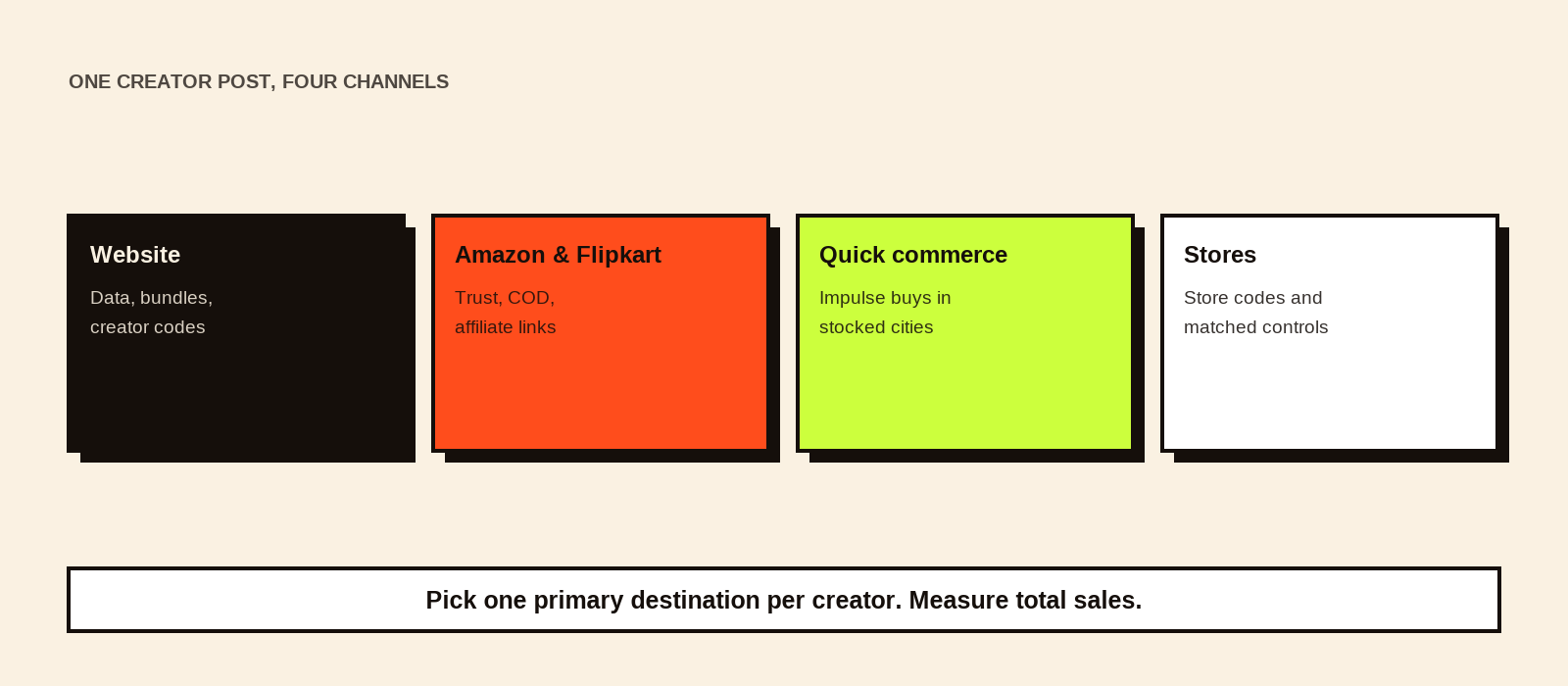
A creator posts a Reel about your new face wash. Some viewers tap the link in bio and land on your website. Some open Amazon and search your brand name. Some see it on Blinkit that evening and add it to a grocery order. A few pick it up at a pharmacy a week later. All of those sales came from one post, but only the first one shows up neatly in your dashboard. For brands that sell everywhere, deciding where to send influencer traffic is one of the most expensive decisions in the campaign, and it's usually made by default rather than on purpose.
Quick answer
Send influencer traffic to the channel where the customer is most likely to complete the purchase and where you keep the most margin, provided stock is reliable there. Use your website when you need first-party data, bundles or a story the marketplace page can't tell. Use Amazon or Flipkart when trust, delivery promises and reviews will convert better than an unknown site. Use quick-commerce apps for low-ticket, impulse products in cities where you're reliably in stock. Pick one primary destination per creator, keep prices and offers consistent across channels, and measure total sales by city and channel, not just tracked clicks.
Why the default choice costs money
Most brands put their website link in every brief because it's the only channel where they can see clicks and orders by creator. That's understandable, and sometimes wrong. A first-time buyer who has never heard of you may trust a familiar marketplace checkout, cash on delivery and fast returns more than your site. Equally, sending everyone to Amazon can mean paying marketplace fees on customers you could have owned, and losing the email address you'd need to sell to them again.
The way people shop also splits across channels. Google's India festive research (an Ipsos survey of 2,450 recent festive shoppers, published October 2026) found that 7 in 10 people who see products in social feeds go on to use Google Search to evaluate them. A creator post often starts a search, not a click. If that search leads to a marketplace listing with a better price than your site, you've paid for the discovery and handed the sale, and the margin, to someone else.
A decision framework: which channel for which product
Start with the product and the customer, not the channel you can track best. These are tendencies, not rules, and many brands will land on a primary channel plus a secondary one.
| Situation | Best primary destination | Why |
|---|---|---|
| Low-ticket repeat item (under about ₹500), bought on impulse | Quick-commerce apps in cities where you're in stock | The buyer wants it today; a 10-minute promise beats a new website |
| First-time customers, unknown brand, mid price | Amazon or Flipkart listing | Familiar checkout, COD, delivery and returns lower the trust barrier |
| Bundles, subscriptions, quizzes or a regimen | Your website | Marketplaces can't sell a routine or a custom bundle well |
| Launch where you need customer data and reviews on your own site | Your website, with marketplaces opening later | You collect emails, phone numbers and first reviews you control |
| High-consideration product (₹5,000 and above) | Website or brand store, plus marketplace for reassurance | Buyers research; they need long content and clear warranty terms |
| Product sold mainly through retail and pharmacies | Store locator or 'available at' message | A link sends people somewhere they won't buy |
| Product out of stock or patchy on a channel | Not that channel | Sending traffic to an unavailable listing wastes the post |
Margin matters as much as conversion. Work out contribution per order for each channel after commissions, payment fees, shipping, returns and, for COD-heavy channels, failed deliveries. A channel that converts 30% better but leaves half the margin may still be the wrong default. The method is set out in how to calculate the break-even point of an influencer campaign.
One creator, several channels: how to write the call to action
Asking a creator to mention four places to buy produces a weak ending that nobody acts on. Give each creator one primary call to action, and let the others work in the background.
| Call to action | Use when | What you can measure |
|---|---|---|
| Link in bio or Story link to your website, with a creator code | Website is the primary channel | Clicks, orders and new customers by creator |
| Affiliate link to Amazon or Flipkart (through their creator programmes) | Marketplace is the primary channel | Affiliate orders, where the programme reports them |
| 'Search [brand] on Blinkit or Zepto' with a visible pack shot | Impulse product, strong city availability | Sales lift by city on the platform, not individual orders |
| 'Available at [store or chain]' plus a store-specific code | Retail-led product | Code redemptions at the till; footfall where measured |
| 'Available on our site, Amazon and Flipkart' in the caption only | Mature brand, wide availability | Mostly blended lift; low per-creator visibility |
A practical split many multi-channel brands use is by creator role: a few creators drive the website (with codes) so you keep a clean, measurable sample, while others push the marketplace or quick commerce in the cities where those channels are strongest. You get learning from the first group and reach from the second.
The creator programmes on marketplaces make this easier than it was. Amazon reports that its influencer programme in India had grown to about 200,000 creators by October 2026, and Amazon products can now be tagged through YouTube Shopping. Flipkart and Myntra launched an affiliate programme with Meta in June 2026, with brands setting their own commission rates. Social commerce in India for D2C brands explains how these routes work.
Keep prices and offers consistent
Nothing undermines a creator post faster than a viewer finding the product cheaper somewhere else. If your creator says '15% off with my code' and Amazon is already 20% off in a sale, you've trained your audience to ignore your site and your creator looks uninformed.
- Check prices on every channel the day before posts go live, and again on posting day. Marketplace prices can change because of platform-funded discounts you don't control.
- Give creator codes a value the customer can't easily beat elsewhere, or offer something other than price on your site: a free mini, a bundle, faster shipping or a longer return window.
- Never ask creators to quote a price. Prices change; a video lives for months. Ask them to talk about value and say 'check the current offer'.
- Remember that goods in India can't be sold above MRP. A higher website price than the marketplace is legal but looks bad; a 'discount' calculated from an inflated reference price risks being treated as a misleading advertisement.
- Agree offer dates with each marketplace account manager before briefing creators, especially around sale events.
Sequencing a launch across channels
Launching on every channel on the same day sounds efficient. In practice, stock, listing approval and review count rarely line up. A staggered sequence often works better, with creators timed to each step.
| Phase | Channels live | Creator activity |
|---|---|---|
| Weeks −4 to −1: pre-launch | None, or a website waitlist | Seeding to a handful of creators for honest first impressions; no buy links |
| Week 1: website window | Website | First wave with codes; collect first reviews and customer data |
| Weeks 2–3: marketplaces | Website, Amazon, Flipkart | Second wave linking to the marketplace for audiences that need trust signals; listing already has early reviews and images |
| Week 3 onwards: quick commerce | Plus Blinkit, Zepto, Instamart in confirmed cities | City-targeted creators saying 'now on Blinkit in Bengaluru'; only where stock is live |
| Ongoing | All | Best posts run as partnership ads pointed at the highest-margin channel with stock |
The order can change. A brand with an established Amazon presence may lead with the marketplace and use the website for bundles. A snack brand may lead with quick commerce in two cities. The principle is the same: don't point creators at a channel that isn't ready. Listings need images, A+ content and stock before traffic arrives. Quick-commerce availability needs checking by pin code: Bernstein's check of 150 products across Mumbai, Gurugram and Bengaluru, reported by Business Today in October 2026, found average in-stock rates from 82.5% to 94.4% depending on the app. A creator saying 'it's on Zepto' in a city where it's out of stock that evening does more harm than good.
For the creator side of the launch itself, influencer marketing for product launches covers seeding, embargoes and launch-day coordination. For the quick-commerce part, influencer marketing for quick-commerce brands covers availability mapping and in-app ads.
Measuring sales across channels you can't tag
Measurement is where multi-channel campaigns usually go wrong, because each channel reports differently and some don't report at all. One correction matters for Indian sellers: Amazon Attribution, Amazon's tool for tracking off-Amazon traffic, lists only the US, Canada, Mexico, the UK, Germany, France, Italy, Spain and the Netherlands on its official page. It isn't available for amazon.in, so plan without it.
| Channel | What you can track | How to fill the gap |
|---|---|---|
| Website | Codes, UTM links, orders and new customers by creator | Post-purchase 'where did you hear about us?' survey |
| Amazon.in | Affiliate orders through the influencer programme; brand search terms and sales in Seller Central | Compare sales and branded search in campaign weeks against a baseline |
| Flipkart and Myntra | Affiliate orders where creators use the affiliate programme | Same baseline comparison; sale-event noise needs care |
| Quick commerce | Sales by city and day from platform dashboards | Run creators in some cities and not others, then compare |
| Stores | Store-specific codes; POS data | Footfall or sales comparisons with matched control stores |
Then add it up. The most honest number for a multi-channel campaign is total sales across all channels in the campaign cities, compared with a baseline or with similar cities where creators didn't post. Tracked codes become a floor, not the answer. Influencer marketing incrementality explains how to set up those comparisons, and measuring influencer impact when customers buy in-store covers the offline side.
A hypothetical example
Illustrative figures, not a benchmark. A protein snack brand sells on its website, Amazon, Flipkart and Blinkit. It plans a ₹6 lakh creator campaign for a new flavour priced at ₹399 for a box.
| Channel | Contribution per order (illustrative) | Role in the campaign |
|---|---|---|
| Website | ₹150 | 6 creators with codes; measurable sample and first reviews |
| Amazon | ₹95 | 4 creators via affiliate links, aimed at audiences outside the top metros |
| Blinkit (Delhi NCR and Bengaluru only) | ₹110 | 5 city creators with 'search on Blinkit' calls to action, from week 3 |
After six weeks, the website creators produce tracked orders the brand can count exactly. Amazon affiliate orders cover part of the marketplace sales, and branded search on Amazon is up compared with the previous month. Blinkit sales in the two campaign cities rise faster than in Mumbai and Pune, where no creators posted. The brand reports three numbers to leadership: tracked orders (the floor), estimated total lift across channels (the realistic view) and the cost per new website customer (the number it controls best). It then shifts the next round's budget toward the channel with the best contribution after lift, not the one with the cleanest dashboard.
A checklist before you brief creators
- Primary channel chosen per creator, with a reason (trust, margin, data or speed).
- Stock confirmed on every channel a creator will mention, by city for quick commerce.
- Prices and offers checked on every channel; no channel undercuts the creator's offer.
- Listings ready: images, creator video where allowed, A+ content and early reviews.
- Codes, UTMs and affiliate links created and tested.
- Control cities or a baseline period agreed for lift measurement.
- Disclosure labels in every brief, as required by ASCI.
If you'd rather plan the channels, creators and measurement together, Kudozz's campaign strategy work starts from exactly these questions. The broader e-commerce view is in influencer marketing for e-commerce brands, and retail-led brands should read influencer marketing for a new store opening. Once traffic lands on a marketplace, sponsored ads decide who captures it; see retail media and influencer marketing together.
Conclusion
When you sell everywhere, the creator's call to action is a channel decision with real margin attached. Choose one primary destination per creator based on trust, margin, data and stock; keep prices consistent so viewers don't find a better deal elsewhere; stagger launches so every channel is ready before traffic arrives; and judge results on total sales across channels, with tracked orders as the floor. Done well, one creator wave lifts every channel instead of quietly moving sales from one to another.